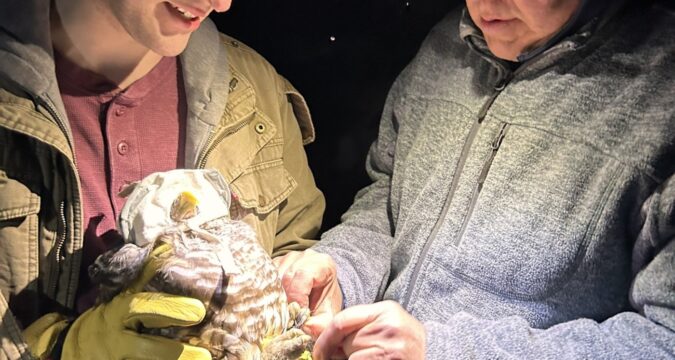
William & Mary researchers hope their studies on barred owls will show how they are adapting to man-made environments.
For over two years, researchers in the university’s biology department have been studying how the birds of prey are adapting to increased urbanization. Along with Williamsburg and James City County, their research has taken them to Newport News and Richmond, studying 17 individual barred owls so far.
One of the main goals is to collaborate with colleagues, said Matthias Leu, William & Mary biology professor. Together, research on the owls has been conducted across Virginia, North Carolina, Louisiana and California.
While the university’s studies are in the early phases, Justin Biggerstaff, a W&M biology master’s student, said barred owls seem to do “pretty well” in urban landscapes. Biggerstaff, 23, said they found the birds in Richmond’s patchy urban environments alongside typical forest habitats. Leu said they are more likely to show up in urban areas with a lot of tree cover.
Both researchers emphasized their findings are still preliminary.
“We see that they clearly are doing OK, at least,” Biggerstaff said.
W&M students Justin Biggerstaff, Matthew Wawerski, Sam Wawersik and Professor Matthias Leu set up nets to safely capture and research barred owls in Freedom Park. (Cheryl Leu)
The project started after one of Leu’s former students traveled to California to study barred owls’ habitat use in the state, he said. There, a management strategy calls for killing hundreds of barred owls because they are considered non-native and invasive threats to the endangered spotted owl. Barred owls are native to eastern North America and are believed to have expanded west after the beginning of the 20th century.
Now found throughout the U.S., barred owls’ habitat can be anywhere with decent shelter, nesting structure and food, Biggerstaff said. Compared to other species such as the great horned owl, barred owls explore in more aquatic habitats, Leu said. Living in mixed forests often near water, they eat fish, crayfish and frogs alongside a diet of mice, reptiles and even other birds.
Wanting to replicate the research in Virginia, Leu placed a proposal for a research plan that was funded by the Virginia Equipment Fund, he said. With funding from the state, he and his team were able to acquire tools such as $2,500 capture equipment and 10 transmitters, each costing $1,400.
To work with the owls, Biggerstaff said he and researchers set up a net along with three speakers placed around it. When the speakers play the species’ territorial “Who cooks for you” call, it typically causes the owls to come and defend their territory. If they come in, researchers switch which speakers play the call, causing the owl to chase the sounds around.
“If the owl is behaving how we want them to behave, they’ll eventually fly into the net that we have set up in-between all the speakers,” Biggerstaff said.
Researchers then take the owl out of the net where they tag it with a metal band, take measurements and finally attach a GPS harness, which captures the owl’s locations. The GPS unit takes a reading of the owl’s speed every five seconds, which is a lot of data when added up over 60 days, Leu said. They then recapture the owl to download the data.
“Then we can actually charge the GPS units and basically affix it to a new owl,” Leu said. “They actually can be used for quite a while.”
Leu said they have tagged barred owls across the Greater Williamsburg area, including the university’s College Woods, College Landing Park, and James City County’s Freedom Park, Powhatan Creek Trail and Green Spring Trail areas.
Justin Biggerstaff holds a GPS harness ready for deployment for barred owl research. The plastic pieces are removed once the harness is affixed to the owl, leaving only the GPS tag and the blue fabric. (Justin Biggerstaff)
Biggerstaff retrieves a barred owl from the net after successfully capturing it for urbanization research. (Cheryl Leu)
Leu and fellow researchers will now focus on analyzing the owls’ habitat use, he said. While he currently does not have an answer to why they adapt well in urban environments, Leu speculates that increased prey availability from bird feeders and stormwater retention ponds could be a factor.
Biggerstaff hopes their research can show how urban ecosystems can be managed. He said he wants to push back against misconceptions that only animals like rats and raccoons can thrive in urban areas. He said if urban systems are managed properly, people can have “charismatic wildlife move in.” One option he suggested was urban areas having zones that allow for co-existence among humans and wildlife.
“That’s kind of what I am hoping that our study can kind of help to contribute to that narrative in a way,” he said.
James W. Robinson, 757-799-0621, james.robinson@virginiamedia.com
https://www.dailypress.com/2026/01/04/barred-owls-urbanization/