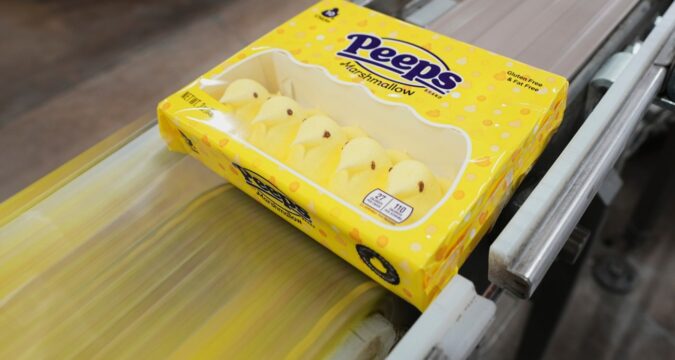
When it comes to Peeps, the staff at Just Born Quality Confections can’t be too careful when the treats make their way down the line.
No human hands touch the marshmallow confections as they move from the assembly line at the company’s Bethlehem plant to the boxes consumers buy. The reason: If one finger pokes a freshly made Peep the wrong way, it turns into a puddle of sweet goo, according to Charlotte Ashcraft, manager of packaging and graphic development at Just Born.
The Soft Robotics gripper, designed to mimic the human hand, gently and accurately picks up Peeps to load into trays at the Just Born Quality Confections factory in Bethlehem. (Courtesy of PMMI Media Group)
Ashcraft said the material the company uses to make its marshmallow for Peeps is softer and more delicate than normal marshmallows. The solution is a robotic arm, with a soft touch that doesn’t pierce the sugar crust.
“It simulates almost how a human hand would pick it up because marshmallows are not a friend to robotics,” she said. “It’s gooey, it’s soft, it’s very delicate. And if you pierce the crust of the sugar on the outside of the Peep, it creates a really big gooey mess to clean up.”
Ashcraft said Peeps are warmer than room temperature when they come off the line and must sit in their boxes for 24 hours before being cool enough to ship.
The robot packer was developed by York-based JLS Automation with an arm developed by Soft Robotics (now Oxipital AI). Just Born officials came across the technology at the Pack Expo International and have been using it for about eight years. They’ll be at Pack Expo East this month in Philadelphia, be looking at the latest machines to make production more efficient.
Almost every piece of packaging equipment has been upgraded over the years. The process has moved from entirely manual packing and palletizing to highly automated lines.
“Instead of having an associate packing every single individual Peep into a package, we can have them running the equipment that does it. … We can disperse that labor into better jobs,” Ashcraft said.
Speeding it up
When Peeps were introduced in the 1950s, they were piped by hand. It took 27 hours to make a batch.
In 1953, Just Born acquired the Rodda Candy Co. of Lancaster, which had a line of marshmallow products made by hand-squeezing it through pastry tubes.
Ira “Bob” Born, son of Just Born founder Sam Born and an engineering physics graduate from Lehigh University, was put in charge of automating the marshmallow line. That turned out to be difficult, though he found a way to make marshmallow bunnies with a cookie-cutter machine.
The breakthrough came in 1954. He and plant engineer Joe Truse built a machine to produce Peeps in less than six minutes, setting the stage for the iconic brand. (Born also created the recipe for Hot Tamales in 1950 and came up with a way to increase the production rate for the cinnamon-flavored candies and Mike and Ike.)
Today, a batch of Peeps can be produced in seven minutes. That adds up to about 5.5 million per day, and more than 2 billion Peeps annually.
The robotic technology makes it work. Ashcraft used the example of the famous candy factory scene from “I Love Lucy” where the title character and her friend are overwhelmed by a conveyor belt of sweets. Ashcraft said technology cuts down on the stress level of Just Born’s (much more competent) Lucy and Ethel, and eliminates wasted candy.
Modern robotics allow the company to reprogram lines quickly for different packaging formats, such as shifting between a six-count to a 12-count tray without needing new machinery. It is being used on two of the lines at Just Born, which also makes Mike and Ike and Hot Tamale jelly bean candies.
Ashcraft said Just Born employs more than 600 people and the headcount has gone up along with the increase of automation. The plant runs 24 hours a day, five days a week. Many workers are involved in higher-skilled roles, such as equipment operation, quality control and maintenance.
Jorge Izquierdo, vice president of market development for PMMI, the Association for Packaging and Processing Technologies, said the confection industry is shifting toward more “intelligent” manufacturing that allows flexibility.
“What’s been a really significant advancement in robotics in packaging is it’s easier than it was before to program these robots,” he said. “It’s very, very flexible. A lot of this is what they are calling ‘future-proofing’ your investments.”
That means adjustments can be made without having to invest lots of money into new technology.
“When you work in packaging, sometimes you don’t know what you’re going to face three years from now,” Izquierdo said. “Marketing is going to come to you and tell you, ‘Hey, now we need a package of 24’ or ‘We need packages of three.’ Having the ability to bring that flexibility into your operations is key.”
Having that flexibility is important as the candy industry continues to grow in the U.S.
The National Confectioners Association reported that nonchocolate candy sales generated $12.9 billion in 2025, representing one-third of all U.S. confectionery sales. Younger generations are shaping the future of the marketplace, which is projected to reach $27.8 billion by 2030.
The report said nonchocolate candy is the second-largest confectionery category and its share of total confectionery units has steadily increased since 2020, reflecting consumer demand for candy’s many types and flavors.
“Innovation is at heart of the confectionery industry, which is especially clear with nonchocolate candy,” said John Downs, president and CEO of the NCA. “As each generation finds ways to put their own stamp on the sub-category, confectionery manufacturers balance tradition with forward thinking.”
Morning Call reporter Evan Jones can be reached at ejones@mcall.com.
https://www.mcall.com/2026/02/16/peeps-packaging-technology/