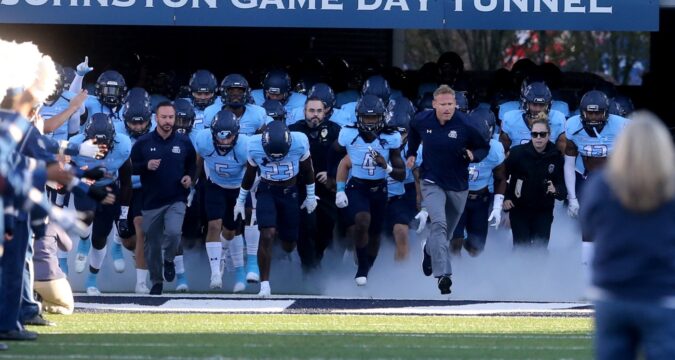
NORFOLK — If there has been a celebrity walking among Old Dominion University’s student body for the past two academic years, it’s been Colton Joseph.
The football team’s starting quarterback since early last season, Joseph has had rightful praise heaped upon him as the Monarchs, under his on-field leadership, have barreled toward the third bowl appearance in program history and their first winning season in nine years.
A sophomore from Newport Beach, California, Joseph has benefited as much as perhaps any athlete on campus from Name, Image and Likeness rules that have afforded him financial compensation. In September, Joseph joined a group of college football players from Clemson, LSU, Michigan, Florida State and other major programs in being paid to promote a national fried chicken chain.
As the program grows in popularity, so does the quarterback.
But being the face of the team comes with unseen consequences, especially in today’s climate.
Relaxed laws governing sports gambling have led to its newly overt ubiquity, even at the college level.
Placing bets that once required knowing a guy who knew a guy now requires just a phone and an account with one of the nation’s many legal sports gambling operations, from FanDuel and DraftKings to BetMGM and bet365.
Combine the ease with which wagers can be placed with the accessibility to athletes that comes with social media, and a perilous cocktail finds the bottom of the blender.
In analog terms, a phone is part casino sportsbook, part omnipotent Rolodex — as far away as a hip pocket.
For football and men’s basketball players at ODU, sports gambling remains a sticky subject that largely — and sensibly — goes avoided. Yet the once taboo subject sometimes worms its way into their lives from multiple angles in ways that seemed unimaginable when they were children.
Want to thank the point guard for scoring the spread-beating basket? Send him a message on X. Having a meltdown because the quarterback threw a late interception that blew the over/under? Hit him up on Instagram and let him have it.
Joseph, as well as he’s played, hasn’t been immune. It can get mean.
“I don’t want to give any specifics,” Joseph said. “Just hateful comments, threats to your family — all that kind of stuff. But they’re just pissed-off people who are just mad about the outcome of a game. And giving them attention, that’s what they want from you when they’re sending these comments and DMs.”
Old Dominion Monarchs quarterback Colton Joseph (1) greets teammates after the game against the Georgia State Panthers at S.B. Ballard Stadium in Norfolk, Va., on Nov. 29, 2025. (Peter Casey / For The Virginian-Pilot)
He’s hardly alone. According to a study released last month by the NCAA, which governs major-college athletics, 16% of Division I football players like Joseph “reported receiving negative or threatening messages” on social media. For Division I basketball players, playing without the cover of dehumanizing helmets and facemasks, that number jumps to 36%.
More than a quarter of both football (26%) and men’s basketball (29%) players reported interacting with students on campus who had bet on their teams.
The survey, titled the “NCAA Student-Athlete Needs, Aspirations and Perspectives Study,” asked nearly 6,800 athletes at 153 Division I schools 19 questions via mobile app in the early fall. Participation was voluntary and confidential.
Fewer than 10% of women’s and non-revenue athletes — read: those not playing football or men’s basketball — reported negative in-person or online interactions regarding gambling.
For those on whom the lion’s share of college sports wagering is done, hearing from disgruntled gamblers is now part of the game.
“Yeah, you’ll get that from time to time,” said Jordan Battle, a senior guard on ODU’s men’s basketball team who transferred from Coastal Carolina. “If it’s a big game or whatever, and say you don’t finish somebody’s line in the parlay or whatever, they’ll definitely hit you up. They’re not scared to contact you and tell you about yourself: ‘You didn’t get me to where I needed to get to.’ But it doesn’t really affect us, honestly.”
Minimizing the risk
Anyone looking to bet on a recent football game between No. 1 Ohio State and No. 15 Michigan had no shortage of choices.
On FanDuel, for example, in addition to wagering that Ohio State would or would not win by at least the 10½-point spread, bets could be made on the combined point total for both teams, how many rushing, receiving or total yards either team might compile and which team might beat the spread at the end of each quarter. And that just scratches the surface.
In professional sports, and decreasingly so in college, betting on individual performances is common. For example, wagers can be placed on how many points, 3-pointers, assists or rebounds a basketball player might generate, to name a few options. A $100 bet on Sacramento Kings star Russell Westbrook to make at least five 3-pointers in a recent game paid $2,000. (He averages 1.1 per game.)
Such possible bets are what prompted NCAA conferences, including the Sun Belt, to take preemptive action.
Nothing is more valuable to gamblers than information. From a team’s typical scoring proficiency to a player’s tendency to rebound, block shots, score touchdowns or hit home runs, it’s all out there for the public to devour.
What wasn’t readily available in college sports, until recently, was anything about that player’s health. A bet on a player is lost if that player doesn’t play. A bet on his team becomes inherently tenuous.
In August, the New Orleans-based Sun Belt Conference, which includes ODU, joined the nation’s major football conferences in providing player availability reports days before each league football game.
An initial weekly report, which comes out online three days before each game, lists players on each team who are “available, probable, questionable, doubtful or out.” A report issued on game day designates players who are “available, out or a game-time decision.”
In the past, without official word, those with a bettor’s interest in the health status of athletes might’ve been tempted to snoop for information, lurking as potentially shadowy figures where they weren’t welcome. Not anymore.
“It makes it so that you don’t have nefarious parties trying to check in with your players or whatever, because that availability’s already out there,” Monarchs football coach Ricky Rahne said. “So it might protect your players from maybe getting involved unwittingly with something that they didn’t mean to and that sort of thing.”
Seven ODU football players said in separate interviews that they had not been asked for injury-related information by anyone they suspected of gambling, though Rahne said it has happened.
Sun Belt commissioner Keith Gill is a proponent of the availability reports. He said the league is looking at ways to provide them in sports other than football.
“There are so many kind of unfortunate things with kind of this explosion of gambling,” Gill said. “And one of those is the harassment of our students and student-athletes. And that really is a problem. So trying to at least take one pressure point off of them in terms of either their friends or people they don’t know asking them, ‘Who’s playing tonight, and who’s hurt, or who might be hurt?’ and some of those things, I think, is easy in making sure that that’s a level playing field.”
Rahne and his staff show their players preseason PowerPoint presentations on the trappings of gambling. They sometimes update the presentations as cases break nationally, which has kept them busy in recent months.
A growing trend
Old Dominion head coach Ricky Rahne points to the video board while officials review a call on the field during a game against Appalachian State at ODU’s S.B. Ballard Stadium in Norfolk on Saturday, Oct. 25, 2025. (Kendall Warner/The Virginian-Pilot)
The U.S. sports betting industry took in a record $13.71 billion in revenue in 2024, according to an American Gaming Association annual report released in February.
Legal sportsbooks, now in 38 states, logged nearly $150 billion worth of bets, a 22% increase over 2023.
A growing number of people want in on the action, and not all of them are buying tickets or watching on TV.
Two Cleveland Guardians pitchers were indicted last month and charged in a scandal that involved the intentional throwing of balls instead of strikes for money. Co-conspirators allegedly won more than $400,000 with advance knowledge of the pitches.
A far-reaching and ongoing NBA scandal involves, in addition to rigged poker games, the selling of injury information to gamblers with mafia ties.
The NCAA enforcement staff has opened recent probes into possible sports-betting violations by about 30 current or former men’s basketball players. At least 12 have been permanently banned from competition.
The NCAA announced recently that former Temple guard Hysier Miller is permanently ineligible after he was found to have placed bets on 23 games involving his team, among others. A would-be transfer to Virginia Tech before last season, Miller bet against the Owls three times while playing for them.
In educating his players against the pitfalls of gambling and the “nefarious parties” it can invite, Rahne reminds them of how lucky they are.
“The only thing I try to tell my players is the game is fleeting, right?” said Rahne, whose 9-3 team will face South Florida in the Cure Bowl in Orlando, Florida, on Dec. 17. “And if you truly love it, you’re not going to give away a play. You’re not going to give away a pitch. You’re not going to give away an opportunity to go out there and play it, because it’s not going to be there forever. That’s the thing that I keep trying to harp on the guys”
The NCAA found that 28% of on-campus bettors use mobile apps to place wagers. Live prop bets, like the Westbrook long shot, have eclipsed traditional money line and over/under bets among that population.
The NCAA — proudly, the only major U.S. sports league that prohibits commercial partnerships and advertisements with sportsbooks — recently rescinded a rules change that would’ve allowed its athletes and staffs to bet on professional sports. The organization has been working toward eliminating bets on individual players’ performances for some time, with several states already on board.
Insults to injury
Offensive lineman Zach Barlev (64) during media day at Old Dominion University in Norfolk on Tuesday, Aug. 19, 2025. (Kendall Warner/The Virginian-Pilot)
Lined up at left offensive tackle with his team trailing by eight in the waning minutes at Appalachian State last November, ODU’s Zach Barlev almost missed his man.
Barlev fell for a juke from linebacker Thomas Davis, who blew past Barlev’s left side and circled around to the right of Joseph.
Barlev regrouped, staving off Davis from the right edge as Joseph, the clock ticking and the play collapsing around him, ducked under the pressure and was sacked by App State’s Joshua Donald.
The first-down play left the Monarchs facing second and long. Joseph threw a pair of incomplete passes before the Mountaineers intercepted him on fourth down to lock up a 28-20 win.
Barlev hadn’t exactly cost his team the relatively run-of-the-mill game, which featured the 4-4 Monarchs against 3-4 App State. But he still heard about it online.
“I got a DM from some random dude just sitting on the couch,” Barlev said, “probably eating potato chips: ‘Oh yeah, you blew that game.’ I was like, ‘Yeah, thanks.’ ”
Barlev, a transfer from Illinois, had no evidence that the fan had money on the game, but given what another NCAA study found, it’s a safe bet.
A pilot study of the 2023-24 athletic year begins with a stern eye-opener.
“Warning: The report you are about to view contains explicit examples of discriminatory, violent and threatening content that has been directed at student-athletes, coaches and officials from abusive online users,” it reads. “The NCAA condemns this behavior and is committed to driving change about this issue.”
The report, which surveyed more than 3,000 college athletes as well as coaches, officials and team social media accounts, used AI to flag 72,412 messages of more than 1.3 million sent by users to target accounts. Of those, 5,020 were deemed to be verified abuse, 78% of which were sent to basketball-related accounts.
The most prevalent type of abuse (18%) was sexual. More abuse related to sports betting and match-fixing (12%) occurred than abuse related to race (10%).
Among other findings, the study concluded that “March Madness (NCAA Basketball Tournament) athletes need protecting from social media abuse,” with 80% of the detected abuse stemming from that event.
“The horrific messages we are seeing across online platforms is absolutely unacceptable,” NCAA president Charlie Baker said in March. “Angry fans are sending numerous abusive messages and threats to student-athletes, publicly and privately, because of lost bets placed on the athlete’s performance in a game. These actions severely threaten student-athlete mental health and well-being, while harming the college athletics environment. We need fans to do better. We need states to do better and ban player props that target student-athletes and enable detrimental abuse.”
Some of the cleaner online posts cited in the study and directed at athletes in general include:
“Yo no big deal but if you don’t get 22 points and 12 boards everyone you know and love will Be dead.”
“I hope your family dies.”
“I am in Cleveland and Im gonna wait for you outside the arena to beat the f— out of your knees with a spiked baseball bat.”
“Cry you gorilla.”
Yet another recent NCAA survey, this one in 2023, found that 67% of those living on college campuses considered themselves bettors. Of those who bet on sports, 41% had wagered on their school’s teams.
Monarchs linebacker Seth Naotala was among those interviewed who said he had not been approached by anyone seeking injury information. But gambling on campus? He’s aware.
“Oh yeah, I see them doing it,” Naotala said. “I actually never came across anyone, like, asking me about it.”
Added safety Jerome Carter: “I’ve never had any experience with that, but I’ve heard about it before. Coach has told us to stay away from things like that, because that can put us in jeopardy.”
ODU has not quantified gambling-related abuse among its athletes, a school spokesman said.
It’s worth noting that any public discussion of gambling around college athletic programs was not even a consideration just a few years ago.
The industry’s proliferation since a 2018 Supreme Court ruling left sports gambling laws to the states has gradually normalized the topic. Rahne only began to be asked about gambling during his weekly news conferences this season when the Sun Belt rolled out its availability reports in late September.
He has discussed at length with the media the formerly off-limits subject.
“I think the hush-hush part of it was the part of it that was making it a problem,” Rahne said. “Does that make sense? I think talking about it, making sure our guys understood what it was and all those sort of things is what’s helping. Making sure that guys understand the issues and guys understand the possible problems, the possible consequences they can have in their career and those sort of things.
“Anytime there’s things that involve any other issues that can plague them, we show them that, too, so that they can just remind themselves that they have a lot of things in front of them, a lot of great opportunities in their life, and to make sure they make good choices not to blow it.”
‘Tough skin’
ODU’s Jordan Battle with the rebound during Thursday, Nov. 6, 2025, night’s basketball game against Randolph in Norfolk. (Stephen M. Katz / The Virginian-Pilot)
In addition to having their faces exposed, those in basketball are vulnerable to another disadvantage.
Unlike in football or most other sports, fans sit right behind the bench. Every angry word, just as when James Naismith hung up two peach baskets to invent an indoor sport in the Massachusetts winter, is audible.
During halftime of a road game out West last season, ODU men’s basketball coach Mike Jones couldn’t help but notice that a fan seemed overly disturbed that Jones wasn’t trotting out a certain player in the second half.
The player in question had started strong, leaving Jones with little doubt as to what was on the fan’s mind.
“Why are you screaming at me with the intensity that you have, asking about this young man?” Jones, a former Monarchs star, recalled thinking.
“I don’t know for a fact, but I can only imagine why that was so important to him. We were in a whole other time zone. You probably don’t even know who this kid is. Why are you asking that question? So it is what it is.”
Basketball players routinely hear cracks about how seemingly meaningless stats might affect those watching the game in person. It’s often nothing compared to what they see when they check their phones.
When ODU point guard LJ Thomas scored 29 points against Butler last season while playing for Austin Peay, he said, “A lot of people kept texting me, saying I messed up their parlay.”
Thomas, whose career began at North Carolina State, said the comments can devolve into threats.
“Yeah, they do sometimes,” he said. “They say stuff like that, but I don’t think they mean anything by it seriously.”
Battle, Thomas’s teammate, shakes off the insults and threats like a wet duck.
“You’ve got to have tough skin in this game, honestly,” Battle said. “But it comes with it. You’re going to get hecklers. You’re going to get people that don’t like your game, that are going to tell you about your game. But what can they do? They can’t beat you. They’re not better than you.”
Joseph, the quarterback, takes a similar approach, even when he’s the target of online posts that might frighten others. He’s never been alarmed enough to contact the authorities, and he generally doesn’t even respond.
How much Joseph, who will transfer and miss the Monarchs’ bowl game, or any other ODU athlete makes through NIL is a mystery. Non-disclosure agreements, the spokesman said, keep things top-secret.
As his passing and rushing yardage numbers have piled up and his legend has grown with each Monarchs win, Joseph has viewed the perceived harassment as an unglamorous part of an otherwise glamorous job.
“Just threats and bad comments,” he said. “It’s just them talking. They’re just mad they lost money. In my position, you’re going to get hate comments no matter what. So you just don’t really look at it and move on.”
David Hall, david.hall@pilotonline.com.