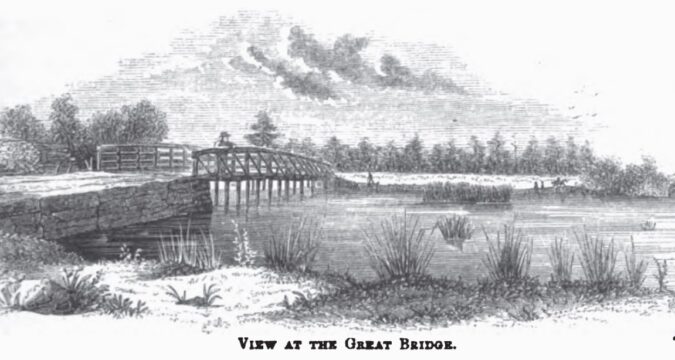
It was a narrow wooden bridge situated over the southern branch of the Elizabeth River in difficult terrain amid bogs and swampland, accessible only by narrow causeways on both the north and south sides.
The redcoats had established an earthen redoubt fortification on the north end, while patriots had thrown up breastworks on the southern side.
A battle here lasting less than one hour just south of Norfolk on Dec. 9, 1775, between British forces and colonial militia — 250 years ago — was a turning point that led to the departure of Virginia’s last royal governor, John Murray, 4th Earl of Dunmore, and his troops. The patriots taking control of the most populous colony would allow Virginia, home to key founding fathers, to commit to independence and become the backbone of the American Revolution.
The crossing was at the small village of Great Bridge, now located in modern-day Chesapeake. The bridge itself was on the main roadway connection between Norfolk and North Carolina. The Battle of Great Bridge became the first major pitched land battle of the American Revolutionary War in Virginia.
“However, it is probably more important to look at the events prior to the battle; they may be more significant,” explained Norfolk native and bestselling author Andrew Lawler, whose book “A Perfect Frenzy” was published this year and focused on Lord Dunmore, his Black allies and the crisis they produced.
By the fall of 1775, British control of the colony of Virginia was in peril.
Lord Dunmore had vacated his governor’s palace and the colony’s capital in Williamsburg and had fled to a British ship in the waters of the Chesapeake Bay. His troops, including the 14th Regiment of Foot, were stationed on other adjacent vessels.
After fleeing from Williamsburg in June 1775, Lord Dunmore operated Virginia’s royal government from a British fleet stationed near Norfolk. “Flight of Lord Dunmore,” Ogden, American Colortype Co., 1907. (Library of Congress)
Dunmore began to recruit his own supporters and starting Oct. 12, “the British were strong enough to make raids along the Virginia coast,” according to history author Charles A. Mills. Virginia’s Committee of Safety on Oct. 25 directed Capt. William Woodford, commander of the colony’s 2nd Virginia Regiment, to lead his forces southeast across the James River to seize Norfolk and Princess Anne County from Dunmore’s control and drive him from Virginia.
But before Woodford could begin to move his troops, the British on Oct. 26-27 attempted a ship-based attack on Hampton that failed to muster enough strength to overcome the accuracy of colonial riflemen onshore.
However, Dunmore was ready for more substantial action.
On Nov. 7, the governor declared martial law and issued a proclamation “to the end that Peace and good Order may the sooner be restored.”
Another portion of the proclamation was incendiary and bothered patriot leaders. It declared: “All indentured Servants, Negroes, or others” who are “able and willing to bear Arms” to support the British would be free. For Black people, it was emancipation and an unprecedented action. Those living around Norfolk feared the worst; Dunmore might increase his attacks with new manpower or the patriot militia might seek vengeance with the citizenry caught in the middle.
Many of the area’s enslaved Black people did everything they could to join the British. Dunmore wrote George Germain, secretary of state for the colonies: “I have been endeavouring to raise two Regiments here, one of White People, the other of Black.” They became known as the Queen’s Own Loyal Virginia Regiment and Lord Dunmore’s Ethiopian Regiment, respectively.
The name Ethiopian was a rare term of respect accorded to Africans by Europeans and referred to the East African Christian kingdom.
Historians have estimated that as many as 800 to 2,000 enslaved men, women and children joined to aid the British and its Ethiopian Regiment. Historian Lawler, in a recent interview, said Dunmore treated enslaved people who joined him “with remarkable dignity and respect — certainly not something you can say about Virginia’s patriots.”
A topographical map depicting the site of the battle at Great Bridge, Dec. 9, 1775, by Francis Rawdon-Hastings, Marquess of Hastings: “A view of the Great Bridge near Norfolk in Virginia where the action happened between a detachment of the 14th Regt. & a body of the rebels.” (Courtesy/William L. Clements Library, University of Michigan)
Somewhat surprisingly, Lawler also countered that Dunmore “was far from the drunk and incompetent leader I was brought up to believe. This view is pure patriotic propaganda. If you examine him more closely, and set aside the vitriol aimed at him after (he ordered the gunpowder seized in Williamsburg), he emerges as a highly educated man of the Scottish Enlightenment who tried to modernize a backward colony, and who nearly doubled the size of Virginia in one brief campaign” — Lord Dunmore’s War in 1774.
The British troops, with the Ethiopian Regiment, were successful in a brief skirmish against the patriots at Kemp’s Landing a few weeks before the Battle of Great Bridge. It was “a victory ignored by historians,” Lawler added. The major Ethiopian Regiment action came at Great Bridge, with the loss forcing the regiment back with Dunmore to Norfolk and to its eventual collapse.
Leading up to the Dec. 9 battle at Great Bridge, the two adversaries were yards apart. Patriot leader Woodford had his 2nd Regiment troops and a detachment of Culpeper Minutemen ready for whatever assault the British would muster.
At Fort Murray, Capt. Samuel Leslie was the British commander who led the redcoats. Small encounters occurred on Dec. 7 and 8. By the night of the 8th, Woodford’s forces numbered about 900 men.
On the morning of the 9th, Dunmore decided to attack and drive the militia from the approach to Norfolk. His decision was based on erroneous intelligence. One report indicated there were only about 400 Virginia militia and minutemen in their embankments and that artillery and about 500 more patriot troops were on the way from North Carolina.
Woodford considered attacking the British but realized his troops would be exposed to heavy fire across the swamp and marsh. But the stalemate continued.
As Lawler put it, Dunmore “either had to withdraw or fight and he gambled that the patriots would flee at the sight of marching redcoats — as they had done at Kemp’s Landing. He lost the gamble, so history has judged him harshly.”
Dunmore’s planned attack began when two British cannons opened fire in an attempt to break apart the patriot breastworks. The plan called for 120 of Leslie’s regulars — men in red — to march six men abreast toward the narrow wooden-planked bridge. They fired by platoons. One platoon fired while the other would reload. As the British moved forward, the patriots, hundreds of them, unleashed a withering volley.
The shooting from both sides increased in volume and Woodford’s patriots began to move forward from their camp to nearby trenches.
Leslie’s reserves failed to counter the attack and he was forced to retreat to Fort Murray. Later in the night, the Tories spiked their cannons and abandoned their position and moved back toward Norfolk.
“View at the Great Bridge,” looking from the western bank, from Benson John Lossing’s book “The Pictorial Field-Book of the Revolution: or, Illustrations by Pen and Pencil of the History, Biography, Scenery, Relics and Traditions, of the War for Independence.” (Harper and Brothers, 1859). Lossing writes, “Great Bridge is the name for a comparatively insignificant structure, unless the causeways connected with it may be included in the term.” The bridge is about 40 yards long, with “extensive marshes” on each side of the river “making the whole width of morass and stream, at this point, about half a mile wide.”
Historians believe that about 1,270 forces — 861 Americans and 409 British — engaged in the battle. The patriots lost only one wounded, while 102 British were killed or wounded. Two members of the Ethiopian Regiment were wounded and captured.
In the aftermath, Woodford’s troops captured Norfolk on Dec. 14, driving British troops and loyalists onto ships in the Norfolk harbor. Weeks later, Norfolk was destroyed by fire, with patriots claiming the British torched the area.
Again, author Lawler countered another long-held belief: He said it was actually Woodford, not the British, who directed the city’s destruction so the British could be blamed. Now, 250 years later, the story of the Battle of Great Bridge and its aftershock is still open for historians to debate.
Wilford Kale, kalehouse@aol.com
https://www.dailypress.com/2025/12/06/battle-of-great-bridge/