How The World Views China Vs The US In 2026
The United States and China are the world’s two preeminent superpowers, but views of them vary widely by country.
This visualization, via Visual Capitalist’s Gabriel Cohen, compares approval ratings for Beijing and Washington using survey results from more than 42,000 respondents across 36 countries.
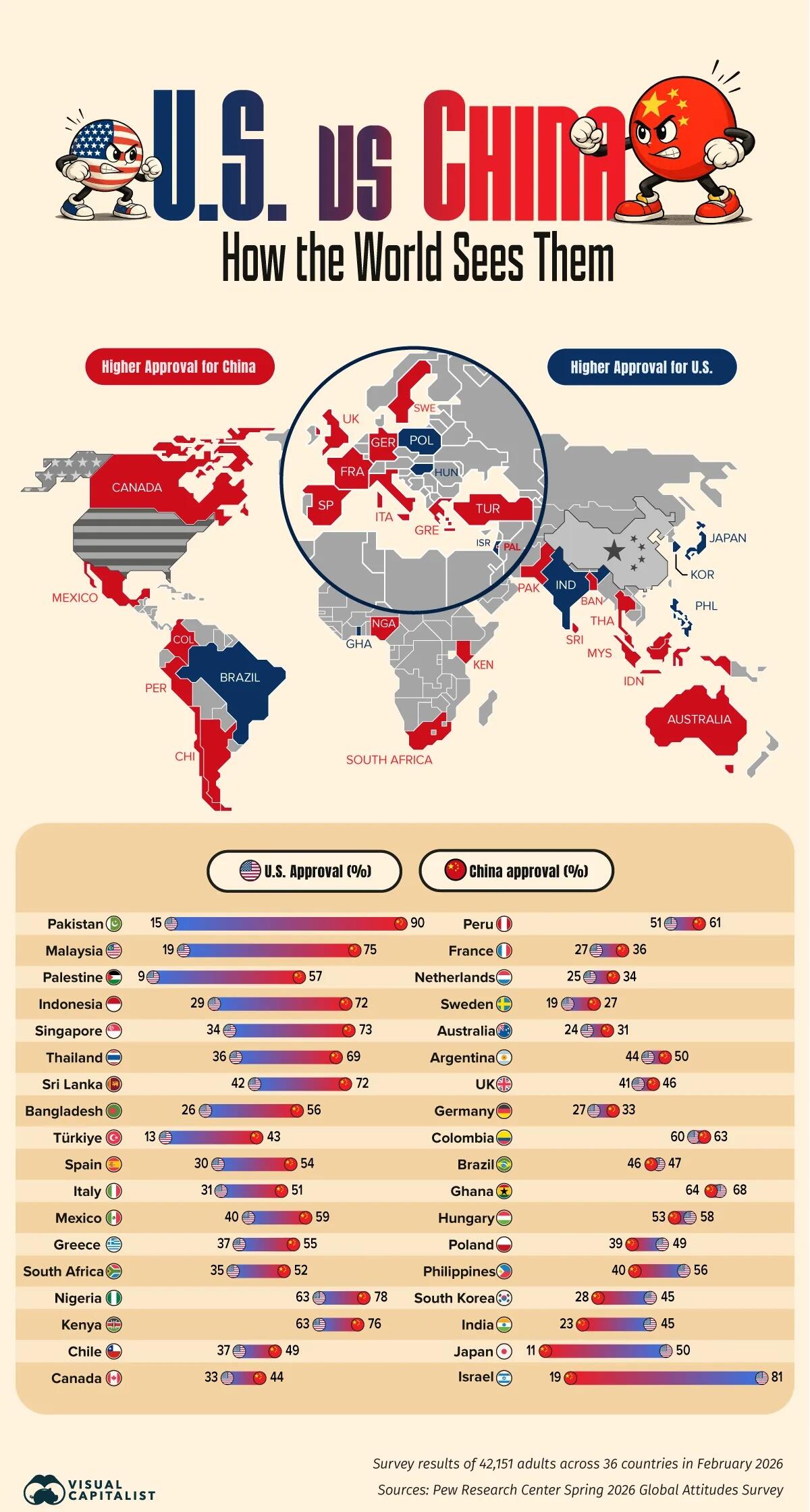
The survey was conducted in February 2026 by the Pew Research Center.
China Now Leads in Global Favorability
Public opinion in many countries has shifted in China’s favor amid changes in U.S. diplomacy and foreign policy.
In 27 of the 36 countries surveyed, China received a higher approval rating than the United States. These include U.S. allies and neighbors such as Canada, France, Germany, Mexico, and the United Kingdom.
The following table lists 2026 approval ratings for China and the U.S. across all 36 countries surveyed.
Country
Approval (%) of U.S. 🇺🇸
Approval (%) of China 🇨🇳
China-U.S. Gap (%)
🇵🇰 Pakistan
15
90
75
🇲🇾 Malaysia
19
75
56
🇵🇸 Palestine
9
57
48
🇮🇩 Indonesia
29
72
43
🇸🇬 Singapore
34
73
39
🇹🇭 Thailand
36
69
33
🇱🇰 Sri Lanka
42
72
30
🇧🇩 Bangladesh
26
56
30
🇹🇷 Turkey
13
43
30
🇪🇸 Spain
30
54
24
🇮🇹 Italy
31
51
20
🇲🇽 Mexico
40
59
19
🇬🇷 Greece
37
55
18
🇿🇦 South Africa
35
52
17
🇳🇬 Nigeria
63
78
15
🇰🇪 Kenya
63
76
13
🇨🇱 Chile
37
49
12
🇨🇦 Canada
33
44
11
🇵🇪 Peru
51
61
10
🇫🇷 France
27
36
9
🇳🇱 Netherlands
25
34
9
🇸🇪 Sweden
19
27
8
🇦🇺 Australia
24
31
7
🇦🇷 Argentina
44
50
6
🇩🇪 Germany
27
33
6
🇬🇧 UK
41
46
5
🇨🇴 Colombia
60
63
3
🇧🇷 Brazil
47
46
-1
🇬🇭 Ghana
68
64
-4
🇭🇺 Hungary
58
53
-5
🇵🇱 Poland
49
39
-10
🇵🇭 Philippines
56
40
-16
🇰🇷 South Korea
45
28
-17
🇮🇳 India
45
23
-22
🇯🇵 Japan
50
11
-39
🇮🇱 Israel
81
19
-62
Pakistan has the largest favorability gap. China has a 90% approval rating among Pakistanis, compared with 15% for the United States, a difference of 75 percentage points.
After Pakistan, the largest gaps are found in Malaysia, Palestine, and Indonesia. In each of these Muslim-majority countries, a majority of respondents view China favorably, while fewer than one-third view the United States favorably.
U.S. Soft Power Abroad
In the Americas, respondents in every surveyed country except Brazil view China more favorably than the United States.
The results from the United States’ two direct neighbors are particularly notable. One-third of Canadians and 40% of Mexicans view the U.S. favorably, compared with 44% and 59%, respectively, for China. Both countries have faced heightened trade tensions with their shared neighbor.
U.S. allies farther from North America tend to view Washington more favorably. The U.S. receives its highest approval rating in Israel (81%), followed by Ghana (68%) and Kenya and Nigeria (63% each).
Several U.S. allies closer in proximity to China also favor Washington over Beijing, including India, Japan, South Korea, and the Philippines.
Europe’s Balancing Act
Across Europe, China receives higher approval ratings than the United States in every surveyed country except Poland. In Poland, 49% of respondents view the U.S. favorably, compared with 39% for China.
Perceptions of the United States have declined across much of the continent. Long-standing U.S. allies such as France, Germany, Italy, Spain, and the Netherlands now rate China more favorably.
Economic tensions, tariffs, and disputes involving Greenland may have contributed to weaker transatlantic sentiment. However, the Pew survey measures public opinion rather than the specific reasons behind these views.
To learn more about how the two superpowers compete through their diplomatic networks, read China Tops Global Diplomacy Index on Voronoi, the new app from Visual Capitalist.
Tyler Durden
Fri, 08/07/2026 – 05:45
https://www.zerohedge.com/geopolitical/how-world-views-china-vs-us-2026