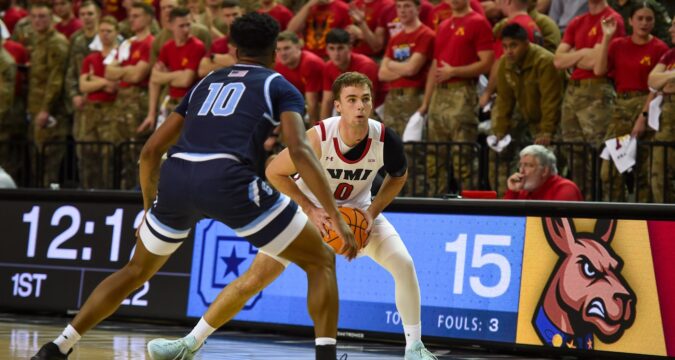
LEXINGTON — The newest addition to the Virginia Military Institute’s basketball staff doesn’t draw a salary, doesn’t wear a whistle and has never set foot on the wood of Cameron Hall.
It exists as a silent layer of code, a digital analyst that never sleeps, processing mountain ranges of film in the time it takes a cadet to polish a boot. Born from Silicon Valley and refined in the pressure cooker of college basketball, this artificial intelligence has become what the staff calls a “smart assistant coach on tap.” It is a system that watches film with the speed of a supercomputer while replicating coaching intuition.
And Jan. 3, it played a role in engineering a breakthrough for VMI basketball.
Chattanooga had held a hex over the Keydets, winning seven straight matchups. But as VMI secured a gritty 79-71 victory, the win wasn’t just a product of hustle. It was the result of “microscopic advantages” identified by Pick & Roll AI, a generative system developed by The Intelligent Search Company.
“It zooms all the way in for you,” VMI assistant coach Michael Caswell said. “It finds those microscopic advantages that could get you one or two more baskets or force one or two more turnovers and move the line between winning and losing.”
But the real story isn’t just a win on the scoreboard; it’s how TISC has turned a military college’s basketball court into a laboratory for the future of human intuition. It stands as a marriage of the old world and the frontier, where a program defined by 186 years of tradition is turning to an intelligence that can watch 10 hours of film in minutes.
“VMI is one of the toughest jobs in the country with all the unique challenges you have,” Caswell said. “What TISC provides is really the next step for technology, analytics and basketball.”
VMI head coach Andrew Wilson looks on during a game against The Citadel on Jan. 19 in Lexington. (Courtesy/Brian McWalters)
A needle in the haystack
Arpan Bhattacharya, CEO and co-founder of TISC, didn’t arrive in Lexington because of a love for the pick-and-roll. He arrived to solve a data science crisis: how do you search for something you can’t describe with a keyword?
“We started this company to build a search engine,” Bhattacharya said. “And turns out, one of the hardest things to search over is video. Coaches spend a lot of time studying film, looking for the right nuggets so they can find the best ways to attack their opponents.”
As a result, Bhattacharya and co-founder Mahbod “Moe” Sabbaghi enlisted basketball as its mode of testing. For decades, coaches have relied on tools such as Sportscode or Synergy. While revolutionary in their time, those systems are essentially digital filing cabinets.
TISC operates differently. Bhattacharya likens it to the “OpenAI” of the sports world, and Pick & Roll AI is its ChatGPT.
“We realized we can power every step of the coaching process if we really understand videos,” Bhattacharya said. “We can find the right needles out of every haystack of film.”
While traditional analytics reduces a game to a spreadsheet, Pick & Roll AI watches film like a scout.
It captures “coaching intuition,” turning tens of hours of tape into minutes of actionable insight. By replicating that intuition, the software can analyze head fakes, defensive posture and the subtle “deceptive intent” of an opponent — the “how” and “why” that previous analytics missed.
VMI assistant basketball coach Xavier Silas talks during a Keydets practice on Jan. 19. (Courtesy/Brian McWalters)
Organic marriage
The partnership between a Silicon Valley AI firm and a Southern military institute might seem like a culture clash on paper, but on the ground in Lexington, it has proven an organic fit.
“The coaching tree that a lot of us come from — like Coach Xavier Silas coaching in the NBA and myself with Florida State — is driven and backed by analytics already,” Caswell said.
Silas, an assistant coach and “power user” of the system as VMI’s offensive coordinator, views the AI as an essential supplement — not a replacement. He compares the leap in technology with the era before Google.
“How long would it take you to get the information that you can type into Google? I can’t even compare it,” Silas said. “I can go into ChatGPT and say, ‘I’m 6-foot-5, 210 pounds, I have back problems, give me a diet.’ That’s the equivalent of what we’re doing here. You get really specific, and it gives you that.”
The relationship between TISC and VMI is built on a rare level of transparency. Teams are often closed off to outsiders with the fear of overexposing information.
VMI opened not only its doors, but its playbook to TISC, allowing AI to learn the “VMI language,” so coaches can ask questions in plain English rather than complex code. Over the season, the AI internalized the team’s specific jargon and philosophy, learning to distinguish between a “bad play” and a play that followed the coach’s specific preference.
“They’re a laboratory for us to make a better product,” Bhattacharya said. “And in the process, they get access to the frontier of this technology. By facilitating our learning, they’re getting access to the best technology in the world.”
Human element
Even the most advanced AI sometimes clashes with human instinct. Early in the season, the software flagged VMI point guard Tan Yildizoglu, suggesting he held the ball too long. Silas pushed back, explaining that VMI wanted that high usage.
“That’s the human element you’re going back and forth with,” Silas said. “You have to give it your human element so it can learn that and apply it next time.”
This “back-and-forth” has turned the AI into a brainstorming partner that optimizes everything. By integrating video directly into the AI’s answers, the staff can move from “telling” to “showing.”
For Silas, the goal is simple: “Can this technology help us score?” By predetermining play call sheets based on what the data shows “really works,” Silas can optimize the offense before tip-off.
This optimization extends to the players. Bhattacharya recently used simple English prompts to generate visual “micro-missions” for players — replacing dense spreadsheets with clear directives, such as noting if an opponent habitually bites on a pump fake.
“Players are smart people,” Bhattacharya said. “If you make a compelling case with real data, they will listen.”
VMI’s Cal Liston, left, and coach Andrew Wilson chat during a game against The Citadel on Jan. 19 in Lexington. (Courtesy/Brian McWalters)
The Citadel trial: Live from the sideline
Against The Citadel on Jan. 17, the tech moved to live execution for the first time. As the system became a frantic tactical hub between 7:11 and 8:54 p.m., the staff queried the AI 19 times (roughly every five to 10 minutes):
Nine timeout strategy requests: Asking what specific aspects of the game to exploit during a quick stoppage.
Six play call requests: Identifying which set would beat the current Citadel defense based on recent events.
Two substitution requests: Factoring in player fatigue and specific defensive matchups.
Two halftime analysis requests: A high-speed audit of the first half’s successes and failures.
This feedback loop isn’t intended to replace the man on the sidelines. Instead, it is designed to lower the cognitive load for coaches when the pressure can be suffocating. Play-calling is a high-stakes puzzle under intense conditions; TISC aims to be the “lift” that allows a coach to breathe.
“It’s not perfect,” Bhattacharya said. “The goal is never to replace human judgment. Coaches have relationships with the players. They know the full social context and organizational dynamics. Coaches have to be the role models, the teachers. We just want to take care of the ‘science-y’ parts.”
The future of the frontier
The AI is, ironically, making the job more human by automating the grueling 80-hour week of film-tagging. It clears the deck for head coach Andrew Wilson and his staff to focus on the “art” of leadership: motivation, mentorship and psychological warfare.
For TISC, the success at VMI has already validated the concept enough for it to look beyond the hardwood. A college football offering is slated for later this year, and the company is exploring deeper analytics such as NIL allocation and predictive recruiting.
However, Bhattacharya is hoping to expand this to other fields where video is prevalent.
“We’re trying to teach software to navigate the physical world, especially when there’s deceptive intent,” Bhattacharya said. “That applies to sports, but it also applies to law enforcement and the military.”
Silas sees a world where this technology is as ubiquitous as health care analytics. He believes this technology will be revolutionary as the KENPOM rankings — the statistical analysis of college basketball teams based on offensive and defensive efficiency.
“It’ll be the new normal at some point,” Silas said. “I think everybody’s going to have something like this. You’re going to have to. That’s where it’s going.”
At VMI, where tradition is carved into the stone of the barracks, the “invisible hand” of AI has found a surprising home. It is an evolution of “The VMI Way” — using every available tool, from the ancient to the cutting-edge, to gain a microscopic edge.
“I’m not taking away from our guys and what they were able to accomplish on the court,” Silas said. “But we had this data that we’ve never had before. It’s an impactful tool when you’re trying to gain a competitive advantage.”