For Wendy Lopez, chef/partner of Reyes Mezcaleria in downtown Orlando’s north quarter, the heirloom masa coming out of Hunger Street Tacos‘ small-footprint taqueria in Winter Park was a game changer two years into her tenure, bringing the flavors of her native Michoacán to the tortillas and thus, the tables.
“The smell, the texture, the flavor, everything. It’s night and day from what we had before.”
Her’s is among a handful of restaurants that have benefited from Hunger Street’s masa journey, which began five years ago during the COVID-19 pandemic, when heavy, white sacks of jewel-toned corn imported from Mexico filled Hunger Street’s tiny front ordering space, and a tiny, one-horsepower mill began grinding away in the kitchen.
Come December, owners Joseph Creech, his wife, Seydi Creech and his brother, David Creech, along with Hunger Street’s first-ever employee Christian Ziegler (owner of Ziggie’s Pizza) in the dual roles of COO and CFO, will open a 2,500-square-foot production facility at 301 Ryder Lane in Casselberry, delivering wholesale masa and tortillas to waitlisted customers and new ones that thereafter join the fray.
It will be called Masamor.
The name is a mashup: masa, the staple dough in Mexican cuisine and amor (love).
Also “more.” As in more of it.
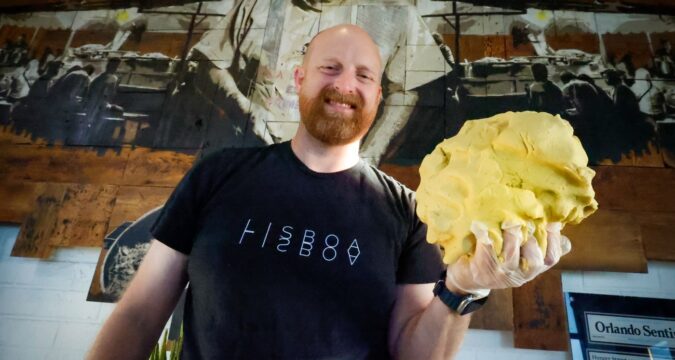
Fresh masa, made from ground corn, is kneaded into a dough before being separated for weighing and packaging at Hunger Street Tacos. (Rich Pope/Orlando Sentinel)
It makes perfect sense because the tiny, in-the-know circle outside of Hunger Street loves this product as much as the crew itself.
“It’s been a dream for me, because tortillas have always been a passion,” says Joseph Creech. “But it’s also a family business.”
Hunger Street Tacos owner Joseph Creech holds up a handful of heirloom corn, imported from Mexico. It comes from family farms that date back generations. (Rich Pope/Orlando Sentinel)
One that means everything to his wife, whose family in Mexico City has roughly 40 tortillerias. Until two years ago, her late grandmother’s was one of them.
“Every tortilla begins with a memory,” says Seydi Creech. “At Masamor, we carry on my abuela Rafa’s tradition of nixtamalizing corn by hand — not just to make food, but to honor the generations who taught us that true nourishment comes from heritage, patience and love.”
Her husband nerded out for the Sentinel back in 2020, when that first shipment of corn, product from families who have been farming throughout Mexico for generations, landed at the Winter Park shop.
Local street taco fave joins the growing ‘masa movement’
Now five years nerdier, the knowledge and expertise they’ve accumulated — Creech gives credit to Lopez, whose feedback helped them shape the process, improving the masa exponentially.
It’s been a lengthy learning process, he says, but the root of masa’s flavor, and the nutrition it imparts, has been around for thousands of years.
Partners in corn: From left to right are Christian Ziegler, Joseph Creech, Seydi Creech and David Creech. Their new 2,500-square-foot masa mill and tortilleria, Masamor, will soon open in Casselberry. (Courtesy Masamor)
Nixtamalization, the process of boiling dried kernels along with alkaline sodium hydroxide (“literally the mineral in lime,” he explains), allows the toughest part of the corn to break down, imparting calcium and changing the pH, “which preserves it naturally, so you don’t have to introduce any to keep it fresh.”
Before making their own, Hunger Street, like so many other taquerias and restaurants, used commodity tortillas, first developed during the industrial revolution.
Hunger Street Tacos owner Joseph Creech weighs a large portion of fresh masa, made from ground corn and used to create tortillas. (Rich Pope/Orlando Sentinel)
“America got involved in corn and tortilla production in Mexico and completely eliminated the nixtamalization process. They stripped it down, which also stripped out the nutritional value. It was the 1950s, and their only goal was mass production.”
People loved it, he says, because it went from a multi-day process to only taking an hour. It also allowed for an explosion of mom-and-pop tortillerias.
“But it absolutely wrecked them nutritionally,” he says. “And the flavor was gone, too.”
Fresh tortillas now await their delicious destinies at Hunger Street Tacos. (Rich Pope/Orlando Sentinel)
Lopez, whose tasting menu at Reyes includes a variety of masa, scratch-made here from corn grown all over Mexico, says the flavor difference is astonishing.
“You taste that heirloom corn and it makes you feel like you’ve been eating cardboard for most of your life.”
With the opening of Masamor, says Jason Campbell, Orlando’s Mexican menu — much like the one he’s crafted at Thornton Park hotspot June — is about to get elevated. So, too, the culinary scene overall.
Maized and enthused as June debuts stellar Mex-inspired menu | Review
“It’s been a saving grace for us,” says Campbell, whose team gets morning masa drops that become the tortillas for each evening rush. Thanks to Creech’s encyclopedic knowledge, he notes, servers here can cite the longitude and latitude of the farms where the corn is sourced.
“It’ll also be a great opportunity for chefs to flex their creative muscles and say, ‘What else can we do with this?’”
A little of everything builds the perfect chicken al pastor taco at June, where Masamor’s masa creates a solid, sweet foundation. (Amy Drew Thompson/Orlando Sentinel)
Reyes gets 90-120 pounds of masa fresh each day. Michelin Guide-recommended Black Rooster Taqueria is among the converts, as well. Maya Grill, a client inside Disney’s Coronado Springs Resort, showcases the interest (not to mention vast possibilities for growth) that Masamor holds within these first-planted kernels of business.
“It’s challenging, but what you see with Old Hearth Bread Company, that’s our goal. To be that level of provider… Eventually, we’ll be direct to consumer, as well.”
Corn is Mexico’s famed foundation — “Sin maíz no hay país” (Without corn, there is no country) is an adage that drives home its profound significance — there is a soul to the masa that stands in contrast to its marketability.
“The first tortilla always sticks,” Lopez says. She means it literally.
“The comal has to be seasoned, it has to be hot enough,” she explains. “It’s a test run.”
Corn is placed into a grinder to be mashed into the masa used to create tortilla shells at Hunger Street Tacos. (Rich Pope/Orlando Sentinel)
But scratch-made tortillas, tasted as a child in Michoacán, are also her very first memories of food.
“The smell, when I’m making a tortilla… it reminds me always of that moment. It’s a core-memory flavor.”
The first tortilla always sticks. Masamor hopes to create moments like this one, all over the city, come year’s end.
Want to reach out? Find me on Facebook, Twitter or Instagram @amydroo or on the OSFoodie Instagram account @orlando.foodie. Email: amthompson@orlandosentinel.com. For more fun, join the Let’s Eat, Orlando Facebook group.
https://www.orlandosentinel.com/2025/10/08/hunger-street-tacos-masa-factory-tortilleria/