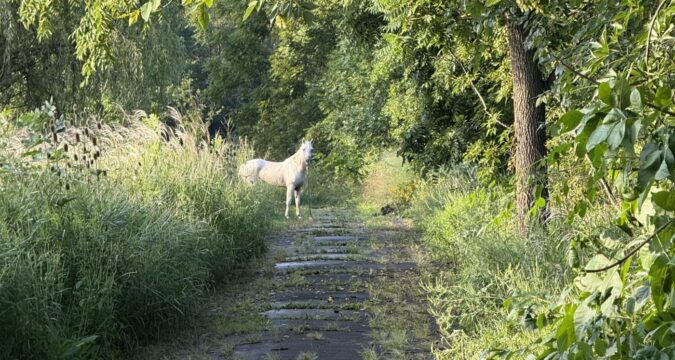
A case of two runaway horses in Wayne — which sparked a multiday horse hunt that ended with the death of both horses — is drawing criticism from some residents of the west suburban village over how many aspects of the search were handled.
The situation illustrates how even with the best of intentions, horse owners’ efforts to rescue unwanted horses facing uncertain futures can go awry, with tragic consequences.
It also marks the latest high-profile shooting death of an animal in the equestrian-oriented village of 2,300 residents, which straddles the DuPage County-Kane County line.
The saga began in mid-August, when a Wayne resident, whose family runs an equestrian facility in St. Charles, purchased two rescue horses from Southern Wisconsin Second Chance Lot, an organization that offers people the ability to acquire horses that otherwise might be sent to slaughter.
Although the family has a long history of working with horses, this was their first effort acquiring rescue horses, said Wayne resident Kelly Owens, a certified volunteer “approved humane investigator” for the state Department of Agriculture who assisted in the search. The rescue horses’ owners did not respond to requests for comment.
The horses — two feral, untrained fillies that previously spent time in New Mexico and that had not spent much time around people — were shipped from Columbus, Wisconsin, to the family’s farm in Wayne during heavy thunderstorms Aug. 18.
While unloading the horses from a trailer that afternoon, the driver who delivered them struggled to secure the horses, and both animals fled in the storms.
The hunt for the horses soon turned into a grassroots effort in Wayne, motivated by multiple factors, including a desire to reunite the horses with their rescue family as well as a goal of keeping local motorists safe from wild horses running amok on local streets.
The smaller of the two horses was located and captured the next day. Shortly afterward, a veterinarian found that it was afflicted with an equine disease called strangles, which spreads easily among horses. With a good chunk of Wayne’s economy devoted to horses, many locals pitched in to try to find the remaining at-large horse, reasoning that if it also had contracted strangles and were to come into contact with other area horses, the disease could start to rapidly spread locally.
“A horse being sick was a huge concern to our economy,” Wayne police Chief Tim Roberts said. “(Wayne-based) Lamplight Equestrian Center has horses that are in the million-dollar range, so this could have been devastating to our area. We also didn’t want to put out information that we couldn’t confirm.”
For the next several days, area residents spotted the other escaped horse, posting photos of it on social media as it was sighted running down country roads and finding its way to a Jewel grocery store parking lot in St. Charles. The horse appeared strong and uneasy, said Roberts, whose department helped with the search. Wayne police are no strangers to hunting down escaped horses, and, in fact, keep horse halters and leads in their squad cars.
At one point, Roberts said, searchers cornered the wayward horse into a fenced-in paddock. The horse then fled, jumping a 5-foot fence.
“It did not appear that the (second) horse visually had symptoms or signs of (strangles), though in the backs of our minds, it’s a contagious disease, and the two horses were transported together,” Roberts said. “We used our drone, which has thermal capabilities at night, to try to locate the horse, and not knowing if the horse was sick, there was an urgency in that regard.”
Wayne’s village government did not disseminate any information about the missing second horse and its potential health risk to the community, although some information made its way to those at the Dunham Woods Riding Club in Wayne and at the Lamplight Equestrian Center. The fact that a horse in Wayne had been found to have strangles also was posted on a state of Illinois Department of Agriculture website several days later.
Ultimately, after five days on the loose, the second horse was cornered on a property on Country Club Road, between Wayne and St. Charles. Professional trappers hired by the rescue family decided if the horse would not remain still long enough for them to shoot it with a tranquilizer gun, they would move to euthanize it.
After about 25 minutes of watching the horse, they made the decision, based on their expertise, to euthanize the animal by shooting it with a small caliber rifle, Roberts said.
Veterinarians never swabbed the second horse after its death to learn if it also had strangles, Owens said. The first horse that had strangles wound up with a major injury, likely suffered while at large, and between the effects of strangles and the injury, a veterinarian recommended euthanizing that horse humanely, Owens said.
“We’re all very sad with how it ended,” said Owens, who did not know the rescue family before this episode. “It was a heartbreaking thing and the owners wanted to give them a wonderful life and they had made all these plans. And everything went wrong before they got here.”
Owens, who also is president and founder of a nonprofit horse rescue organization called Hands & Hooves that she operates from her home, blamed Second Chance and its shipper. Right before being shipped, the horses had been seen by a veterinarian and had signed health certificates clearing them to cross state lines, although Owens questioned whether they should have transported a horse if it was visibly ailing from strangles.
“That first filly we caught the day after (escape) was very, very sick at that time,” Owens said.
Owens also faulted Second Chance’s hauler for delivering the horses during a storm, with thunder and lightning striking as they were led off the trailer. She also said that two horses that have no experience interacting with people should never be escorted from a trailer together by one person with a rope in each hand.
A spokeswoman for Second Chance told the Tribune both horses were healthy when they were loaded onto the trailer in Wisconsin. She blamed the hauler for mishandling the horses during the storm and the rescue family for not having fences high enough to prevent a mustang from escaping.
“They are fight-or-flight animals, and their first instinct is flight,” said the spokeswoman, who would not provide her full name.
Wayne Village President Eileen Phipps referred all queries to the Police Department. However, she noted that the village, for a time, lacked definitive information as to whether either of the two escaped horses had strangles.
Some members of the Wayne equestrian community sharply criticized village leaders for not communicating better with residents about the horses being at large, as well as the potential risk for the spread of a contagious equine disease.
“The public should have been notified of the loose horse,” said Olivia Pilch, who runs a horse dressage business in Maple Park. “I was showing horses at Lamplight (while the horse was at large), which means I had staff driving back and forth to help me. And it could have put them, myself and the horses at Lamplight at risk. If the community isn’t aware of the problem, how can they help and take measures to protect themselves and horses?”
Lisa Koerner, longtime owner of a Wayne horse farm, assisted in the search and kept watch for the horses while they were at large. However, she also lamented seeing little information provided regarding any potential health issues.
“I did what I could to keep updates posted as we all work together in this small equestrian community for the safety of the horses and the public,” she said. “The outcome of this situation has been extremely sad and disturbing on several fronts. It is my hope that matters such as this will be handled in a more caring and constructive manner in the future in order for positive outcomes and stronger community ties.”
And Wayne resident Ron Bowers, noting that strangles is a curable condition with proper veterinary intervention, complained about a lack of communication from village leaders.
“Shockingly, neither the mayor nor the Village Voard issued any public statement, guidance or support regarding the escaped horses or their tragic outcome,” he said. “While residents took it upon themselves to spread the word, mobilize the community and raise awareness about the loose animals, the silence from our elected officials was deafening.”
Bowers cited the last time the shooting of an animal in Wayne made news — in 2021, when Phipps’ husband, Hal, shot and killed neighbor Joe Petit’s Dogo Argentino dog, Ludwig. Eileen Phipps had said at the time that her neighbor’s dogs had threatened her husband. Ultimately, the Kane County state’s attorney’s office announced that there would be no criminal charges against Hal Phipps. In 2023, Petit filed a lawsuit against Hal Phipps seeking more than $500,000 in damages. That lawsuit remains pending in Kane County Circuit Court.
“The 2021 incident, where no charges were filed and no meaningful reforms followed … showed the same lack of accountability,” Bowers said. “Now, with these horses, we see the same inaction. Wayne’s leadership has consistently failed to address critical issues, leaving residents to pick up the pieces. These tragedies — Ludwig’s death and now the loss of these horses — are symptoms of a leadership that fails to act proactively or communicate effectively.”
Owens called what transpired “a horrible situation.”
“It’s not that the owners are bad people — but one needs to go through a reputable rescue organization. Don’t blindly pick a horse off Facebook and have it shipped to you,” she said.
The one saving grace behind the tragedy, Roberts said, is that there were no reports of human injuries or property damage associated with the situation. There were no reports of any other horses in Wayne contracting strangles.
Still and all, he said, the episode “is an unfortunate situation. It’s not a win for anybody.”
Bob Goldsborough is a freelancer