Cities and counties across Virginia are continuing to add cameras to enforce speeding laws, with the cash they are raising showing no signs of slowing down.
Law enforcement agencies across the commonwealth raked in $54 million from their speed enforcement cameras in 2025 — a 61% increase from the $33.7 million the year before, according to a new report from the Virginia State Police.
As recently as 2021, Virginia’s law enforcement agencies were not using cameras to enforce state speeding laws. But 49 agencies were operating such cameras by 2025, up from 39 the year before, according to the State Police report.
The New Kent County Sheriff’s Office — which runs four speed cameras on Interstate 64 — was the biggest money maker in Virginia in 2025, the report shows.
New Kent generated more than $7.1 million from about 106,000 speeding violations in 2025, with that single county alone accounting for 13% of the state’s revenue collections.
Nearly all of county’s revenue, or $6.9 million, was generated in fewer than five months from the I-64 “highway work zone” speed camera program that began Aug. 12.
Under the initiative, the standard 70 mph limit on I-64 is reduced to 60 mph for a nine-mile stretch during construction hours. If someone is clocked going more than 70 mph, they get a $100 bill a few weeks later.
New Kent’s I-64 program recorded 103,000 violations between Aug. 12 and Dec. 31, translating into more than 725 violations per day on that stretch of interstate. That means New Kent took in nearly $49,000 a day running the cameras.
Operating the I-64 speed cameras over a full year, which is expected in 2026, would bring in more than $18 million.
Four Southeast Virginia localities — New Kent, Suffolk, Hampton and Chesapeake — together took in more than $18 million in 2025, or more than a third of the entire state’s total. They accounted for 31% of the 957,000 speed camera violations across the state.
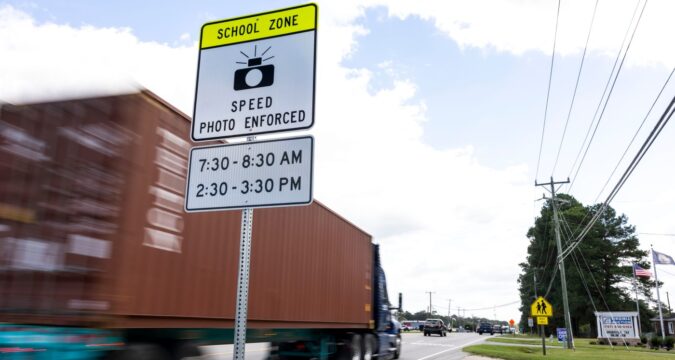
The General Assembly passed a state law in 2020 allowing localities to make money on the new camera systems. Cities and counties could operate the cameras, so long as those getting fines were going more than 10 mph over posted limits in work zones, school zones and “high-risk” segments near schools.
Such tickets can’t be more than $100, with the law requiring that a current or retired law enforcement officer review each violation. The citations don’t show up on someone’s driving record and aren’t seen by insurance companies.
A sign warning motorists of a work zone speed camera sits in the 1500 block of Holland Road in Suffolk on Oct. 2, 2025. (Kendall Warner/The Virginian-Pilot)
Under the enabling legislation, the State Police must report to the General Assembly each year on how many violations the localities issued and how much money they took in.
At a Virginia State Crime Commission meeting in August, Sen. Mark J. Peake, R-Lynchburg, fumed when he saw collection numbers for 2024, including the $8 million raised that year by Suffolk.
“I have to tell you, I’m looking at these totals, and I am appalled,” Peake said at the time. “This is outrageous. We have to do something as a General Assembly.”
Though he seemed to garner support on the panel that day, Peake’s bill this year to repeal the 2020 law went down to defeat. It was killed off in the Senate Finance Appropriations Committee on Feb. 10 in a 10-5 vote.
Though there are other speed camera bills being considered at the General Assembly, none call for outright repeal.
The State Police reports over the past four years show a rapid and steady acceleration in the deployment of speed cameras statewide.
In 2022, for example, only five agencies collected $4 million on 92,062 speed camera violations.
But it’s been a roughly tenfold increase since: Between 2022 and 2025, law enforcement agencies have raked in $112 million in revenue on more than 1.9 million violations.
Localities are generating significant cash from cameras near schools that happen to be located on busy thoroughfares. Of the $54 million collected statewide last year, for example, 64% came from school zones, with the rest coming from highway work zones.
In 2025, the 49 cities and counties with the speed cameras collected on about 63% on their speed camera violations. That means that about 37% of those who got a speed camera violation did not pay the bill.
A work zone speed camera sits in the 1500 block of Holland Road in Suffolk on Thursday, Oct. 2, 2025. (Kendall Warner/The Virginian-Pilot)
The Suffolk Police collected $6.5 million on speed cameras in 2025. That ranked the locality second in the state after New Kent, even as the city’s collections dropped from nearly $8 million in 2024.
Suffolk’s 116,000 violations issued were the highest in the state. The city operated 30 speed cameras in 15 zones, tying for the state’s highest rate.
The city’s numbers include several cameras at two highway work zones on U.S. 58 that collected a combined $5.3 million.
The rest, or $1.2 million, was spread widely over various school zones. The highest money maker was the $185,000 collected at the Elephant’s Fork Elementary School zone on Godwin Boulevard.
The Hampton Police Division ramped up its speed cameras in a big way in 2025, bringing in $2.6 million for the year on 45,600 violations. That’s a nearly five-fold increase from the $536,000 the city collected the year before, with the city’s collections last year ranking third in the region.
Hampton’s revenues are spread over 13 different school zones.
For example, the city took in $445,000 from speed cameras on Armistead Avenue, near Machen Elementary School; $350,000 from cameras on Fox Hill Road, in the Barron Elementary School zone, and $344,000 from cameras on Big Bethel Road, outside Bethel High School.
The Chesapeake Police Department collected $1.8 million in 2025 on 30,600 violations. That was down from the $3.2 million collected in 2024, but still high enough to rank the city’s collections fourth in Hampton Roads.
The report shows Chesapeake’s collected $659,000 in revenue from speed cameras on George Washington Highway, near Deep Creek High School. The city also collected $565,700 from cameras on Kempsville Road, outside Greenbrier Christian Academy.
The Norfolk Police also got into the speed camera game for the first time in 2025, collecting $973,000 at nine city schools.
Speed cameras outside the Ruffner Academy on Tidewater Drive generated $216,00, while cameras outside the Southside Stem Academy on Campostella Road took in $255,000, according to the State Police report.
The Southampton County Sheriff’s Office ramped up its program in a big way, collecting $948,000 in 2025, up from less than $20,000 the year before.
That county’s revenue came entirely from its cameras outside Capron Elementary School on U.S. Route 58, a busy thoroughfare running through the county. In fact, the $948,000 collected at Capron was the highest of any single school zone in Virginia.
The Portsmouth police took in about $898,000 in 2025, placing the city seventh in the region. Still, that was less than half the $1.9 million that the city collected on speed cameras in 2024.
Portsmouth collected $467,000 from outside the I.C. Norcom High School on High Street and London Boulevard, according to the report, with the rest spread over multiple schools.
The York-Poquoson Sheriff’s Office took in $483,000 for 2025, nearly triple what it collected the year before. The bulk of the collections, or $287,000, came from the York High School crossing zone on U.S. Route 17.
The James City County Police collected $397,000 for the year, the county’s first in the program. That was spread out over seven school zones, with the highest being the Norge Elementary School on Richmond Road.
Two large Hampton Roads localities did not run speed cameras last year.
Virginia Beach, the largest city in the region by population, did not participate in the program in 2025. But the city is now on board as of 2026, launched its brand new speed camera program in late January.
Newport News, for its part, has not jumped on the speed camera bandwagon. “It’s been discussed, but there aren’t any formal plans to implement them at this point,” said Matt Michalec, a spokesman for the Newport News Police.
While Gloucester County is on the State Police list, it did not collect any revenue in 2025, with the program expected to get underway this year. Agencies in Mathews, Middlesex, Isle of Wight, Smithfield, Surry and Franklin are not running cameras.
The State Police report shows that no Virginia cities or counties deployed cameras in 2025 under the statute’s “high-risk intersection” category. Those are road segments near a school crosswalk that have had a fatality since January 2014.
But a distinction in the law could explain the reason. Unlike with school and highway work zones, localities can’t keep the cash collected from high-risk intersection cameras. That money instead goes — or would go — to the Virginia Highway Safety Improvement Program.
Peter Dujardin, 757-897-2062, pdujardin@dailypress.com