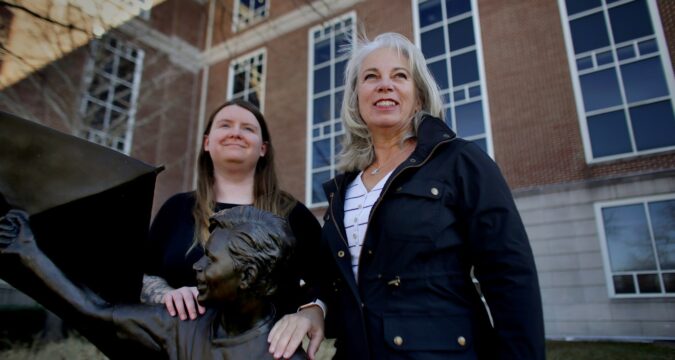
Theresa Orr says she’s had 30 kids.
“You come into our house and you are a part of our family,” Orr said.
The 60-year-old retired Virginia Beach police captain, no longer a foster mother, hoped to have an impact on a child’s life. So for the past 10 years, she’s volunteered as a court-appointed special advocate, or CASA, in Virginia Beach. She is one of well over 1,000 CASA volunteers across the state, who work over 10 hours every week to advocate for safe homes for abused and neglected children who are the subjects of juvenile court proceedings.
Trained and appointed by a judge, Orr visits a child every week, interviews family and friends, and compiles school and medical records into court reports meant to inform a judge about a child’s life. More than 3,400 children in the state have been assigned a CASA advocate this year, according to the state’s Department of Criminal Justice Services.
CASA was founded in 1977 in Seattle by Judge David Soukup, who hoped to address the need for having more information on cases involving children within an overburdened social service and legal system.
CASA spread nationwide, finding its way to Virginia through Roanoke in 1985, followed by Norfolk and Newport News soon after. In 1990, the Virginia General Assembly passed legislation to help implement CASA in all local courts.
Every volunteer assigned to a child visits them every week for as long as their case remains in the court system — sometimes for more than five years.
For every visit, Orr takes a notebook — it’s filled with child-drawn doodles and tracings of hands, interspersed with notes on what the child tells her about their life.
“I don’t work for social services, the police department, parole officers, Medicaid, or the parents,” Orr said. “I work for the judge on behalf of the child.”
Isiah Williams, 59, remains in touch with the five children he was assigned over a decade ago for his first case in Portsmouth.
Together they recall the moment when he stood up to the kids’ foster parents, Williams said, who were abusing them.
“I am no stranger to witnessing trauma,” Williams said. His day job is managing sexual assault cases as a military police officer. “I know when something is not right.
“I can see through a child’s eyes how important it is to have someone who truly cares about their welfare and improving their life.”
Unlike a social worker and the Guardian ad Litem — attorney for a child — who often have dozens of children on their case load, CASA volunteers have one case.
“The importance of having even one stable, consistent adult in a child’s life cannot be overstated,” said Roxie Hoven, executive director of Norfolk CASA. That stability is essential “to developing self-worth and a sense of belonging.”
It still strikes Hoven how one volunteer, for two years, would drive hundreds of miles each month to deliver a hospitalized boy his favorite milkshake.
“That’s the heart of a CASA,” she said.
With 38 volunteers currently serving 67 kids, Hoven said there are 45 children waiting to be assigned a CASA in Norfolk’s juvenile court.
Volunteers undergo more than 30 hours of training, as well as continuing education courses, in the workings of juvenile court, child psychology and court reporting before serving as a CASA.
Elizabeth Johnson, an Old Dominion University graduate working in shipping logistics, has been working as a Virginia Beach CASA on her first appointment since April. She leaves work early every Tuesday to visit the home of the family to whom she’s assigned.
Johnson, 22, said there’s few opportunities for kids to just talk about themselves.
With two teens, she’ll sing the KPop Demon Hunters song “Soda Pop” or trade insider fan facts about Myles Morales, the hero from “Into the Spiderverse.”
Johnson will ask them what they ate that day, how they are doing in school and how they’re feeling.
For every new court date, CASA volunteers interview children, parents, grandparents, and compile records from doctors, therapists and school staff into a court report for the judge to review before making decisions in a child’s case.
If a family doesn’t have food stamps or reliable transportation, that goes into the report. If a parent isn’t making progress on court-mandated next steps, such as taking a mental health evaluation or securing employment, a CASA will write in the report why.
“You can’t help everyone,” said Johnson. “But with each case you can help a family.”
From financial hardship to mental health challenges, CASAs empathize with parents. One parent’s circumstances a few years ago struck Norfolk CASA volunteer Gary Murphy hard.
But in the courtroom, Murphy said he had to confront the legal precedent: that a child can’t wait for their parent to be ready to provide them with a stable home environment.
“Our mission is to advocate for the child’s best interests,” said Murphy, even if that means placement in a new home.
https://www.pilotonline.com/2025/12/29/casa-advocates-vulnerable-children/