On a sunny day Pittsburgh is one of America’s prettiest cities. One hundred years ago that wasn’t the case. The people in Pittsburgh didn’t know what a sunny day was like. The city was the home to a number of steel mills that operated around the clock and poured copious amounts of smoke into the atmosphere. When Mother Nature decided to lend a hand, as she did on October 15, 1925, the dreariness could be overwhelming.
October 15 was the day the seventh game of the World Series was slated in Pittsburgh’s Forbes Field. Actually, Game Seven had been scheduled for the previous afternoon, but a steady rain had forced a postponement. The weather was no better on the 15th, but Commissioner Kennesaw Mountain Landis ordered the game to proceed. The two best teams in baseball were ordered to play the most important game of the season under unplayable conditions. Amazingly, 42,856 people — most of them clad in heavy coats and carrying umbrellas — made their way to the gigantic ballpark.
The Pirates were in the World Series for the first time in 16 years. In an era where power hitters were beginning to dominate the game, their team was a throw-back. Seven of their eight regulars batted over .300. They depended on speed and finesse.
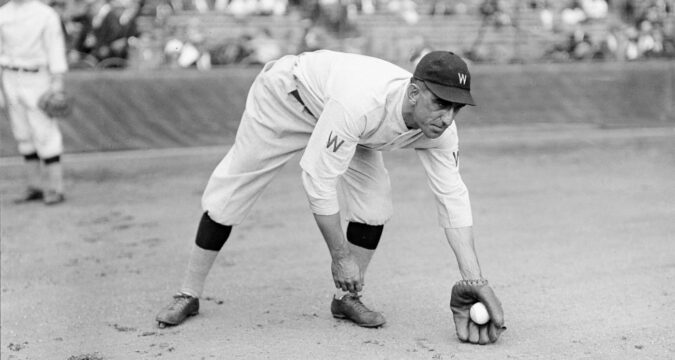
Their opponents were the Washington Senators — the defending World Champion. Their shortstop, 34-year-old Roger Peckinpaugh, had been named the American League’s Most Valuable Player, but he was struggling in the Fall Classic. In the first six games, he was 5-for-21 at the plate and was responsible for six of Washington’s seven errors. The Senators’ pitching was anchored by Walter Johnson, who now, at the age of 37, had become a living legend. Johnson had won 20 games during the season and two more in the Series. The postponement had made it possible for him to make a third start in Game Seven.
Washington had one other notable weapon. Firpo Marberry could throw an intimidating fastball, but he refused to mix in any other pitch. Player-manager Bucky Harris had elected to turn him into a short reliever. Today we would call him a closer, but there was no such thing in 1925. His role with the Senators was unique.
At 2 p.m. when Vic Aldridge threw the first pitch, there was very little breeze in Forbes Field. The cold rain was falling straight down, creating so much murk that the spectators seated in the outfield could barely see what was happening in the muddy infield.
A great deal happened very early. Aldridge could not control a wet baseball. He walked three of the first six batters and sprinkled in two wild pitches. He was credited with only one-third of an inning before manager Bill McKechnie replaced him with Johnny Morrison.
Johnson also struggled with the conditions. He didn’t walk anybody, but he allowed 10 hits in the first five innings, but that appeared to be good enough. Washington held a 6-4 lead after five and Landis decided to call the game. He turned to Senators owner Clark Griffith and congratulated him on his second consecutive World Championship.
Amazingly, Griffith urged Landis to reconsider his decision. He pointed out that the conditions were no worse than they had been when the game started and argued that Landis would be vilified by the press if he stopped the game as soon as it became official. Landis agreed and allowed the travesty to proceed.
Things got worse. About the seventh inning what had been a steady drizzle turned into a downpour. Visibility became real concern, but the teams played on.
Eddie Moore of the Pirates led off the bottom of the seventh with what looked like a routine pop fly to shortstop, but Peckinpaugh had trouble finding the ball, then succeeded in dropping it for his seventh error. Moore reached second on the bobble and scored when Max Carey doubled to left field on a ball the Senators insisted was foul. Home plate umpire Barry McCormick ruled otherwise, but he was probably guessing. It is doubtful that he actually saw the ball from his position.
With two out Pie Traynor drove a ball to right field that disappeared from view. Traynor churned through the mud as he slogged around the bases and didn’t stop until he was tagged out between third and home. That was the third out, but Carey had scored the tying run.
Peckinpaugh, of all people, untied it with a homer in the top of the eighth. Washington had a 7-6 lead. Was it time to bring in Mayberry?
Harris, apparently didn’t even consider it. He had the best pitcher in baseball history on the mound. Or, at least, he had the man who used to be the best pitcher in baseball on the mound. He wasn’t about to make a change.
Johnson retired the first two batters he faced in the eighth, before Earl Smith rapped a double. McKechnie then tapped light-hitting Carson Bigbee to pinch hit for his pitcher and Bigbee produced a double of his own, tying the game. Moore drew a walk — the first free pass the Pirates had received from Johnson.
Still, Harris declined to make a pitching move.
Johnson appeared to be out of the inning when he induced Carey to hit a routine grounder to shortstop — except that on this day nothing was routine. The ball was wet and Peckinpaugh muffed it for his eighth error. The bases were loaded when Kiki Cuyler’s ground-rule double produced two runs and gave Pittsburgh a 9-7 lead.
That was enough. The Senators went down in order in the ninth.
American League president Ban Johnson furiously confronted Harris. He accused the Washington manager of blowing the game by sticking with a faltering pitcher “for sentimental reasons.”
Harris replied that if he had to do it over again he’d manage exactly the same way.
Ban Johnson’s ire was mis-directed. The man who deserved to be second-guessed was Landis, but no one dare question his authority.
One hundred years have passed, but no one has yet.
A FEW STATISTICS: Trea Turner of the Phillies won the NL title with a .304 average. Not since 1968, when Carl Yastrzemski’s .301 paced the AL, has a batting champion had such a low figure … Bobby Witt of the Royals led the majors in hits with 184. That is the lowest total for any full season leader since 1891, when the schedule called for 140 games … The Mets used 46 pitchers this season. Six of them pitched one inning or less … Five players appeared in all of their teams’ 162 games, but Rafael Devers managed to appear in 163. Devers played 73 games with the Red Sox and 90 with the Giants. Boston was 37-36 with him on the team and 52-37 without him. San Francisco was 41-31 without him and 40-50 after the trade … According to Baseball-Reference, the highest defensive WAR was achieved by Ernie Clement, who played 157 games for the Blue Jays. He appeared at all four infield positions. Ceddanne Rafaela of the Red Sox was a close second. Rafaela played both center field and second base … Shohei Ohtani of the Dodgers did not lead the majors in doubles, triples or home runs. However, he did lead in extra base hits … The AL finished with a 367-353 edge in interleague games … Elly De La Cruz of the Reds stole 37 bases, which was 30 fewer than he swiped the previous season. However, the 102 runs he scored was only three fewer than in 2024 … For the second year in a row, no major league team was able to win 100 games … The Tigers sacrificed successfully only five times all season. Then they did it twice in their first playoff game … Stephen Voit of the Guardians and Ron Washington of the Angels were the only managers to complete a full season without an ejection … Yandy Diaz of the Rays batted .400 in the month of September. Twenty-five of his 32 hits were singles … The Padres bullpen posted a 44-27 record with a 3.06 ERA … The Rockies played only six extra-inning games. They lost five of them … On May 5 Eric Fedde of the Cardinals shut out the Nationals, thus becoming one of only 13 pitchers to blank an opponent this year. Fedde finished the season with a 4-11 record that was compiled with three teams.
Former Hall of Fame voter Jay Dunn has written baseball for The Trentonian for 57 years. Contact him at jaydunn8@aol.com