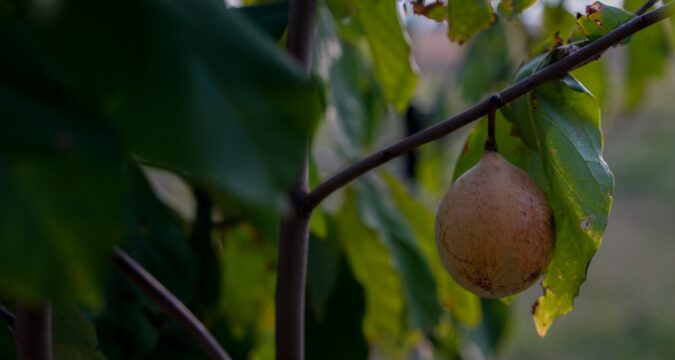
It’s September, and I’ve always been a child of autumn, immersing myself in its sights, sounds and colors. And its foods: farm stand apples, cider and the first winter squash. But the food I associate the most with autumn is North America’s largest edible native fruit: Asimina triloba, or the pawpaw. If you’ve never eaten a pawpaw, you’ve missed out on nothing less than an eatable piece of Americana.
Pawpaw trees, with their droopy, tropical-looking leaves, are found along creeks, streams and rivers, inseparable from the American landscape. Indeed, some varieties of pawpaws are named for some of our most storied rivers: Allegheny, Potomac, Wabash, Susquehanna and Shenandoah.
Pawpaws, both the trees and the fruit, are as colorful as a painting, from the lush maroon of their early spring blossoms and the light green of their foliage and fruit to the yellow-orange of their flesh and the dark chocolate of their bean-sized seeds.
As the fruits mature in late August and early September, their flesh develops a sweet, gooey, custard-like consistency — you can eat it with a spoon! — and they give off a heady, floral aroma. Their flavor teases the senses: banana vanilla up front and behind that, at times, pineapple or caramel-like accents. But be forewarned that a pawpaw’s skin is somewhat toxic. And never eat an unripe one. Trust me.
Native Americans, early settlers, some of our Founding Fathers and today’s small-town folk have harvested and relished pawpaws on sunny fall days. Devotees often consume pawpaws right after they’re picked, while others puree the flesh and fold it into batter for cakes, cookies and quick breads, or blend it into custards, ice cream and smoothies, the last with a touch of dark rum, if you please.
But pawpaws are not merely a unique fruit; they are also part of American folk culture. Surely you recall the song “Way Down Yonder in the Pawpaw Patch”?
When I think of pawpaws, I recall the paintings of Winslow Homer, Thomas Hart Benton and the Hudson River School, and I dwell on homemade foods based on recipes passed down over generations by people who still care about such things.
When I talk to others about pawpaws, I often find their reactions to be bemusing. There are the self-important smirkers and sneerers, usually city or suburban dwellers: “Well, I never heard of them!”
The reaction, though, of supposed country folk has puzzled me the most. People claiming to be from prime pawpaw country — Illinois, Indiana, Kentucky, West Virginia, to name a few states — have looked at me cautiously, if not suspiciously, before admitting that they have never heard of a pawpaw. Sigh.
Why do I wax nostalgic about the pawpaw? At the outset, I associate the pawpaw with America itself, and I worry about America. Too many people today are hardwired, digitalized and virtual. There is nothing “virtual” about a pawpaw. Pawpaws belong to an older America I fear we have forgotten, a slower-paced, more thoughtful America, one before asphalt and concrete, steel and glass, shopping malls and fast food.
Pawpaws are not fast food.
Thus, I have been addressing all of you in the hope that we all still share a love for the homemade, for the old songs and for the grandfatherly things that can’t be replaced by smartphones and the internet — and definitely not by artificial intelligence! — and a love for the land itself, America.
If I’ve whetted your appetite for pawpaws, on Saturday, Sept. 20, the second annual Pawpaw Festival will be held in, of course, Paw Paw, Illinois, which is due west of Chicago. A very good friend and I attended the inaugural event last year, and we had a blast.
If you go, save some for me!
John Vukmirovich is a Chicago-area writer and book reviewer.
Submit a letter, of no more than 400 words, to the editor here or email letters@chicagotribune.com.
https://www.chicagotribune.com/2025/09/05/opinion-pawpaw-americana-autumn/