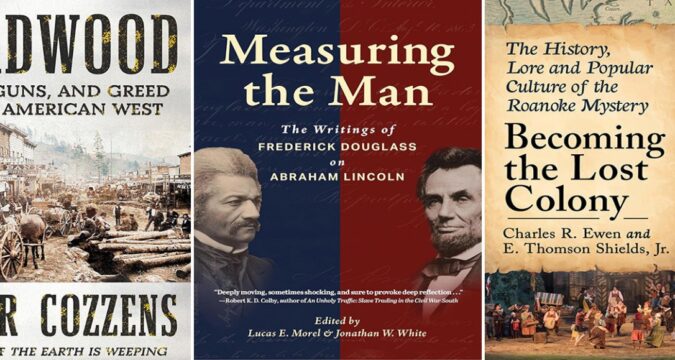
Deadwood had a reputation in the late 1870s “as a place to hunt gold, gamble, consort with prostitutes and then die brutally.” It was a Dakota town at the edge of the developing Wild West.
That is the view claimed by author Peter Cozzens in his latest volume, “Deadwood: Gold, Guns, and Greed in the American West (Knopf, 432 pgs., $35).
Stolen from the Lakota in the midst of the Black Hills, the town was established in 1876 — almost 150 years ago. Similar to the community depicted in the HBO television series “Deadwood,” the 1870s area was developed for mining, primarily gold. There was even a mining trench right down the middle of Main Street.
Cozzens, enjoyably, tells tales involving Wild Bill Hickok, Calamity Jane and gambling and town leader Al Swearengen as well as an array of other characters. His description of the frontier town is probably one of the best of all accounts of how the West was won or better yet, how it developed its wild flavor.
Deadwood, as defined by Cozzens, was not like Tombstone or Dodge City — places where outlaws lurked. It was a place built by outlaws, and because it was in Lakota land, it was not part of any United States territory nor was it subject to any U.S. laws or under any type of governance.
During a time of deep-seated discrimination, Deadwood welcomed all, including Chinese and Black Americans. Everyone did their own thing, Cozzens says. Just stay away from me.
Calamity Jane — real name Martha Jane Canary — was a true sharpshooter and frontier woman. A friend of James Butler “Will Bill” Hickok, she was allegedly his wife. Even Cozzens, who found all types of stories about the two characters, never could determine if a marriage was involved.
He did confirm that Calamity Jane was a prostitute for much of her adult life. In the end she was buried beside Wild Bill in Deadwood. Not Wild West lore, just a lot of reality
About Hickok, Cozzens dispels the tale that the sheriff/gun fighter was shot while he was holding a pair of aces and a pair of eights — known today as the “dead man’s hand.” He was playing poker and was shot in the back of his head, but held no such hand.
The death of George Armstrong Custer in the Black Hills a few months before the birth of Deadwood created a sensation in the country and much lore has come from it, but Cozzens mentions it in passing. His focus was more on the Indigenous people of the time — Lakota warriors Crazy Horse and Sitting Bull and their tribes — those whose love of the land in the Black Hills was love above all else.
Ironically, within the past week or so, a major news story hit the media highlighting Deadwood as a small South Dakota town — with only a population of 1,300 — that now welcomes about 2.3 million tourists annually. Thriving on a revived gaming/gambling industry, bars and hotels, Deadwood has gradually become an alternative to more costly Las Vegas and its classy casinos.
Today, Deadwood also has some Wild West, gold-rush flavor of 150 years back.
Lincoln and Douglass debate
Four years ago, television journalist Brian Kilmeade wrote an intriguing book, “The President and the Freedom Fighter: Abraham Lincoln, Frederick Douglass, and Their Battle to Save America’s Soul.”
A popular history, the book was “an amazing story of two souls’ movement toward Emancipation.” American novelist and nonfiction writer Brad Meltzer also relates that the Lincoln-Douglass story “is the story of America itself and shows how intertwined race is with our history.”
Two Virginia historians and professors have produced “Measuring the Man: The Writings of Frederick Douglass on Abraham Lincoln” (Reedy Press, 312 pgs., $24), a collection of Douglass’ feelings about the Great Emancipator. It fits nicely with Kilmeade’s volume and an earlier book, “The Radical and the Republican: Frederick Douglass, Abraham Lincoln, and the Triumph of Antislavery Politics,” published in 2008.
As editors, Lucas E. Morel, a politics professor at Washington and Lee University and Jonathan W. White, an American studies professor at Christopher Newport University, collaborated to shed new light on these two amazing leaders.
Among the statements in this skillfully annotated compendium are a dozen newly discovered documents, some of which were written to abolitionist friends in England. It is interesting also to note Douglass’ feelings regarding Lincoln in the years prior to the Emancipation Proclamation and then the time after Lincoln’s assassination. In reading all of Douglass’ words about Lincoln, you realize, as historians have recognized, that he was the “most eloquent Black man in America” during the 19th century.
All about the Lost Colony
Two academics from East Carolina University have put together “Becoming the Lost Colony: The History, Lore and Popular Culture of the Roanoke Mystery” (McFarland, 220 pgs., $29.95).
Anthropology professor Charles R. Ewen and E. Thomson Shields Jr., emeritus professor of English, relate the various scenarios of what happened to the colony, established in 1587 on Roanoke Island, North Carolina.
Coming from different fields, Ewen and Shields provide a multidisciplinary perspective on the various possible routes to the colony’s end. In all honesty, they write, no one knows how the mystery ended and none of the various new bits of evidence pass muster in the historical, archaeological and literary evidence known to date.
There are a few disappointments in the volume, including the lack of photography. Not enough of what is known is illustrated and what would cap this work is a full presentation of what various archaeological excavations have revealed both on and off Roanoke.
Pulitzer Prize-winning playwright Paul Green’s outdoor drama, “The Lost Colony,” presented each summer at the Waterside Amphitheater on the island, is still the best-known piece of lore about the Lost Colony. When he wrote it in 1937 and revised it several times until his death in 1983, he always left the ending ambiguous.
At the end, Green wrote, “In the cold hours before dawn they began their march into the vast unknown.” And that’s still the way it is.
Have a comment or suggestion for Kale? Contact him at Kalehouse@aol.com.