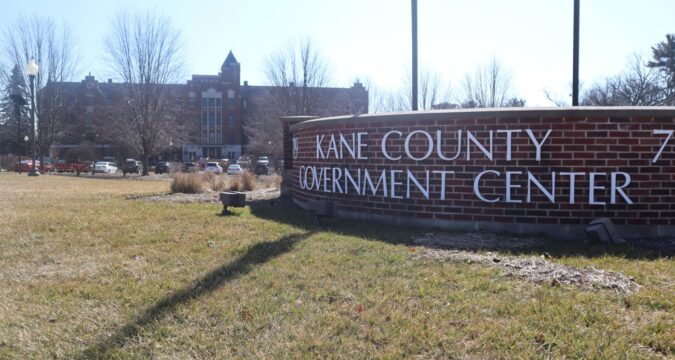
As budget discussions continue, the Kane County Board recently discussed — and narrowly approved — two tax-related proposals meant to generate revenue for the county.
The two measures include a hike in the county’s current motor fuel tax from five cents per gallon to eight cents per gallon, and a 1% grocery tax replacing the state’s grocery tax set to expire on Jan. 1. Both are slated to take effect in the county on July 1.
These measures are being passed as the county board debates how to solve a budget shortfall it’s been facing in its general fund in recent years, and as the deadline to approve a 2026 fiscal year budget draws nearer.
In recent years, the board has been solving its budget woes by dipping into the county’s cash reserves. Last year, for example, the budget was balanced with the planned use of about $27 million in general fund reserves, according to past reporting.
But, if revenue and spending were to remain level, the county’s Finance Director Kathleen Hopkinson has cautioned that the county must make significant cuts or find new revenue before 2027 to avoid dipping into its required 90-day reserves.
So, after a failed sales tax referendum in April, county board members have been left with the task of finding new revenue or cutting costs to avoid spending down the county’s reserve funds.
They’ve considered a hiring freeze, reallocated a portion of the county’s Regional Transportation Authority sales tax funds from transportation to public safety and asked county departments and offices to cut their individual budgets by roughly 8% from last year.
The increase in the gas tax approved by the board is expected to generate more than $6 million annually, according to board member Verner Tepe. At Tuesday’s Kane County Board Finance Committee meeting, Tepe explained that those funds would go to the Kane County Division of Transportation.
The money would fund the operation, construction and improvement of public highways and waterways in the county, as well as the county’s ability to acquire property and right-of-way for public highways and waterways, per the measure.
This is meant to essentially replace the funding the Kane County Division of Transportation was set to lose out on this year because of a different measure passed by the board earlier this year. In August, the county board voted to reallocate 25% of the Regional Transportation Authority sales tax funds the county receives from transportation to public safety, according to past reporting. That meant the county’s Division of Transportation was set to receive considerably less RTA funding to pay for its expenses this year.
However, Tepe said the board may at a later date vote on a measure to allocate another $4 million in RTA funding away from transportation and into the general fund to pay for public safety expenses, as changes to the budget are still being made.
Kane County Board Chair Corinne Pierog asked if diesel-powered vehicles would be included in the tax, and a county spokesperson later confirmed that they would.
After being moved forward by the Finance Committee on Tuesday, the Executive Committee took up the gas tax matter, with Tepe emphasizing the need for additional revenue to move the budget forward, even though further changes will be coming.
Then, moved forward by the Executive Committee, the topic generated significant discussion at the full Kane County Board meeting later on Wednesday.
Board members David Young and Myrna Molina criticized the proposal, while board member Michelle Gumz defended it, suggesting that the board doesn’t “hold up (its) end of the bargain” in terms of finding additional revenue while asking the county departments and offices to make cuts.
And Tepe also expressed support for the proposal, framing it as a sort of last-ditch effort to balance the budget.
“If we do not get the gas tax increased, we don’t know what to do,” Tepe said. “And I mean, when I say we don’t know what to do, we don’t know what to do.”
Board member Deborah Allan suggested that the board’s budget issues came in part from the county departments and offices getting used to the programming funded by grants the county has received in recent years.
“This is the first time in my tenure,” Allan said, “that I have seen a board who has said, ‘The rubber is meeting the road here. And we just can’t afford to fund everything.’”
But, as for the gas tax, she suggested that the Kane County Division of Transportation wouldn’t have needed the money if the board hadn’t diverted RTA funds away from transportation, and expressed concerns about the cost of gas for her constituents.
Board member Anita Lewis said she was supportive of the motor fuel tax because her constituents value the services the county provides, particularly those for public safety.
And board member Jon Gripe asked if reserves could be used if the motor fuel tax fails, but Tepe said it was likely the reserves would go below the required amount.
“All you’re doing is focusing on the gas tax,” Tepe said. “We’re focusing on the budget.”
Board member Leslie Juby, on the other hand, said there were sufficient funds to account for what the motor fuel tax would generate.
Ultimately, the measure passed with nine board members voting for it, and eight voting against. Hopkinson, at the meeting, said the increased tax will not go into effect until July 1.
The board has also been considering instituting a 1% grocery tax, as the state’s tax is set to expire on Jan. 1.
At Wednesday’s board meeting, Hopkinson explained that this measure was essentially to keep the existing tax on groceries in place, rather than institute a new tax. The tax is estimated to generate between $40,000 and $400,000 a year, she said.
That measure was also narrowly passed by the board on Wednesday. That tax will also go into effect on July 1.
mmorrow@chicagotribune.com