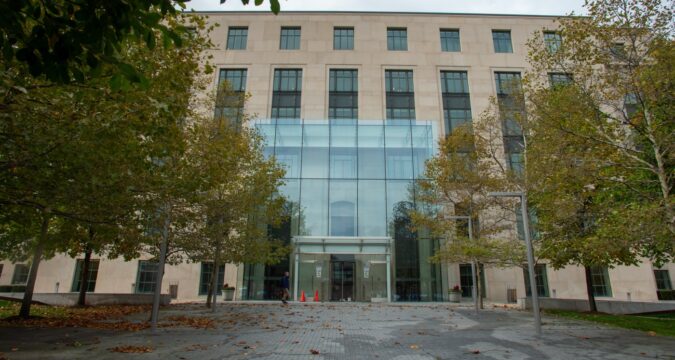
Connecticut State Police investigators have been spending hours watching video recordings from security cameras at the State Office Building at 165 Capitol Ave. in Hartford.
Department of Emergency Services and Public Protection Commissioner Ronnell Higgins is devoting all the resources he can muster to the investigation of alleged sexual misconduct by three state troopers who worked at the building and a private security guard who also worked there.
The cameras near the small office provided to the trooper on duty in the building are of particular interest to internal affairs investigators and their colleagues because one of the troopers is alleged to have engaged in the misconduct with the security guard in the building while on duty, as reported here a week ago.
On Tuesday, Higgins sent a letter the four statewide elected officials whose offices are in the building, State Treasurer Erick Russell, State Comptroller Sean Scanlon, Secretary of the State Stephanie Thomas, and Attorney General William Tong, memorializing his conversations with them, A considerable portion of the letter was devoted to expressing his confidence in his agency’s ability to conduct a thorough, professional, and timely investigation.
Of the many nightmares law enforcement agencies must confront, the ones created from within can do the most lasting damage. The allegations of a sex scandal involving three troopers, a young private security guard, and the security of four state elected officials will test many talents of veteran police officials.
Higgins, who came to DESPP from Yale, enjoys a reputation as a leader who wants to do right but has been surprised at the many obstacles work and other rules present to implementing decisions quickly.
A factor in internal investigations that is often absent in probes of criminal ones is discretion. Police pay close attention to what goes on in the agencies that employ them. Internal investigations hold a particular fascination for them because they often see plenty that is never reported to superiors. When it is, such as the alleged acts at the State Office Building now being investigated, they pay close attention and talk among themselves. That talk often finds its way outside the agency and into a story like the one you are now reading. That sort of scrutiny is one of the informal guardrails for a high-profile investigation like the one now taking place. Those on the inside never think that porous nature of these investigations is a benefit. It is.
Another informal factor plays a part in this unusual investigation. Members of the state police force are mostly appalled at this strain of alleged misconduct. Yes, there will be some snickering and lewd comments but dismay at the alleged conduct and the consequences that will flow from a report that confirms and expands on it.
There is also the collateral damage to spouses and children. These are the victims most likely to endure the deepest and most enduring wounds. Members of the Connecticut State Police agency, civilian or troopers, will be diminished if the allegations are found to be true. In an age of intense skepticism about our traditional institutions, an investigation that confirms the allegations will make it more difficult for the police to do their jobs. The greater risk will be if there are few consequences at the conclusion of an investigation that finds misconduct by troopers. Higgins seems to understand this tripwire.
Each one of the four constitutional officers who work in the State Office Building has formal duties, but they also have informal influence within state government that extends beyond their job descriptions. They want to know if they and many others working in the building were unknowingly exposed to security gaps through misconduct that thwarted careful planning. Then there’s the question of costs to the state treasury.
There’s an informal, thorny consideration in nearly every police internal affairs investigation. Did others know of the alleged misconduct and remain silent? This requires a determination to pursue what is not always present in an internal affairs investigation. While we may each think we recognize conduct unbecoming an officer when we see it, defining it for purposes of discipline requires a formal, consistently applied definition.
The letter Higgins sent Tuesday states, “On the evening of Friday, January 16, 2026, command at State Police Troop H in Hartford were notified about potential misconduct involving State Police and Private Security personnel assigned to 165 Capitol.” The three troopers alleged to have been in sexual relationships with the private security guard were immediately reassigned. The commissioner’s letter does not include how the brass at Troop H learned of the allegations.
Col. Daniel Loughman learned a week later that one of the three troopers had attempted to enter 165 Capitol Avenue, “to purportedly retrieve personal items from the location.” That trooper was assigned to administrative duties, and his police powers were suspended.
This is one heck of a headache that is consuming a lot of time and other resources beyond the internal affairs division. Higgins and his brain trust have many other pressing issues, especially vexing problem of overtime. State police in 2024 paid $60 million in overtime and 17 of the top 25 state employees who received the most overtime that year were state police troopers. Because overtime is calculated in pensions, those overtime payments are with us for decades.
A sex scandal, on the other hand, has a beginning and an end, and they should not be far apart.
Kevin F. Rennie can be reached at kfrennie@yaoo.com