Kimi, Crude, & Carney: Rabobank Sums Up The Geopolitical Chaos
Authored by Molly Schwartz, Rabobank cross-asset macro strategist,
Trading Playbooks
The advancement of one of China’s AI models, Kimi, has sharpened attention on the latest US plans to counter China’s growing AI challenge. Kimi is reportedly more powerful than several US flagship models, though not yet as powerful what lies on the frontier. However, Kimi operates at a fraction of the cost per token. That cost advantage raises the competitive threat to US AI leadership more broadly, including for other leading firms in the space, and Trump is once again taking a page out of China’s playbook by cracking down on the free market and unfettered competition. With tariffs, the US sought to limit China’s influence to bolster its own struggling manufacturing sector. Now, the more immediate question is whether Washington will do the same in an attempt to maintain its lead in the AI race…and if it will be successful.
According to Axios, “the Commerce Department last year considered adding multiple Chinese AI labs to its ‘Entity List,’ which would effectively cut off US access without a license.” The US is considering other avenues of approach as well, such as banning Chinese AI for national security reasons. But not all in the land of the free are happy with Trump’s interventionist approach to global markets. Axios reports that David Sacks said on X that “we are at a critical inflection point in AI policy,” warning that leading closed labs want the government to eliminate their open- source competition. For markets, the issue is not just who builds the best model, but whether AI becomes another front in the fragmentation of global capital, technology, and trade flows.
But protecting US AI dominance domestically may not be enough. China has made itself the manufacturing hub of the world, exporting cheap, shiny goods at a rapid pace and allowing its sphere of influence to grow throughout developing and emerging markets. As these same markets adopt the need for AI infrastructure, who are they more likely to turn to? The niche technically superior (?) and more expensive US AI models, or the cheaper Chinese alternatives that do almost as good of a job?
While the US tries to restrict China’s access to new customers in the AI market, the Houthis may be unintentionally squeezing China’s access to its existing customers in the physical goods market. The Houthis have announced that they plan to impose a sea navigation ban against the Saudis, blocking off the Bab el-Mandeb Strait, which separates the Red Sea (and the Mediterranean Sea via the Suez Canal) from the Arabian Sea.
As the flow of vessels through the Strait of Hormuz remains limited under the current escalation, additional risks to the global supply chain are the last thing global economies need. Brent crude oil opened above $90/bbl yesterday—the highest price since June 11—and diesel traded around $16/bbl—the highest price since May. Additional upward pressure on oil prices because of the Houthis only further increases the fears of a supply-side-driven inflation shock and a consequential slowdown in economic activity as consumers struggle to keep up with the cost of living.
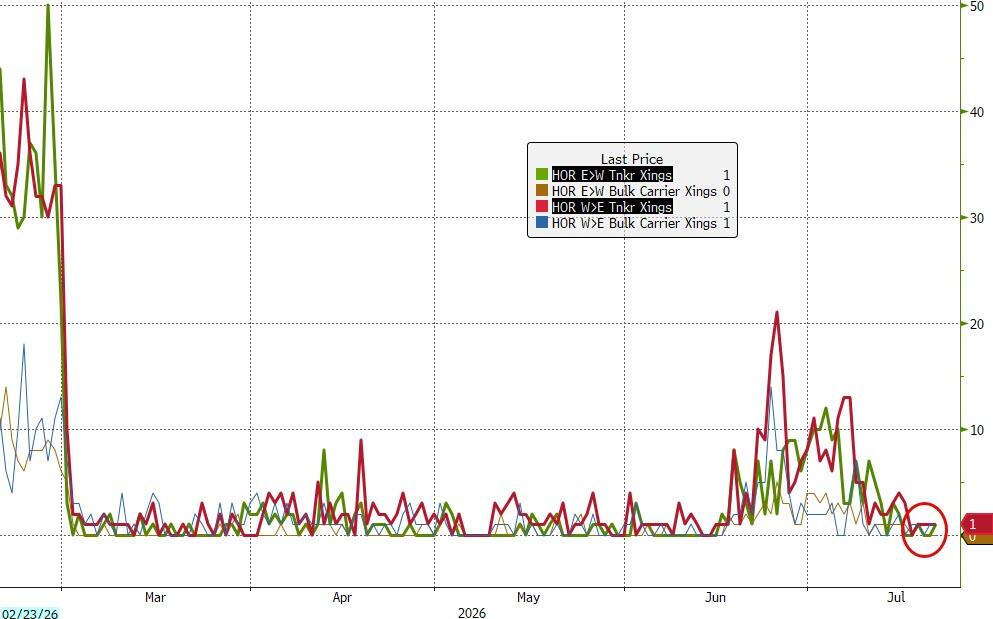
That means fewer consumers willing and able to purchase Chinese imports. A significant part of the current energy narrative, which is also informing our energy forecasts, is that China has more oil reserves than many once thought, giving China more room to wait out the war by drawing on its reserves. Therefore, yes, disruptions to the Bab el-Mandeb Strait may have little direct impact on China’s energy supply, but Xi is unlikely to welcome the pressure they put on China’s customers.
Europe, meanwhile, remains firmly behind the curve on both AI development, and the situation in the Middle East. It is, however, seeking to build its own additional barriers to global trade as Brussels tries to enforce new sanctions on Russia. But the EU’s habit of regulating itself into irrelevance is once again making an appearance, and several member states are putting up barriers of their own against Brussels. The Financial Times reports that Greece refused to sign on to the sanctions agreement, demanding a carve-out that would allow it to continue transporting Russian LNG. Austria, France, Greece, Germany, Italy, and Portugal also came to the table with their own demands. The FT cites a diplomat saying that “around the table, the moral imperative is functioning less and less. Capitals all agree on tough rhetoric and talk of solidarity, but then it all melts away.”
Over the weekend, the World Cup was able to do what the USMCA wasn’t – bring the leaders from the US, Canada, and Mexico together. Many people (mostly economists and market-types) wondered if the three would have some trilateral conversations about trade and the ambiguous status of the USMCA. An announcement from yesterday would suggest that if those conversations did happen, they didn’t go especially well for Canada.
As highlighted earlier in this article, Trump is no stranger to trading playbooks with leaders from more centrally planned economies, and tariffs have emerged as a signature tool of this Administration. Yesterday, Trump signed three proclamations to enforce additional tariffs on Canadian goods, covering motor vehicles, alcoholic beverages, and dairy. These proclamations enforce 50% tariffs across several product lines “ranging from wine to hockey sticks to cement” by leveraging Section 388 of the Tariff Act of 1930. Bloomberg notes that Section 338 has never been used by a President to impose tariffs. As a major distinction from previous tariffs we have seen the Trump Administration enforce on Canadian and Mexican goods, these explicitly “apply to all covered goods regardless of whether a good originates under the USMCA.” They are currently scheduled to take effect in 30 days.
Just because proclamations are signed does not mean that these tariffs will come to fruition, or that even if they do come to fruition, they will be long-lasting. This is not the first time the Trump Administration has leveraged tariffs as a negotiating tool, and then dampened them once demands were met. Given the USTR National Trade Estimate Report on Foreign Trade Barriers, issues involving the dairy, alcohol, and vehicles were always bound to come to the forefront in the USMCA negotiations. These tariffs likely serve as an intended message to Canada that the US wants to “even out the playing field” and will not take no for an answer.
The next step is for Ottawa to negotiate with the US before these tariffs come into effect, or, forbid, try to call Washington’s bluff.
Tyler Durden
Tue, 07/21/2026 – 12:40
https://www.zerohedge.com/geopolitical/kimi-crude-carney-rabobank-sums-geopolitical-chaos