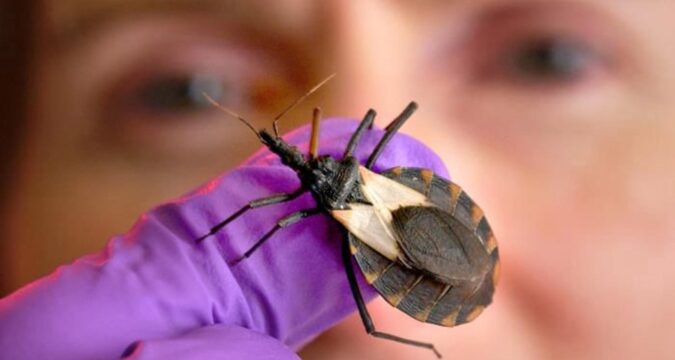
In a year where avian influenza, measles and legionnaire’s disease have taken the spotlight, the Centers for Disease Control and Prevention is saying that a parasitic infection caused by a “kissing bug” and believed to have been mostly isolated to Latin America, is now endemic to the U.S.
A recent paper published by the CDC journal Emerging Infectious Diseases states that Chagas disease has been identified in 19 states, and the insect that spreads it is in 32 states, including Pennsylvania.
Chagas disease is an infectious disease caused by a parasite called Trypanosoma cruzi. This parasite is primarily spread by the blood-sucking insects of the triatomine family, sometimes called “kissing bugs” because of their tendency to target the face.
Dr. Jeffrey Jahre, St. Luke’s University Health Network’s chief emeritus of infectious diseases, said that these bugs are nocturnal, like bed bugs, and have a similar feeding style in that they do not attach to the host for an extended period of time while they feed, preferring to dine and dash.
The bug can transfer the parasite over to the victim while feeding. However, a common source of infection is the feces the bug leaves behind on its victims, with the person or animal getting infected if they accidentally rub the feces into the wound, their mouth or their eyes.
Chagas cannot spread through normal human contact, but can spread from mother to fetus, via blood transfusion, organ transplants or by consuming contaminated food or drink.
The disease is marked by two phases, starting with the acute phase that lasts for the first weeks or months after infection.
During the acute phase, the most striking possible symptom is what is called Romaña’s sign, a severe swelling of the eye. This is caused by the bug’s feces getting into the eyelid or the bug biting near the eye. Other symptoms can include fever, fatigue, aches, headache, rash, loss of appetite, diarrhea and vomiting.
Chagas disease has no guaranteed cures or vaccines, though Jahre said if it is identified early enough into the acute phase, it can be treated with some available anti-parasitic drugs.
Once the acute phase subsides, the disease moves into the chronic phase, which can last years or even the rest of a person’s life. During the chronic phase, most people will have no symptoms but 20% to 30% may develop problems such as an enlarged heart, esophagus or colon; heart failure; altered heart rate or heart rhythm; and even sudden death. About 300,000 people in the U.S. live with chronic Chagas disease.
Chagas disease was primarily present in southern Mexico, Central America and South America. Jahre said the insect that carries it tends to inhabit rural areas, taking refuge in earthen homes, such as those made of adobe or mud. It has since become reasonably prevalent in parts of the southern U.S., with most cases being in California and Texas.
He said there have been no confirmed acute cases of Chagas disease originating in Pennsylvania or the Lehigh Valley; however, Jahre said there are individuals in the Lehigh Valley who have chronic Chagas disease.
“We’ve seen people where they have immigrated from these areas and they now have the kinds of complaints that we’ve talked about and we do some testing and find out lo and behold they have Chagas disease. But unfortunately at that stage of the game the treatment is not as effective,” Jahre said.
There are confirmed cases of animals being infected with the disease in nearby Maryland and Virginia. Still, Jahre said at this time, there is no reason for anyone in the Lehigh Valley to be excessively concerned about Chagas disease. It is something to be aware of if you spend time in a rural area of the American South or in rural Latin America and notice a bug bite on your face.
“If someone says, ‘Look, I’ve just traveled to and spent a lot of in rural Mexico or Central America or South America, and they have a swollen eye, it’s one of the things that you need to think about. If you don’t think about it, then you’re not going to test right?” Jahre said.