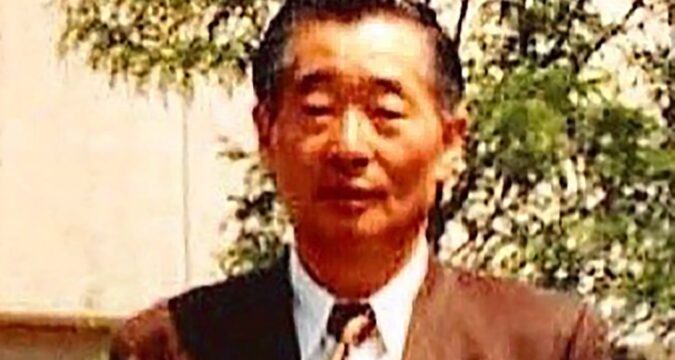
Imbued with an entrepreneurial spirit, Kun Chae Bae founded a pharmaceutical generics company and later owned a host of low-power television stations including in Chicago, along with other holdings like a golf course in northwest suburban McHenry and the now-razed Purple Hotel in Lincolnwood.
Known to many by his initials, K.C., Bae also cofounded Foster Bank in Chicago.
“He traveled in any circle that was forward-thinking, and he was very entrepreneurial,” said former Chicago Ald. Patrick O’Connor, 40th. “He did a ton of things, and he was never afraid to get into something new. So many people basically stay in their lane, but Mr. Bae, any lane that he thought was something worth a try, he was willing to try it.”
A longtime Northfield resident, Bae died on July 22. He was 91.
Born in Jinju, South Korea, in 1934, Bae grew up under Japan’s occupation of Korea and then the Korean War. After graduating from Jinju High School, he earned a bachelor’s degree in chemistry from Seoul National University, where he felt the impact of bombs falling while he was working in the university’s chemistry lab, said his daughter, Stefanie.
In 1956, Bae was awarded an international scholarship to attend Millikin University in Decatur, Illinois, where he earned a degree in chemistry. He then moved to Chicago, where he worked on the manufacturing line at Curtiss Candy Co., helping to manufacture Baby Ruth and Butterfinger bars. Bae later became the head chemist and brand manager at a different company’s laboratory.
With a keen desire to start his own company, Bae found a corporate customer that allowed him to form Bay Laboratories, a pharmaceutical company in Skokie that eventually developed generic over-the-counter drugs like Baytussin, in 1973. Bae secured contracts with drugstores, the U.S. Department of Defense and Veterans Administration hospitals. Five years later, he had bought out all his partners and taken full ownership of the firm.
“My father saw the pharmaceutical field as the perfect way to combine his skills with his desire to help others,” Stefanie Bae said. “(His) early mix of resourcefulness, hard work and intellectual talent laid the foundation for his later success as an entrepreneur.”
Stefanie Bae said her father was drawn to the drug market by his desire to focus on his base of knowledge — science — and a heart for helping others, along with the sense of challenge that came from operating in a highly regulated market. She said her father also felt there always would be a need for medicine, and he had a strong belief that generic drugs could bring affordable options to those who might otherwise not treat their ailments.
“For him, it was never just about building a business — it was about using science to solve problems and improve lives,” she said.
Bae later sold the rights to the name Bay to Bayer Pharmaceuticals and rebranded his company as My-K Laboratories and opened a newly constructed plant in 1987.
After selling My-K to Dutch conglomerate Akzo in 1988, Bae decided to diversify his business focus. In 1989, he cofounded Foster Bank in Chicago, one of the first Korean-American-owned banks in the Midwest. The bank was acquired by a Los Angeles-based bank in 2013.
“His vision was to provide a place in the community where immigrants and small business owners could be supported financially — helping families buy homes, entrepreneurs start businesses and the community build stability,” Stefanie Bae said.
As Korean-Americans shifted in the 1980s and 1990s from living mainly on the city’s North Side to suburbs like Schaumburg and Northbrook, Bae had a desire to serve the area’s Korean community by keeping them informed and connected. Chicago’s Korean newspapers had slugged it out while vying for readers but the city still had lacked any options for Korean TV news.
Bae first began renting cable time to air Korean-language news segments, and then eventually produced his own local Korean-language news programming in Chicago, leasing access by the hour on stations like Weigel Broadcasting’s low-power Channel 23.
“It was ridiculously expensive, and after a while, Mr. Bae got to thinking, ‘Why am I renting time on this when I can just go buy a station?’” said Jeff Timmons, a broadcast lawyer who long had represented Bae.
So Bae decided to acquire two low-power TV station broadcast licenses in Chicago and boosted their signals by moving their antennas to the top of Chicago’s John Hancock Center.
One of Bae’s Chicago stations, WOCH, was a low-power station that began its life in 1989 on Chicago’s Channel 4 before relocating to Channel 28 and then to Channel 41. The other Chicago station, WOCK, occupies Channel 13.
“He had no broadcast experience, but he was able to recognize an opportunity and take advantage of it,” said Aaron Shanis, a lawyer and expert at working with the FCC who represented Bae. “He was no one’s fool by any stretch of the imagination. But when he made a deal, he made sure that he honored it. He was very fair. I can’t say enough good things about having represented him.”
Bae sold WOCH in 2013 and the station’s license later was surrendered to the FCC, but WOCK continues to operate. His Skokie-based KM Communications later acquired low-power TV stations elsewhere in the U.S., including in Arizona, Texas, Iowa, Georgia and Guam.
Bae had other business interests, including owning the 18-hole Chapel Hill Country Club in McHenry from 1990 until 2013. The Village of Johnsburg later acquired the course in 2017.
From 1992 until 2012, Bae also owned the famed and now-demolished Purple Hotel at 4500 W. Touhy Ave. in Lincolnwood. One of his sons managed the hotel, which closed in 2007. A subsequent redevelopment proposal by Inland Real Estate fell through in 2009, and after Bae sold the hotel, it was demolished in 2013.
“He was a brilliant person with a hard-working spirit,” said Paul Park, a onetime roommate of Bae’s and a businessman who ran in the Democratic primary for U.S. Senate in 1996.
Bae never retired or took vacations, his daughter said. He enjoyed spending long weekends fishing and golfing at his summer homes, and he also was fond of raising bees on properties he owned, along with planting fruit trees that include Korean pears, she said. He shared those harvests with others, including donating produce to the Boy Scouts of America, local churches and community groups.
“Though my father never truly retired from business, he was a farmer at heart and found great joy in working the land,” his daughter said.
In 2004, Chicago officials proclaimed the corner of Foster and Kedzie avenues in the North Park neighborhood as Kun Chae Bae Way, but Bae declined to allow the sign to be erected. Millikin University in 1996 awarded Bae an honorary doctorate in science.
“I’ve described him as the great American success story,” Timmons said.
A first marriage ended in divorce. Bae is survived by his second wife, Myoung; three sons, Donald, Kevin and Scott; a daughter, Stefanie; three grandchildren; and two great-grandchildren.
A private memorial service was held.
Bob Goldsborough is a freelance reporter.
https://www.chicagotribune.com/2025/09/05/kun-chae-bae-obituary-northfield/