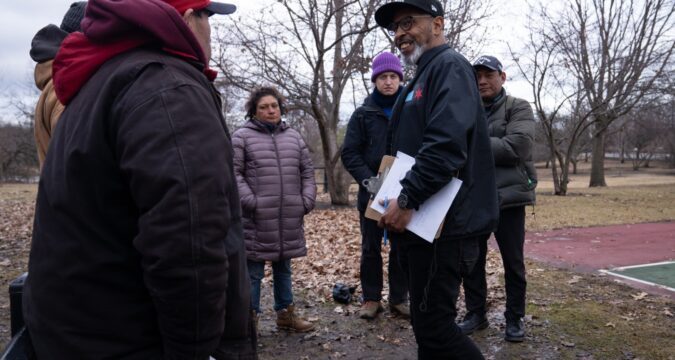
As a Far Northwest Side elected official and former case manager for people experiencing homelessness, I am focused on policies to end homelessness. I fight the uphill battle to maintain the state budget for shelters and housing while simultaneously providing constituent services to unsheltered residents living in area parks — some in tents. Given my own everyday experience, I was struck by the knowledge gaps in the recent editorial “Tent cities don’t belong in Chicago’s parks” (Sept. 14). It’s clear that the Tribune Editorial Board and most Chicagoans have no idea how arduous it is to access “emergency” shelter, often a vital part of someone’s pathway to housing stability.
In order to access shelter in the city of Chicago, one must dial 311. According to the city and state’s own data, when people do just that, they are connected to shelter only 35% of the time. Further, at last year’s Department of Family and Support Services budget hearing, we learned that it takes an average of 21 days for a single adult to access shelter in Chicago. I have since learned it takes an average of 117 days in suburban Cook County and 90 days in DuPage County. All the while, Access Living’s lawsuit against the city for a lack of accessible shelters lingers.
Simply put, it is extremely difficult to access “emergency” shelter in Chicagoland, and the 311 system is broken. My unsheltered constituents must call 311 and wait around for 20 to 30 days to hear back about a bed in a faraway part of the city. They wait in parks, in their cars and in police station lobbies. Far too many are seniors. They often give up.
Can you blame a person for refusing a bed, after a 30-day wait, in a faraway neighborhood?
There are zero shelters for singles on the Far Northwest Side of Chicago. Although shelters are not the sole solution — we need supportive and affordable housing, too, along with robust outreach — shelter remains vital to the service continuum. I’m proud to work with Ald. Ruth Cruz, 30th, on the long-term work to get a first-ever emergency shelter for singles on the Far Northwest Side of Chicago.
I agree that tents don’t belong in parks, but until we have a functioning shelter system serving all parts of Chicago paired with more affordable housing, a call for sweeps with a tone-deafness for service inadequacy will do nothing to decrease homelessness in Chicagoland.
— State Rep. Lindsey LaPointe, D-Chicago
Resources for unhoused
“Shifting the tents from one park to another … doesn’t solve anything.”
We agree with this statement from the Tribune Editorial Board in the Sept. 14 editorial. We also agree that the city should “commit to … permanent housing solutions” and that, as a community, we are able to quickly connect people to housing when the political will and resources exist.
The editorial board, however, does not acknowledge that the city lacks the resources necessary to provide permanent housing at scale for people experiencing homelessness in Chicago’s parks and throughout our city. Suggesting that the Part District evict community members sleeping outside — without sufficient resources to house them — contributes to the pattern of displacing people from one park to the next. This kind of displacement, combined with the Donald Trump administration’s threats to funding and to best practices such as “housing first,” would make our local communities even more hostile to people sleeping outside.
Additionally, the editorial reinforces inaccurate assumptions about unhoused people, such as that their presence inherently creates a risk to public safety. People experiencing homelessness are significantly more likely to be victims of violence than perpetrators and are often seeking safety, community and survival together in parks and under viaducts.
The editorial board and Ald. Samantha Nugent, 39th, also suggest that people aren’t willing to “accept” housing, when the reality is that there simply isn’t enough affordable housing for everyone in need. For every one person who moves into housing, nine more people become newly homeless. Moreover, the short-term housing options often come with a significant set of barriers, with people being asked to relocate to a different part of the city and without their partners, pets, belongings and sense of community.
We seek partnership from elected officials, civic leaders and community members to focus together on the actual solution — housing — and to work with us to generate new, dedicated, sustainable revenue to fund the permanent housing and services our community deserves.
Too often, we focus on the quick fixes to the optics of visible homelessness and not the collaboration needed to truly solve homelessness in a dignified, permanent way.
— Emily Krisciunas, executive director, Chicago Funders Together to End Homelessness, and Doug Schenkelberg, executive director, Chicago Coalition to End Homelessness
Solutions, not cruelty
In 1729, Anglo-Irish satirist Jonathan Swift, author of “Gulliver’s Travels,” wrote a biting satirical essay titled “A Modest Proposal” in which he suggested that a solution to the extreme poverty and overpopulation in Ireland could be solved by selling Irish children to the rich and elites as food. This of course was a provocative satire aimed at the English government and aristocracy, which had created the poverty in the first place.
In contrast to Swift’s satire, Fox News host Brian Kilmeade recently said that the solution to dealing with people who are homeless was “involuntary injection or something. Just kill them.” His co-host Lawrence Jones prefaced Kilmeade’s remarks by suggesting homeless people be “locked in jail.” These notions of incarceration and execution were not satirical but cruel.
I have worked in a homeless shelter and observed people who are homeless in downtown Chicago. They deserve our compassion, not our derision, and we must continue to work to find solutions to this complicated challenge.
— Alan Bergeson, Winfield
This is a Chicago issue
Two years ago, I wrote about the pain of being racially profiled at a downtown checkpoint on Mexican Independence Day. I wondered how, in a city that celebrates its diversity, I could still be treated like an outsider.
Today, as “Operation Midway Blitz” sweeps through Chicago with Immigration and Customs Enforcement agents and the looming threat of the National Guard, that same question has taken on a darker urgency. The U.S. Supreme Court recently ruled that it is permissible to racially profile Latinos in these operations. That ruling is a green light for fear, division and humiliation to spread across our communities.
Chicago has declared itself a sanctuary city. Illinois has declared itself a sanctuary state. Those words matter, but they do not shield us from the weight of federal policies that target and terrorize Latino families. They do not stop ICE from setting up shop in our neighborhoods or erase the threat of a military presence in our streets. Sanctuary without protection is a promise unkept.
While these raids and checkpoints are focused on Latinos today, history tells us the net never stays small. Black Chicagoans know the pain of stop-and-frisk and overpolicing. Muslim and Arab neighbors remember the surveillance and suspicion cast on them after 9/11. Immigrants of every background — from Poland to Pakistan — carry stories of being treated as “less than.”
When profiling is legitimized against one group, the door is opened for it to spread to others. What happens to Latino communities today sets a precedent for how any community can be treated tomorrow. That should alarm all of us.
Chicago’s strength has always been its people — the workers, immigrants, families and dreamers who built this city block by block. We cannot allow federal operations to undo decades of progress by turning neighbor against neighbor or by making children fear their parents might not come home.
We have to stand shoulder to shoulder across communities and refuse to let racial profiling be normalized, whether against Latinos today or another group tomorrow.
I said it two years ago, and I will not stop saying it now:
We are not outsiders.
We are not second-class citizens.
We are Chicagoans.
We are human beings. And we deserve dignity, safety and belonging in the city and country we call home.
This is not just a Latino issue. This is a Chicago issue. This is an American issue. And the only way forward is together.
— Jose M. Muñoz, CEO, La Casa Norte, and co-chair, Illinois Latino Agenda
Submit a letter, of no more than 400 words, to the editor here or email letters@chicagotribune.com.
https://www.chicagotribune.com/2025/09/21/letters-092125-tent-encampments-shelter/