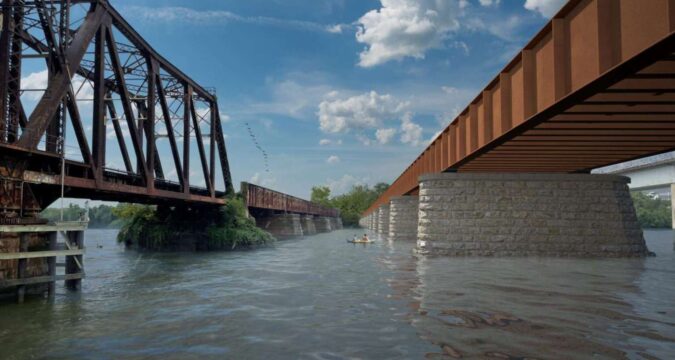
RICHMOND — Virginia is making tracks with the Long Bridge Project, a multi-year initiative that will boost options for train commuters, bicyclists and pedestrians. The Long Bridge Project was created to meet the increasing demand for efficient train travel in the region.
The preexisting Long Bridge is two-tracks that moves cargo and commuters across the Potomac River from Northern Virginia into Washington.
The current two-track bridge carries 80 trains daily and supports 4.5 million Virginia Railway Express (VRE) passengers annually. Work is underway to install a new railroad bridge and a pedestrian bridge adjacent to the existing bridge, according to Dallas Richards, CEO of VRE.
This will double the rail capacity across the river and create a four-track corridor.
“It basically bifurcates that traffic between passenger and freight so that we can have more fluidity, better reliability,” Richards said.
Virginia was the first state to purchase freight rail property to construct its own rail infrastructure, according to the Virginia Passenger Rail Authority. The VPRA was established in 2020 to expand and sustain passenger and commuter rail services in Virginia and offer an alternative to sitting in traffic, according to the organization’s website.
The VPRA administers all capital expansion projects and strategies related to rail transportation construction and provides funding to VRE and Amtrak Virginia.
VPRA ridership has been on the rise, at almost 1.4 million in 2024. The numbers this year have remained strong, and look on track to meet or exceed ridership last year, according to VPRA monthly counts.
“It’s a convenient, efficient way to travel, and we are making it more efficient and more a higher quality ride with these projects,” said Gerica Goodman, VPRA director of external affairs and communications. “It’s only going to get better, and so it’s a really great investment.”
The project budget is estimated at $5.8 billion. The VPRA has set aside over $2 billion so far.
“The idea was to alleviate congestion on our highways and give people more options to travel as Virginia continues to grow across the state,” Goodman said.
There has also been increased freight transportation, according to Goodman. The established separation between freight and riders will benefit both commuters and package transfers, as well as service ports.
Washington, D.C. construction
One of the more recent construction phases involves closure through 2030 of the Maine Avenue SW westbound access road to northbound 14th Street SW. There will be traffic and pedestrian shifts throughout the area.
The VPRA website will have up-to-date information, according to Goodman.
Construction will occur within a limited time frame because of specific noise and construction regulations, according to Richards. Beginning in January, changes will take effect for five hours a day, six days a week.
The last two trains in the morning to Fredericksburg and Manassas will be the only lines terminated during construction.
Although fare expenses and travel time may slightly increase during the service changes, VPRA prioritizes its riders, allowing them to use their SmartBenefits for the VRE and Metro, according to Richards.
“You have somewhere to be in the morning and you have somewhere to be in the evening,” Richards said. “Our goal is to not impact that commute any more than we have to.”
Riverbed work
Geotechnical investigations are underway, with crews conducting construction activities underneath the Potomac’s surface, according to the VPRA. That means there are more barges, workboats and cranes along this stretch of the water.
This is early stage work that provides the foundation for the bridge. Crews are extracting core soil samples, from depths up to 150 feet, to determine how the bridge foundation will be installed.
The Potomac Riverbed is part of the Mid-Atlantic Coastal Plain, marked by a lot of clay, silt, sand and rock.
Outreach team
An outreach team shares project updates, receives feedback and connects with the community in Southwest neighborhoods, keeping people engaged and up-to-date during the construction phases.
Outreach events and activities began in July and are continuing through October. The group attends the Southwest Farmers Market that runs 9 a.m. to 1 p.m. every Sunday
Goodman said communication is essential during this time. The authority has a service guide on its website explaining the changes. To effectively coordinate information to the community, VPRA has established the Community Advisory Groups for the Washington, D.C. and Arlington areas.
The advisory groups will work alongside the project’s outreach team to ensure the community’s voices are heard.
Project benefits
Virginia is a key connector to the Southeast, which makes it essential in rail transportation planning, according to Goodman. Every $1 invested into rail infrastructure returns approximately $4 in economic benefits, according to the Long Bridge newsletter.
“It really unlocks the ability to add more service up and down the East Coast,” Goodman said. “That additional capacity and that additional service provides so much opportunity to be able to do additional connections.”
Vienna resident Pat Slaughter pays tolls that range from $10 to $40 twice a day, on their work commute. Despite the high toll costs, traffic continues to increase.
Transportation options could offer both accessibility and developmental possibilities, Slaughter said.
“There’s more of a likely scenario too where increased transportation opportunities on the fringes of D.C. will help development in those areas,” Slaughter said. “If you can get into town quicker but live further away, I think that that is always going to be interesting to people.”
Capital News Service is a program of Virginia Commonwealth University’s Robertson School of Communication. Students in the program provide state government coverage for a variety of media outlets in Virginia.