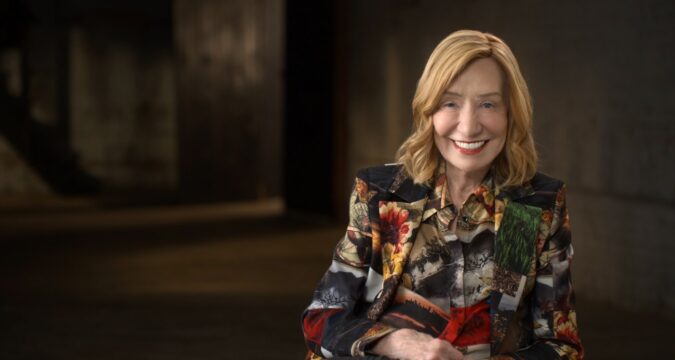
The thing about Doris Kearns Goodwin is: She’s cool.
Maybe not red-carpet, TikTok kind of cool. But historically speaking, as one of America’s foremost historians, she is her own kind of cool. The kind of cool that sold out the Broward Center’s Au-Rene Theater a few years ago. The kind that plays herself as Lisa’s teacher on “The Simpsons,” and a historian on “American Horror Story.” The kind that makes movies with Steven Spielberg and Kevin Costner, and gets Bryan Cranston to narrate her audiobooks. The kind that shows up on late-night talk shows and speaks with affable authority in rapid-fire raps that invariably leave you rapt — about, of all things, history.
The kind that, simply by association, makes history cool.
Since her literary debut with 1977’s “Lyndon Johnson and the American Dream,” the secret sauce to Goodwin’s cool has been her talent for illuminating American presidents with such intense intimacy that she’s wont to refer to them as “my guys.” In her eight books probing presidencies, Goodwin’s magnetic storytelling doesn’t just put us in the room with the men ensconced in the seat of American power — she sits us right down there next to them.
Richard Goodwin and Doris Kearns Goodwin in 2015.
Last year, however, the Pulitzer Prize-winning author’s literary focus took a panoramic selfie. Her historical memoir, “An Unfinished Love Story: A Personal History of the 1960s,” frames her poignant love affair with late husband Richard Goodwin against a backdrop of the pivotal decade. Dick, who succumbed to cancer in 2018, was a presidential speechwriter and advisor who Goodwin likens to the Zelig of the era, continually entrenched at the nexus of its consequential characters and moments.
The best-seller emotionally etches what became the denouement of his life — the couple’s excavation of his personal “time capsule,” a collection of 300-plus boxes of memorabilia and documents he’d saved for more than 50 years. The book is being developed into a feature film by a team including Tom Hanks and Goodwin’s own Pastimes Productions, the independent film and television production company that has opened new, collaborative avenues for Goodwin’s love of history. Beginning with 2020’s docuseries on Washington, the company she co-founded with producer Beth Laski has also produced documentaries for The History Channel on Lincoln, Theodore Roosevelt and FDR, as well as this year’s Kevin Costner’s “The West.”
Of course, Pastimes is not the author’s first foray into film. Lincoln, Spielberg’s 2012 adaptation of her “Team of Rivals,” was nominated for 12 Oscars — winning Best Actor for Daniel Day-Lewis’s portrayal of the embattled president.
Goodwin, who turns 83 in January, will appear at Festival of the Arts Boca on March 2, as part of its Authors & Ideas program. She will speak on the suddenly timely topic of “The Enduring Significance of the American Revolution.”
“Actually, the first year I came down there to give a talk,” she says, “I loved it so much that my husband and I went down there year after year after year and stayed right in Mizner Park for a couple months in the winter. So it had a big effect on me, that festival did.”
Doris Kearns Goodwin has had a big effect on the festival as well. This will be her eighth appearance since that first one in 2008. In heralding the occasion with this exclusive interview, the always engaging historian adds a distinguished grace note to the retrospective tone of City & Shore magazine’s 25th Anniversary Issue.
She also makes it kind of cool.
Doris Kearns whispering to President Johnson during a White House Fellows event organized in 1968.
As we look back over 25 years of City & Shore, what do you believe will be viewed as the historic hallmark of our country during that time?
It’s such a great question and I can’t really pick one. First, OK, it’s 9/11. Then I think of the COVID pandemic. Then the financial crisis. Then the storming of the Capitol. Then there’s also great things that happened — the legalization of same-sex marriage and that night in Grant Park with Barack Obama and the COVID vaccine showing great medical breakthroughs. So I really couldn’t decide if somebody forced me on a platform to say which one. I’d say 9/11, the COVID pandemic, and the storming of the Capitol are the three central events that stand out in terms of the impact on the country.
First responders work at ground zero after the Sept.11 attacks, Sept. 12, 2001, in New York City.
What was the most unforgettable experience of your life in those 25 years?
Really, it would be 9/11 for the following reason. My son, Joey, had just graduated from Harvard College in June of 2001 with no thought of the Army. He was going to work for a year and then go to law school. Once 9/11 happened, he joined the Army. So it had a huge impact on our family. He was inspired to enlist because he thought the country needed young people. He felt he’d had so many advantages in the family and community he grew up in, in Concord, Massachusetts, that he wanted to give back to the country.
So he found himself in Baghdad, where he spent 13 months in combat duty as a platoon leader in the 1st Armored Division. He would say later it was probably the thing he would feel prouder of than anything else — bringing a team of people from all different classes and parts of the country together in a common mission. He earned a Bronze Star from that duty.
Then he came home and was working for NBC Universal in New York City, when he was called back to the Army — this time as a captain — and sent to Afghanistan in 2008. That was harder in some ways. Once you know what life in the Army is like, and all the sadness and horrors of it, you know what you’re getting into. But he was assigned as an advisor to the director of Strategic Communications, and his job was to go to various parts of the country where collateral damage had happened, and deal with the villagers and the people there. So it was equally hard from a different point of view.
Anyway, he finally came out and went to law school. But for us, obviously, it was a time of great worry, because they didn’t have the communication we have now. So we relied on old-fashioned letters. It was so exciting when letters would come back and forth. I felt like I was back in my own historic study, where letters and diaries meant so much.
Richard and Doris Goodwin at their wedding in 1975.
I would have guessed your most unforgettable experience was discovering and exploring Dick’s ‘time capsule.’
You’re right. That took place in those 25 years, too. That exploration of the boxes led to my husband’s sense of fulfillment looking back at the ’60s before he died — remembering that it had been marked by great impact in a positive way, with people feeling a great sense of mission from the Peace Corps to the Great Society to civil rights and to women’s rights. It was a sense really that the country was moving forward.
That gave him a real solace and purpose in those last years of his life. He just kept wanting to work on the boxes, so that even in that last year, when he had cancer, he would wake up in the morning and say, ‘OK, let’s get to the boxes.’ So I think you picked something that’s right.
For all those years I spent writing about presidents no longer alive, now I was able to bring my husband hopefully back to life. I certainly was worried about it at the beginning that it would make me too sad. But in the end, it really gave me a great sense of fulfillment. So that’s a really interesting way you just bookended the beginning of the 25 years and the ending of the 25 years — both had a deep personal impact on me.
How have you taken to being an executive producer of documentaries? And if you had to choose: producing or writing?
Beth and I formed a production company called Pastimes and then The History Channel asked us about working on a documentary on George Washington. There was a sense of loneliness because Dick was my partner in writing — and writing is in general, anyways, a solitary endeavor. Whereas working on these films is a much more collective experience, a camaraderie. I realized that I’d always wanted to write about Washington, but I knew that at this stage of my life — since it often takes me 10 years to write a book — it might not be the most realistic thing to think I could start on George when so many other people had written about him. It took me longer to write about Lincoln in the Civil War and Franklin in World War II than those wars to be fought.
The great thing was that we were working with an entire team at several production companies for different projects. It was just an exciting way to tell a story and learn new things. It was done in two years, as a result of having this entire team — even though the process was much like writing in some ways, with primary sources, letters and diaries being the favorite things to use. But this time I got to stand on the shoulders of all my fellow historians who are the experts in the documentary, who’d spent their careers studying Washington and could tell their stories.
I hope I don’t have to ever make a choice between writing. I’m working on a new book on Teddy Roosevelt during the Gilded Age and his relationship with the titans of the time. The 20th century is so like our time right now that I feel like sometimes I’m living in the present as well as the past.
President Franklin D. Roosevelt, taking members of the press on a tour of his country home at Hyde Park, NY on July 4, 1937.
Which brings me to my next question: Has our country in peacetime ever been faced with the severity of the challenges it’s facing now?
We know we’re living in a really rough time, but what you know from history is that we’ve lived through very rough times before, and that somehow we got through them and emerged with greater strength. That’s why it’s so important to remember history. Because the people living at the time, say, of the Great Depression, they didn’t know how it was going to end. They lived with the same anxiety we live with now. They didn’t know that the Depression would come to an end with the mobilization of the war.
Somebody said to Franklin Roosevelt right before the inauguration: ‘You know, if your program works, you’ll be one of the great presidents. If it fails, you’ll be one of the worst.’ He said, ‘No, I’ll be the last American president.’ That’s how fragile democracy was, you know, with one out of four people out of work and no safety net and the financial system collapsing and starving people in the streets. Yet somehow he was able to get people back to work and make government work again on their behalf.
That’s what’s so important about knowing history, and it’s so heartbreaking to feel that it’s being diminished. It gives you that sense of perspective you can’t get without looking at the lessons we can learn from it. Or most importantly, it gives you hope that we can get through this tough time because our ancestors got through their tough times.
But it’s also different with the whole media operation today. At least before, even though opinions might be different, the facts were the same so people were arguing from the same foundation. One of the things Teddy Roosevelt warned against was that if people in different sections or classes begin regarding each other as the other rather than as common American citizens, that’s when democracy is in peril. There are new elements to this crisis, but it’s not unusual that each one has a different way of thinking about it. But then there are also ways to think about getting around that. We know we’ve done that before. History does give us that comfort. That’s why I love it so much.
Abraham Lincoln, the 16th president of the United States, was born in 1809 in present-day LaRue County, Ky.
Which of our presidents would be the one to lead us through today’s crises?
This is hard. I feel like if I choose one, it’s like choosing a boyfriend over the others — like the others will be mad at me because I didn’t think of them. I guess in the end there’s no question that Lincoln is the person. It’s not just what he did, but who he was. If we want an example of somebody to lead us through, of the need for reconciliation in our polarized country today, look at what he was able to do just as the war was coming to an end. It was a great rush for prosecuting the Confederate generals and officers and putting them on trial and having them hang as retribution and vindictiveness. He said no more bloody work. I don’t want any retribution. I just want to move forward. Then, of course, there’s the second inaugural address: ‘With malice toward none and charity for all, let us bind up the nation’s wounds.’
When I first was thinking about writing the Lincoln book, I went to see the great Lincoln scholar from Harvard. His name was David Donald, and he lived in Lincoln, Mass., on Lincoln Road, bizarrely. I said to him, it was just scary because there were 16,000 books already written about him. And he said, it doesn’t matter. He said, you will find yourself by living with Lincoln that you feel like you’re a better person at the end of the process. And that’s absolutely true. You just feel like he had all the normal human emotions we have of anger, envy and jealousy, but he knew that if you allow those emotions to fester, they’d poison you. So I told the same thing to Steven Spielberg and Daniel Day-Lewis when they started doing ‘Lincoln.’ Both of them felt the same way as I did — that somehow you are a better person living in his presence.
President Theodore Roosevelt
But also Teddy Roosevelt was able to knit that country divided between country and city and East and West back together again during the 20th century by taking a whistle-stop train around the country with the same message of a square deal for the rich and the poor, the capitalist and the laborer. So that would have some relevance today. Franklin Roosevelt’s ability to just make people feel that he was their friend through those Fireside Chats. His communication ability was perhaps the best of them all in terms of making people feel he was talking directly to them. There’s a story of a construction worker hurrying home one night and his partner said, ‘Where are you going?’ He said, ‘Well, my president, he’s coming to speak to me in my living room tonight. It’s only right that I’d be there to greet him when he comes.’
Then if you want somebody to get Congress working again, it would be Lyndon Johnson. He’d keep them in the White House and not let them leave before they came up with a solution to the problem of the government shutdown, probably. But he was brilliant at bringing Republicans and Democrats together for civil rights and voting rights and Medicare and aid to education and immigration reform and NPR and PBS and so much else.
So maybe the presidents could all come together and do their specific thing.
Yes, it sounds like a composite. But as for this current presidency, is it too soon to predict how history will view it?
President Dwight D. Eisenhower
Particularly because the passions and the partisanship are so extreme right now, it’s going to take some time for historians to judge more dispassionately what we’ve gone through in these last years. It sometimes takes at least a half-century to see a presidency in full. Truman’s presidency was so deeply unpopular when he left office in 1953. Then by the 1980s, he was viewed as one of the near-great presidents for his vision in the Cold War and his domestic accomplishments. Eisenhower was dismissed as passive in the 1960s. But once you get the behind-the-scenes understanding through memoirs and documents and presidential papers, it was clear that he was much more actively involved in leadership than we knew at the time.
Especially with all the emotions that are so strong right now, there’ve been tons of books already on President Trump. But the kind of historic look at him backward, I think, will take a period of time.