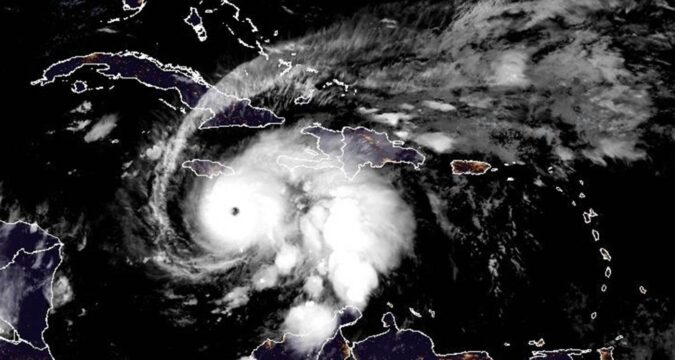
Hurricane Melissa on Sunday intensified into a Category 4 storm dropping torrents of “catastrophic” rain across the Caribbean with the National Hurricane Center now forecasting it to become a Category 5 hurricane before it makes landfall on Jamaica this week.
As of the NHC’s 8 a.m. advisory, Melissa had maximum sustained winds of 140 mph located about 120 miles south-southeast of Kingston, Jamaica and 280 miles south-southwest of Guantanamo, Cuba moving west at 5 mph.
“I urge Jamaicans to take this weather threat seriously,” said Jamaican Prime Minister Andrew Holness. “Take all measures to protect yourself.”
The system could drop 15-30 more inches by Wednesday with some areas getting as much as 40 inches on both Jamaica and southern Hispaniola.
Hurricane Melissa forecast path as of 8 a.m. Sunday, Oct. 26, 2025. (NHC)
A hurricane warning was in place for Jamaica, hurricane watch and tropical storm warning for southwestern Haiti and a hurricane watch for the Cuban provinces of Granma, Santiago de Cuba, Guantanamo and Holguin.
Cuba is forecast to get from 6-12 inches of rain with some areas getting as much as 18 inches into Wednesday, the NHC stated, but that is expected to increase as the storm gets closer.
“A slow westward motion is expected today, followed by a turn to the north and northeast on Monday and Tuesday,” said NHC senior hurricane specialist Philippe Papin. “On the forecast track, the center of Melissa is expected to move near or over Jamaica through Tuesday, across southeastern Cuba Tuesday night, and across the southeastern Bahamas on Wednesday.”
Hurricane-force winds extend outward up to 25 miles and tropical-storm-force winds extend outward up to 175 miles.
“Further rapid intensification is expected through tonight, followed by fluctuations in intensity. Melissa is expected to be a major hurricane when making landfall in Jamaica Monday night or Tuesday morning and southeastern Cuba late Tuesday,” Papin said.
The system became a hurricane on Saturday afternoon and quickly grew in strength to a major hurricane by Saturday night, and has intensified more than 50 mph in less than 24 hours.
Jamaica will bear the brunt of the storm’s wrath for the next two days.
“Damaging winds and heavy rainfall today and on Monday will cause catastrophic and life-threatening flash flooding and numerous landslides before the strongest winds arrive Monday night and Tuesday morning,” Papin said. “Extensive infrastructural damage, long-duration power and communication outages, and isolation of communities are expected. Life-threatening storm surge is likely along portions of the southern coast Monday night and Tuesday morning.”
The rain for the system has already caused deadly flooding and landslides in Haiti and the Dominican Republic with more heavy rainfall expected through midweek.
Melissa’s next target will be eastern Cuba, the southeast Bahamas and the Turks and Caicos with winds, rain and storm surge a threat. In eastern Cuba, the risk of flooding and landslides will increase as well.
The erratic and slow-moving storm has killed at least three people in Haiti and a fourth person in the Dominican Republic, where another person remains missing.
“Unfortunately for places along the projected path of this storm, it is increasingly dire,” said NHC deputy directory Jamie Rhome on Saturday.
Hurricane Melissa has rapidly intensified into a major, Category 3 storm.
Strengthening is expected to continue overnight. pic.twitter.com/CbuAg6c1qx
— CIRA (@CIRA_CSU) October 26, 2025
Authorities in Jamaica said on Saturday that the Norman Manley International Airport in Kingston will be closed at 8 p.m. local time. It did not say whether it will close the Sangster airport in Montego Bay, on the western side of the island.
More than 650 shelters were activated in Jamaica. Officials said warehouses across the island were well-stocked and thousands of food packages prepositioned for quick distribution if needed.
Haitian authorities said three people had died as a consequence of the hurricane and another five were injured due to a collapsed wall. There were also reports of rising river levels, flooding and a bridge destroyed due to breached riverbanks in Sainte-Suzanne, in the northeast.
“The storm is causing a lot of concern with the way it’s moving,” said Ronald Délice, a Haitian department director of civil protection, as local authorities organized lines to distribute food kits. Many residents are still reluctant to leave their homes.
The storm has damaged nearly 200 homes in the Dominican Republic and knocked out water supply systems, affecting more than half a million customers. It also downed trees and traffic lights, unleashed a couple of small landslides and left more than two dozen communities isolated by floodwaters.
The Bahamas Department of Meteorology said Melissa could bring tropical storm or hurricane conditions to islands in the Southeast and Central Bahamas and the Turks and Caicos Islands by early next week.
Map: Where will Hurricane Melissa hit? Here’s the latest
Melissa, which formed Tuesday, became the 13th tropical cyclone of the season.
The U.S. National Oceanic and Atmospheric Administration had predicted an above-normal season with 13 to 18 named storms.
Five now have grown into hurricanes with four becoming major storms. Only one, Tropical Storm Chantal, made a U.S. landfall this year.
Hurricane season runs from June 1-Nov. 30.
The Associated Press contributed to this report.