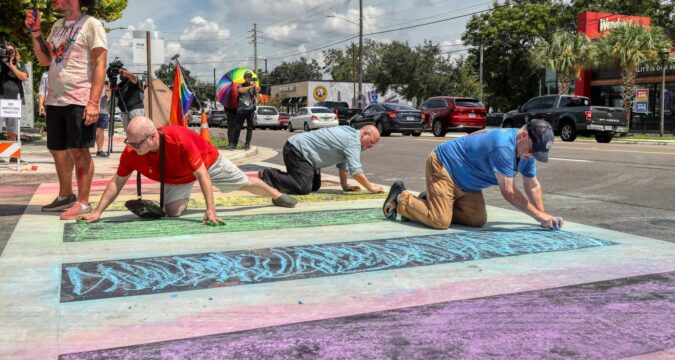
Marking the first amid ongoing tensions, a 29-year-old man was arrested for protesting the removal of the rainbow crosswalk at Pulse.
Orestes Sebastian Suarez was arrested Friday night by Florida Highway Patrol and charged with criminal mischief and defacing a traffic control device, court records show.
Suarez, who was celebrating his birthday, colored the bottom of his shoes with chalk and walked across the crosswalk, according to court records.
FHP and Orlando Police Department have been heavily patrolling the area for over a week, telling protesters they won’t be arrested if they are not impeding traffic. Protests erupted after the Florida Department of Transportation in the middle of the night painted over the rainbow crosswalk, meant to memorialize the 2016 mass shooting at Pulse that killed 49. Since then the department has had to repaint it at least once more due to ongoing protestors painting the crosswalk with rainbow paint and chalk.
Suarez was released on Saturday after the judge found no probable cause he committed the crime, records indicate.
Suarez’s attorney Blake Simons called his release a “victory” in a post to Facebook on Saturday.
“The attempt by Governor Ron DeSantis and the Florida Highway Patrol to infringe on our right to free speech and their attempt to conduct unlawful arrests has been thwarted,” Simons said. “The question now is whether FHP decides to continue with the unlawful arrests and thereby waste taxpayer money … or move on.”
FDOT has ordered other cities to remove rainbows and other painted designs from their roads.
DeSantis has defended the state’s actions, saying it’s not political and cited a new state law — a claim lawmakers refute — and the designs “jeopardize both driver and pedestrian safety.”
But an Orlando Sentinel analysis of city traffic data shows the opposite. The city’s many decorative crosswalks and murals in Downtown Orlando, including the crosswalk by Pulse, have helped reduce crashes with pedestrians despite increased foot traffic.
In a statement, FDOT said it conducted a “months-long” update of the Manual on Uniform Traffic Control Devices with input from representatives of state and local governments. The update included a prohibition on “non-uniform” traffic control devices and explicitly “prohibits the application of pavement or surface art on travel lanes, paved shoulders, intersections, crosswalks or sidewalks.”