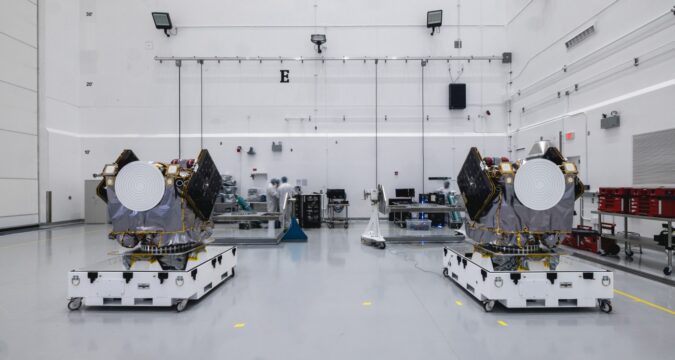
A pair of Mars-bound satellites are back at Kennedy Space Center a year after NASA bowed out of its chance to be part of the debut launch of Blue Origin’s New Glenn.
The satellites for the Escape and Plasma Acceleration and Dynamics Explorers (ESCAPADE) mission, constructed by Rocket Lab, look to fly on what would be New Glenn’s second ever mission.
The two small satellites, dubbed Blue and Gold, were built by Rocket Lab in California for NASA and the University of California Berkeley’s Space Science Laboratory.
“It’s been a long road, but we are so excited to be launching Blue & Gold on their mission to understand the Martian space weather environment.” said Rob Lillis, the mission’s principal investigator and associate director for planetary science at the UC Berkeley Space Sciences Laboratory. “Through the usual ups and downs, Rocket Lab has been right alongside NASA and UC Berkeley, supporting us every step of the way on this interplanetary journey.”
The mission’s purpose is to orbit Mars and observe plasma and magnetic fields around the planet to help understand what processes strip atoms from Mars’ magnetosphere and upper atmosphere. That could help explain why Mars’ atmosphere is so thin, and how it may have evolved over time.
They are now sitting at a cleanroom for post-transport inspections and tests before proceeding to fueling and being encapsulated for launch on New Glenn from Blue Origin’s pad at Cape Canaveral Space Force Station’s Launch Complex 36.
Jeff Bezos’ company was awarded a $20 million task order to launch the mission. If successful, Blue Origin could be in line to be certified for national security launches by the Space Force, which requires two complete missions before it gets the green light to compete for the lucrative Department of Defense contracts.
New Glenn has plenty of other launches lined up, though, including future missions with both uncrewed and crewed versions of its Blue Moon lunar lander. NASA recently awarded the company a second Commercial Lunar Payload Services task order to get the resurrected VIPER ice-hunting rover to the lunar surface.
NASA is also relying on Blue Moon to be the second of the Artemis program’s two lunar human landing systems.
The first New Glenn launched this past January several months after Blue Origin’s original target liftoff plan. Because of concerns that New Glenn would not be ready by what was supposed to be a fall 2024 launch, NASA opted to hold off the ESCAPADE mission to ensure money would not be wasted on fueling the two satellites.
Rocket Lab won the design subcontract for the two satellites, using the company’s Photon spacecraft, in 2021 as part of NASA’s Small Innovative Missions for Planetary Exploration (SIMPLEx) program with NASA’s Science Mission Directorate, which aims to bring high-value planetary science at lower costs on faster timelines.
Rocket Lab constructed the two satellites in 3 1/2 years.
The company is better known for its small launch vehicle activity, second to only SpaceX in recent years for number of launches, mostly from New Zealand from whence its founder and CEO Peter Beck hails.
“ESCAPADE is a perfect example of why Rocket Lab exists – to make ambitious space science faster and more affordable,” Beck said. “Delivering two interplanetary spacecraft on schedule and within budget for a Mars mission is no small feat, and it speaks to the determination and agility of our team.”
The plan is for the dual satellites to make a 22-month transit to the Red Planet and enter complementary elliptical orbits for the one-year planetary science mission. The delay in launch from last year has meant its arrival to Mars won’t come until 2027, two years later than planned.
Beck said it won’t be his company’s last foray into Mars missions noting work on the forthcoming Mars Telecommunications Orbiter.
“We’re laying the groundwork for more complex, capable, and essential missions that will support future human exploration,” he said.