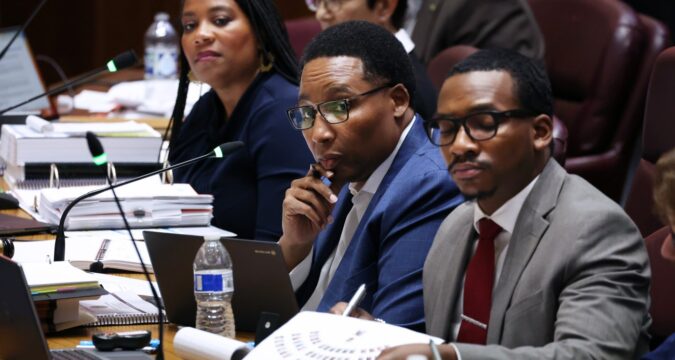
Mayor Brandon Johnson finds himself in an unexpected fight as he works to rally at least 26 votes to pass his $16 billion 2026 spending plan.
Though aldermen have agreed in every Chicago budget for the past decade to pull money out of tax increment financing districts around the city, both allies and opponents of the mayor on the City Council are voicing serious reservations about the bulk and breadth of this year’s deficit-plugging standby.
The mayor’s proposal to sweep a record $1 billion out of the city’s TIF piggy banks has even drawn criticism from Ald. Jason Ervin, the mayor’s hand-picked budget shepherd, Ald. Michelle Harris, his Rules Committee chair, and Ald. Walter “Red” Burnett, his latest appointee to the council.
The sum is nearly double what the city surplused last year and would hit 68 of the city’s 108 TIF districts, according to projections provided to aldermen.
By Ervin’s estimate, more than half of the dollars would come out of “socially, economically disadvantaged areas,” and potentially delay much-needed improvements in those TIF districts. He cast it as yet another example in a long history of the South and West sides getting short shrift.
To delay projects “for other communities that are not putting in their total share, in my opinion, is having the residents of the South and West sides ultimately have to bail out CPS when other communities are not having to pay that burden,” Ervin said immediately after Johnson introduced his budget.
When the mayor touted the TIF surplus in his 2026 budget speech to aldermen, he could hardly have predicted it would turn into a racially charged front on which he would need to try to convince them to support him.
Johnson has echoed decadeslong criticism of TIFs as an inequitable development policy that traps dollars inside already-wealthy areas and prevents other taxing bodies such as CPS from accessing the broadest tax base possible. When he convinced aldermen in fall 2024 to back his bonding plan that was funded by allowing some TIF districts to expire and recouping the money in them, he said “too many communities on the South and West sides in particular have not benefited from the prosperity of our tremendous city.”
In his budget speech, Johnson said this year’s surplus maneuver was designed to protect special education teachers and the city’s youth “from the Trump administration’s attempts to dismantle and privatize our public education system,” to help restore funding for CPS’ Black student success plan, and to make sure the district’s lowest-paid workers receive their pensions.
Mayor Brandon Johnson delivers his budget address to the City Council on Oct. 16, 2025, at City Hall. (Brian Cassella/Chicago Tribune)
And administration officials said such a hefty surplus would be a major relief for other local governments being hit by federal cuts, who are entitled to a proportional split from the surplus under law.
An estimated $552 million would go to CPS (plus another $20.6 million for its building improvement fund), $233 million to the city’s corporate fund, and $18.6 million for the Chicago Public Library system. On Tuesday, Ervin demanded to see “plans for these dollars” from CPS and the other taxing bodies. Ald. Lamont Robinson, 4th, asked for the same.
In recent Chicago history, elected officials have seen dipping into the huge sums of property tax money in the development districts as a path of least resistance to fill major budget gaps. Though fiscal watchdogs and ratings agencies tend to criticize City Hall for relying on the short-term fix, mayors and aldermen often prefer their scolding to anger from voters over tax increases or pushback from powerful public sector unions over layoffs.
And progressives in particular have long derided TIF districts as mayoral slush funds, so Johnson had reason to believe his base would largely back the idea for 2026.
Broader council politics also made the decision a no-brainer: surplus money mostly came from districts that were already flush and guaranteed to fill up again quickly when people paid their next property tax bills. As property values grow inside the boundaries of a TIF district, more tax dollars are sequestered in the TIF.
The booming districts in and around downtown usually paid out the most. Smaller, less prosperous districts got to keep growing uninterrupted.
But next year’s billion dollar figure means in addition to those downtown areas, dozens more districts well outside the Loop will get partially drained, some for the first time.
Among them: the Midwest and Northwest Industrial Corridor districts that blanket part of Ervin’s ward. Johnson’s budget calls for surplusing $36 and $26 million from each, respectively. $125 million would come from the Pilsen Industrial Corridor TIF on the Southwest Side. $27 million would come from the 47th/King TIF in Finance Chair Pat Dowell’s Near South Side ward. $5.4 million would come from the 87th/Cottage Grove TIF in Harris’ ward.
The city has a surplus policy that mandates sweeping out all balances above $2.5 million that are not already dedicated to a project. Some districts are exempt, such as the city’s two transit TIFs, new districts created in the past two years, or TIFs created for a specific project.
Like the city, CPS would use the funds to plug their own budget this year. The district also pledged to pay the city back for a portion of a $175 million pension payment the city picked up.
That payback will close the city’s deficit for the rest of this year. Without it, the city would end 2025 with “very little” in one of its key reserve funds, Budget Director Annette Guzman told aldermen this week.
The city’s 2026 budget doesn’t count on any pension payback from CPS.
One after another on Tuesday, aldermen expressed reservations that hoped-for projects to eliminate blight or otherwise spiff up their neighborhoods would be delayed or abandoned. Ald. Monique Scott, 24th, said members of the City Council would be like “crabs in a barrel,” fighting for what dollars were left. Ald. Nicole Lee said she was “shocked” at the overall figure and that she was put off that Johnson’s administration did not discuss its plans with aldermen beforehand.
TIF dollars typically fund everything from smaller roadwork to park and school improvements and large-scale bridge replacements and affordable housing projects. Most are split between several wards and subject to review processes across city departments, but those projects are one way aldermen can claim they’re bringing home the proverbial bacon from City Hall.
Guzman assured aldermen that TIFs at large were performing so well that the funds would be quickly replenished. $523 million would still be left after this proposed surplus, then filled back up with an estimated $1.3 billion by the end of next year, she said. Later in the day, Ervin said he was relieved to see his projects still in place as part of the city’s 10-year plans.
Projects that were “sort of ideas not fully formed” or “no longer viable” were nixed, Guzman said.
Those half-baked ideas — not yet approved by city agencies or on the paperwork runway — seemed to be the biggest worry to aldermen.
At the defunct site of the Lincoln Yards development on the North Side, long-awaited construction that is supposed to finally kick off under new ownership could “take a potential hit,” Ald. Scott Waguespack, 32nd, told the Tribune. The controversial “mega-TIF” encompassing the site, which Waguespack opposed at its founding, will see nearly $34 million go back to taxing bodies under the mayor’s plan.
Ald. Scott Waguespack, 32nd, talks with a reporter Oct. 16, 2025, outside City Council chambers after Mayor Brandon Johnson delivered his budget address at City Hall. (Brian Cassella/Chicago Tribune)
The property’s former owners were on the hook for vast infrastructure upgrades. They would get paid back for city-approved projects with TIF dollars. The team behind “Foundry Park,” due to replace Lincoln Yards, will need to strike a new city agreement to take over and potentially put together new TIF spending plans, which they have hinted would be far more modest.
Waguespack has said it presented an opportunity to “reset” how the site will look, but he worries the loss of TIF funding to balance the budget will cause the site to sit vacant longer. The district’s proposed 10-year plan calls for the realignment of Elston Avenue and roadwork on Wabansia Avenuev to kick off in 2027.
“This administration is making arbitrary decisions without consulting aldermen,” Waguespack said.
“Most of them don’t know what’s going on. And just making decisions that are not based on discussions with aldermen who’ve been working on some of these projects for years is just wrongheaded, and it’s going to lead to serious problems.”
Waguespack argued it should not be difficult for Johnson’s team to sort out which projects matter most to aldermen and make adjustments. But if they don’t, their current plan will have lasting effects both in neighborhoods and inside City Hall, he predicted.
“The consequence is holding up affordable housing, it’s holding up necessary infrastructure, it’s breaking down what’s left of some of the relationships with the City Council members,” Waguespack said.
Chicago Ald. Walter “Red” Burnett, 27th, asks a question during a City Council budget hearing Oct. 21, 2025. (Terrence Antonio James/Chicago Tribune)
Burnett, a Johnson appointee who joined the City Council last month, leads the ward with some of the city’s richest TIF districts: Kinzie Industrial, Near North, Central West and River West, which combined started 2025 with a balance of $667 million.
For red-hot TIFs such as Kinzie, the money lost to the planned mega-surplus would quickly replenish, he told the Tribune. But for slower-growing funds serving other neighborhoods, the big sweep could handicap his ability to plan out future developments by snagging money that will not simply reappear, he added.
He worries the $126 million taken from the Near North TIF will make it harder to support development in Cabrini Green. Around the United Center, where the Wirtz and Reinsdorf families are planning a $7 billion mixed-use development, the $23.7 million sweep of Central West may take money that could have helped fund a new CTA Pink Line station near the arena.
“It wasn’t confirmed yet, so it’s not on the docket,” Burnett said.
“If we completely sweep those TIF dollars, are we really preparing for the influx of people who are going to be in this new neighborhood?” he asked.
Burnett also criticized the size of the sweep as a short-term solution to a budget in need of structural changes.
But as with any budget give-and-take, aldermen opposed to Johnson’s plan to use the TIF dollars will need to come up with an alternative.
Ald. Byron Sigcho Lopez reminded his colleagues that 27 had signed on to a letter promising to support a surplus “to help balance both the city and CPS budget” earlier this year.
“I fully support for us to make those commitments, especially those that signed the letter,” Sigcho Lopez said Tuesday during a budget hearing.
“I know in my ward, there’s a surplus of $125 million. … Even though some of the proposals we’ve had have not come to fruition, I support us being responsible in what we commit.”
The Chicago Teachers Union celebrated the surplus. Pavlyn Jankov, CTU’s research director, told the Tribune the infusion would help prevent mid-year cuts at schools while stabilizing the city’s parks and library systems after the loss of pandemic relief and frozen funds from the Trump administration.
But he acknowledged record surpluses can’t last forever. TIFs can see values drop during recessions or when real estate bubbles pop, a key reason why they are not considered a stable, or “structural” source of revenue by fiscal watchdogs. CTU, like the mayor, are among critics that note TIF dollars are over-concentrated in wealthy areas and would be better spent on citywide initiatives such as the mayor’s Housing and Economic Development bond.
Jankov said the union views recent surpluses as a bridge until adequate state funding comes through.
“There’s a reason why that magnitude is needed, and it’s because of the gap that the state has created,” he said. “The city is making every effort to fill the gap when the state is falling even further behind.”