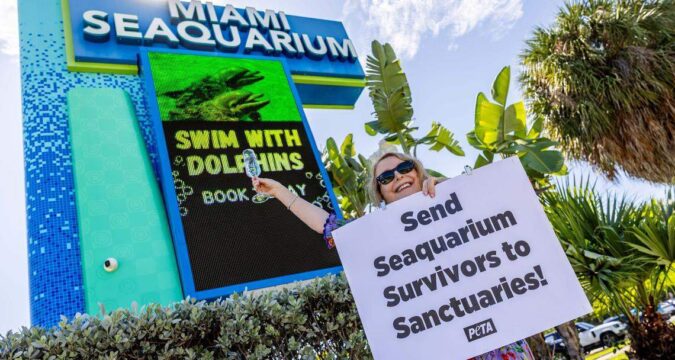
A steady stream of families made their way to Miami Seaquarium on Sunday, eager to help close the marine theme park’s final chapter.
But as cars streamed into the park’s entrance off the Rickenbacker Causeway, many visitors were met by protesters urging them not to spend another dime at the faded South Florida tourist attraction.
Sunday marked the end of the Seaquarium’s 70 years on Virginia Key, where it opened on Sept. 24, 1955. Plans for the waterfront site’s redevelopment are already under way with a $22.5 million investment for a county lease.
The marine theme park’s storied legacy has been clouded by accusations of animal mistreatment and an eventual eviction notice.
Still, for many South Floridians who grew up visiting the Miami landmark, its closure was bittersweet.
Flipper, a TV series filmed at the Miami Seaquarium, aired 88 episodes on NBC from 1964 to 1967. The show followed two hit films — Flipper starring Chuck Connors and Flipper’s New Adventure.
Following the show’s success, the Seaquarium introduced two orca whales: Hugo in 1968 and Lolita (also known as Tokitae or Toki) in 1970. Lolita became the park’s main attraction, while Hugo died in 1980 from a brain aneurysm, possibly from the years of ramming his head into the tank known as the Whale Bowl. He was quietly disposed of, and Lolita lived alone for the next 43 years, continuing to perform.
Lolita died on Aug. 18, 2023.
Warm memories
Karen Slusser teared up as she spoke of how Sunday would be her last visit to the Seaquarium.
Raised in Key Biscayne, where her mother worked at an environmental center, Slusser now lives in Cooper City in Broward County and made the trip to Miami with her adult children, who were also raised visiting the park.
“I was like, we’ve got to do it. We’ve got to do it one last time,” she said, ready to capture the moment with photos of her family.
She recalled a story about her friend, Dennis Elster, who once managed the aquarium. While cleaning the killer whale tank, the famous orca Lolita grabbed his wetsuit, which “snapped like a rubber band,” she said with a laugh.
For Slusser, the Seaquarium holds countless memories — from watching killer whales drench the audience during their shows to seeing nurse sharks and manatees being fed. Those moments, she said, will always have a special place in her heart.
‘Another nail in the coffin’
But for Susan Hargreaves, 66, who has been protesting the aquarium since she moved to South Florida in 1986, the closure is a “step forward for animals and it’s another nail in the coffin of the aquarium industry,” she said with a glass of celebratory champagne in hand.
Hargreaves, who founded Animal Hero Kids, an organization that promotes animal education (and veganism) to children, said that animals such as dolphins, orcas and seals “do not need to be confined in this day and age.”
“It’s a victorious sign of the times,” Hargreaves said of the closure.
Miami developer David Martin and his company, Terra, plan to take over the property and transform the tourist attraction. Martin is buying the lease from the Dolphin Company, the Mexican-based operator of marine theme parks that had been leasing the land from Miami-Dade County.
The county has been in the process of evicting the Dolphin Company, which filed for bankruptcy earlier this year. The Dolphin Company began leasing the Seaquarium from the county in 2022.
If the county approves Terra’s lease, Martin intends to preserve the Seaquarium name and construct a new aquarium on the site, without marine animals.
The marine mammals now at the Seaquarium will be relocated to new homes, while a marina, restaurants, and a scenic public baywalk will line the edge of Biscayne Bay.
Hargreaves said she loves that Martin does not plan on keeping mammals on the property.
Around a couple dozen protesters, mostly with PETA, a Virginia-based nonprofit animal-rights organization that was formed in March 1980, joined Hargreaves signs in hand and telling attendees that it was the “last day to pay for abuse.”
For years, PETA has campaigned for the Seaquarium’s closure, using lawsuits, protests, celebrity endorsements and even letters to county officials.
“PETA is celebrating that after more than 50 years of imprisoning animals in crumbling concrete tanks, denying them veterinary care and forcing them to perform demeaning and often painful tricks, the Miami Seaquarium is finally closing down,” Amanda Brody, a campaign manager for the activist group said.
Miami Herald staff writer Howard Cohen contributed to this report.
©2025 Miami Herald. Visit miamiherald.com. Distributed by Tribune Content Agency, LLC.