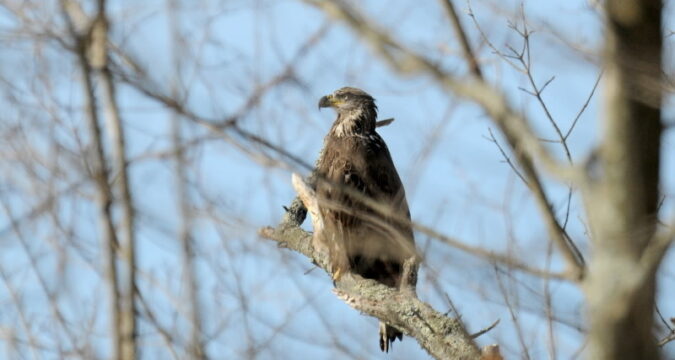
Each winter at an unassuming dam in Southbury dozens of people come out daily and wait patiently with cameras in hand hoping to catch a glimpse of America’s iconic bird.
For a long time, bald eagles were rare in Connecticut. The bird of prey rebounded from being nearly wiped out in the 1950s to over 80 active territories by 2022, according to the state’s Department of Energy and Environmental Protection. Several programs aimed restoring their population in the state, including a ban on DDT and furthering habitat protection, have allowed them to expand their territory over the past few decades.
This year at the Shepaug Dam eagle observatory in Southbury, over 40 bald eagles have been spotted so far, a high number of sightings for the bird that became “the most recognized symbol of the United States.”
“For the days we’ve been open, we always see an eagle in view,” said Lucy Walker, site manager at the observatory. “It is wonderful for our visitors who come to see the wild eagles during the winter time. The weather can really affect the numbers. Eagles move to find food and their primary food is fish. So they will move to find open water.”
The observatory and dam, owned and operated by clean energy company FirstLight, has welcomed approximately 175,000 visitors since opening in 1986. Each winter, bald eagles are drawn to the area because water flowing through FirstLight’s Shepaug generating station prevents the river below the dam from freezing, creating ideal feeding conditions, according to a spokesperson with the company.
Officials said they marked the 40th season of the bald eagle observatory with an anniversary ceremony. Since December, thousands of people have made the trip to see the majestic birds. So far, there have been bald eagle sightings every day, allowing birders opportunities to spot eagles up close. Walker said that on an average day, hundreds of people visit the observatory with binoculars and cameras in hand.
State officials say that the number of sightings points to the success of programs meant to rebound the population in the state. In 1999, nearly 30 years ago, only two bald eagle nesting territories were active in the state, according to DEEP. That season, neither pair was successful and no chicks were produced. By 2019, the state smashed records for the number of active territories with 64, with 45 successful nests and 81 chicks hatched. In addition, 14 new nesting territories were reported in 2019, with six of those new nests being successful in raising chicks.
“We continue to see growth in numbers and new breeding territories pop up across Connecticut,” said Brian Hess, a wildlife biologist with DEEP. “The other thing that might be going on this winter is that the number of wintering eagles we have in Connecticut may have increased. Wintering for bald eagles is dependent on the weather. This year we’ve had more ice than we have had in the past few years. That probably means more eagles from the north have flown south to find warmer waters to feed. So we could have more eagles in the state than usual from other places.”
January is considered a key month for eagle breeding, especially for bald eagles in warmer regions as it mars the start of nesting preparation, courtship, nest reinforcement and early egg-laying occurring, according to Hess. Eagles rely on finding warmer to hunt fish and feed both themselves and their young during the winter months.
“Bald eagles don’t migrate to the same spot each year like other birds. They are just trying to fly the shortest amount of distance to find the resources they need. So bald eagles will often head south to find spots with good fishing opportunities,” Hess said. “The Shepaug Dam is a great place for them since the water never freezes because the generating station keeps the water warm. So it presents a good opportunity for eagles further north. My guess is some eagles from other state’s are wintering at the dam.
“A lot of the protections that exist for waterways benefit eagles too, since the birds are an indicator of healthy waterways and healthy fish populations,” Hess added. “So seeing more of them this year is an indicator of ecological health and that is something to celebrate.”
The Shepaug Bald Eagle Observatory will remain open through March 15, officials said. Admission is free but advance reservations are required. Guided viewing with wildlife specialists and volunteers will continue throughout the season.
Stephen Underwood can be reached at sunderwood@courant.com.