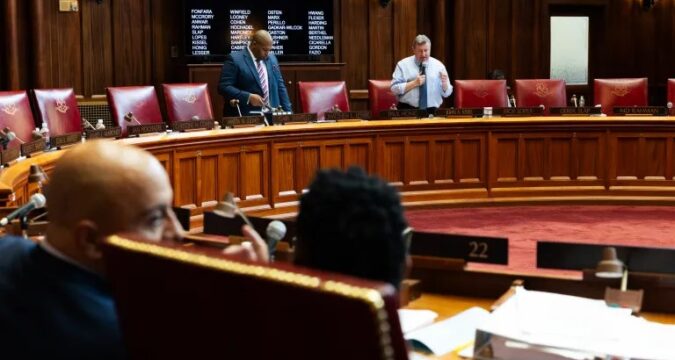
With ICE arrests continuing in Connecticut and immigrant advocates calling for state officials to act, lawmakers are in discussions about increasing legal protections during an upcoming special session.
State Sen. Gary Winfield, D-New Haven, co-chair of the Judiciary Committee, said there are significant conversations among his colleagues and the executive branch about potential legislation during a special session but there are key differences internally among parties to the discussion.
He said nothing has been finalized.
“I think we should do everything we legally can to protect these people,” Winfield said. “Others are concerned about what those decisions mean for the federal government interfacing with the state,” the senator said. “I think that is where the differences come in. We are trying to negotiate between those different sets of thoughts and concerns and we just have not come to a place where we have done that.”
In the state there have been increased arrests and detentions of immigrants by ICE agents wearing masks showing up at court, at the offices where people go to make child support payments and at people’s workplaces and their homes, immigration advocates said.
Immigration advocates and faith leaders called on legislators Monday to pass legislation during the special session to protect immigrants.
“It is extremely important to protect the courthouses and make sure that people are not in danger of being picked up by ICE when they are reporting for other issues,” Constanza Segovia, cofounder of the Hartford Deportation Defense and organizing director for Connecticut For All Coalition said. “It ends up impacting the justice system as a whole if people don’t feel safe going to court for a speeding ticket or to report domestic violence. It is a matter of public safety to access the courts.”
Protecting personal data of immigrants and citizens is also crucial, Segovia added, explaining that people should feel safe paying taxes in the state and not fear that they will be picked up as a result.
Undocumented immigrants in the state have contributed about “one billion (dollars) in federal, state and local taxes each year,” according to DataHaven.
On Sept. 19, Gov. Ned Lamont and the state Supreme Court Justice Raheem Mullins issued a new policy that states that ICE cannot make arrests without a warrant inside the state courthouses. Further, the policy states that immigration agents cannot wear masks.
Ninety-two organizations committed to immigrant rights, civil rights, human rights, gender rights, worker rights and racial justice, sent a letter to the lawmakers outlining specific priorities for immigration protections including protecting immigrants at courthouses; preserving Husky Medicaid for undocumented children and pregnant individuals; protecting the personal information of the immigrant community and all Connecticut residents; and making communities safer by prohibiting the use of state and local resources to assist in immigration enforcement, according to the letter.
Local immigration attorneys said that ICE is targeting those with deportation orders and those enrolled in former President Joe Biden’s parole program. But some are just being profiled as ICE agents pass by.
This past June Lamont signed legislation strengthening the controversial Connecticut Trust Act, the current law maintaining the independence of state and municipal police.
The Trust Act blocks local police from making an arrest that is based only on a request by federal agents in the Immigration and Customs Enforcement Agency.
Sen. Matt Lesser, D-Middletown, said with over a $100 billion of federal funding allocated for ICE starting this fiscal year, the state has to respond in some way.
“I want to make sure the constitutional rights of everyone in Connecticut including U.S. citizens are protected,” he said. “The federal government has a responsibility to enforce immigration laws. I respect that. I am concerned about overreach and infringement of constitutional rights.”
He added that the legislature should pass the state civil rights law and ensure protections are in place to tighten rules upon state data.
The state civil rights law would expressly protect federal constitutional rights in state law, according to Lesser.
“The state has the ability to protect federal constitutional rights at the state level and to say that we are going to ensure that they are not violated,” Lesser said.
“We need to tighten up the rules on data sharing,” he said.
State Sen. Saud Anwar, co-chair of the state’s Public Health Committee, also called for legislation to protect immigrants.
“We need a comprehensive strategy going forward because the federal government is on a different trajectory,” he said. “We must make this a priority. No immigrant in the community should live in fear of masked individuals kidnapping them.”
Senate Republican leader Stephen Harding of Brookfield said he has hesitation anytime any advocate wants to expand the Trust Act because in his view all it does is expand protections to criminals.
“The only way to expand the Trust Act from its current form is by adding more crimes that undocumented immigrants can be convicted of and still be protected under the Trust Act,” he said. “I am all for having a discussion for those who may be here illegally but otherwise abiding by the law and positively contributing to society. I am not willing to have any discussion about helping individuals that are being convicted of violent, heinous crimes and protecting those from deportation.”
Harding added that “we go down a very slippery slope when we start dictating to federal authorities what they can and cannot do in the state of Connecticut.”
Winfield said it is a red herring for Republicans to talk about the issue of crime related to the Trust Act.
“Never in the conversation about the Trust Act has anyone who is an advocate of the Trust Act said, ‘you know what, we are working to make sure more crimes don’t fall under this,’” he said. “The only thing that has happened with the Trust Act is we’ve said, ‘let’s put more crimes so more crimes are covered as exceptions.’
“The stuff we are talking about is what happens in our courts. The stuff we are talking about is whether ICE can run throughout the state of Connecticut unidentified. The stuff we are talking about is whether they follow the laws of the state. It is a distraction. They know better,” Winfield said.
The law strengthening the Trust Act also expands situations in which officials can comply with federal immigration detainers and not be subject to litigation, according to the Connecticut Mirror. The Mirror reported the bill added 13 crimes including sexual assault, injury or risk of injury to a child, strangulation and others for which state and local law enforcement can comply with a federal detainer request.
Winfield said at the core what we “are trying to do is offer people protections that we can and from my perspective you can call it the expansion of the Trust Act, you can call it something new — I don’t care what you call it. What I care about at the end of the day is what is the state of Connecticut’s policy toward immigrants who largely have been good neighbors to us.”
Reporting from Courant reporter Christopher Keating is contained in this article.