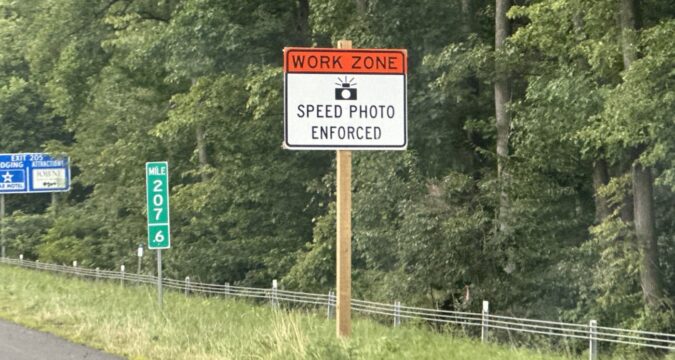
Since late August, the New Kent County Sheriff’s Office has been using automated cameras to enforce speed limits in Interstate 64 construction zones.
The recordings have so far logged more than 60,000 violations.
If the ticket is approved by a sheriff’s deputy — and the overwhelming majority are — the drivers get $100 fines in the mail a few weeks later.
This has raised questions about the speed camera program — how it works, how much money it’s raking in and how long the program will last. We try to answer some of these, and more:
More than 60,000 violations seems like a lot. How many tickets is that per day?
From Aug. 12 through Aug. 26, New Kent sheriff’s deputies used hand-held cameras, with a couple thousand violations logged. But between Aug. 28 and Oct. 10, new cameras mounted on pickup trucks have amassed more than 60,000 violations. That amounts to an average of more than 1,428 per day — or 60 an hour — over that six-week stretch. And given that cameras are running only when interstate construction is underway — typically about 12 hours a day — the photographs are likely nabbing more than 100 speeders for each hour of actual use. On one day alone in September, the cameras logged 3,854 violations, New Kent County Sheriff Lee S. Bailey said.
How much money is New Kent County taking in as a result?
If all 60,000 people were prosecuted for $100 tickets, that would result in $6 million flowing to the county. But it’s likely to be far less. First, some tickets are thrown out after review by a sheriff’s deputy. In some cities and counties, that’s about 10% of the total. Second, many people don’t pay their fines. Statewide, an estimated 38% of those receiving citations from photo cameras don’t pay. Then the camera vendor gets a 15% cut of each bill paid. When all is said and done, New Kent County could collect about $2.8 million for the six weeks of violations, or about $66,000 a day. That would result in about $24 million flowing to the county over a year’s time.
How big of an infusion to the county is that?
Huge. New Kent County is one of Virginia’s most rapidly growing counties in terms of population. But with only 28,000 people, it’s still on the smaller side. A $24 million cash infusion is nearly triple the county sheriff office’s annual budget of $8.7 million, and would amount to about 18% of the entire county’s $136 million annual budget.
What’s the county planning to do with all that cash?
It’s not clear yet. As of last week, the county has not received any checks from its camera vendor, Blue Line Solutions, but is expecting one in the next couple weeks, Bailey said. At the Board of Supervisors meeting Sept. 29, Bailey proposed that some of the money go toward a new six-person “traffic safety unit” to focus on improving traffic safety going throughout the county — not just on the interstate. “Speeding is a problem everywhere around us, on all of our county roads,” he said. He estimated the unit would cost about $1.3 million for new vehicles, equipment and other costs to get up and running, and about $500,000 a year after that. The board has not approved that request, and there’s been little discussion about how the rest of the new money would be spent.
Why is the county running these speed cameras?
The goal, the sheriff said, “is to slow people down” — to get travelers through work zones without a crash. Interstate collisions, he said, jumped to 444 in 2024 — after construction got underway — from 240 the year before. Bailey said speed reduction is the only goal of the program, and that he “truly couldn’t care less about the revenue that’s generated.” He said a sheriff from another county recently drove through New Kent, and told Bailey that he “thought he was on a racetrack,” and that drivers were “jockeying for positions” on the interstate. Bailey said speeds of over 100 mph on I-64 are not uncommon these days. Such speeds, he said, have led to several crashes involving three or more vehicles. “And when we have these, it just completely immobilizes the county because you’ve got all this traffic coming off of the interstate and it is backing up on county roadways.” But Bailey said there have been fewer crashes between July 1 and Sept. 30 of this year than in the same period in past years.
How many cameras are there, and where are they?
There are now four cameras in undisclosed locations on a nine-mile stretch of I-64 in New Kent County, between the 205 and 214 mile markers. Between Aug. 28 and Oct. 7, only eastbound lanes had cameras. But on Oct. 8, they were added to the westbound lanes. Bailey said the cameras are on pickups, with two cameras — one for each driving lane — on the back of each truck. So all four lanes of I-64 are now being captured. The camera trucks can be moved as the road project proceeds, though Bailey declined to further describe the pickups or their locations.
Who issues the tickets and how much are they?
Under a 2020 state law, a current or retired law enforcement officer must sign off on each ticket on a case-by-case basis, which requires viewing footage from the cameras. It was not immediately clear how many violations New Kent County deputies have dismissed during that process. But for approved citations, Blue Line Solutions sends a $100 civil violation notice in the mail a few weeks later.
Is the number of speeders expected to go up or down in the coming months?
It’s not clear yet. Bailey says the tickets are trending significantly downward as drivers learn to go slower on that stretch of I-64. On the other hand, the cameras now on both sides of the interstate are likely to lead to an uptick in violations.
What are the speed limits in that area?
The normal posted limit in that stretch of I-64 is 70 mph. It’s limited to 60 mph during construction periods, with drivers notified of the changes by digital signs. Bailey said cameras are set to flag cars driving 71 mph or more during construction — or 11 mph over the reduced speed limit. On the other hand, if a car is going faster than the standard speed limit outside of construction times, the cameras won’t flag them.
What are some of the criticisms?
A main complaint is that the construction periods switch up at varied times, so drivers can’t anticipate the speed limits in advance. Moreover, Google Maps and Apple Maps — which many drivers use for navigation — use GPS systems that tell drivers the speed limits in the area. But the limits shown on those mapping systems don’t keep up with the daily shifts for roadway construction. A driver following his mapping system might believe they are OK at the standard speed. “They’re just picking them off up there,” said Tim Anderson, a local attorney who has sued two local cities over their camera usage. Anderson added that a driver recently told him he got five speeding tickets in New Kent over only a couple of days. Some also contend it’s not inherently dangerous to drive 72 mph or so through a construction zone that has hefty concrete Jersey barriers separating workers from the roadway.
Can you challenge a ticket?
Yes. It’s a civil violation that does not appear on your driving record, and does not affect your car insurance rates. But you can still take the case to court by filling out a form on the back of the bill. Anderson notes that the 2020 statute requires that safety camera citations be “conducted in the same manner as prosecution for traffic infractions.” In a case he’s taking to the Virginia Supreme Court, he contends that the law also requires that people get summonses and court dates — rather than bills from the camera vendor. In any event, few people actually trek to court to challenge the $100 fine.
What will happen to those who don’t pay the ticket?
It’s not clear yet. New Kent County could send thousands of unpaid bills to collection agencies. But “no decision at this point has been made,” Bailey said. He added he, the county administrator and county attorney must weigh in on “whether this is the avenue the county wishes to pursue.” For his part, Bailey believes that “people should be held accountable” for driving too fast. As of now, however, no driver’s bills have been sent to collections.
How long will this speed camera program last for New Kent County?
It’s not clear. First off, the Virginia State Police are embarking on a pilot program to run similar speed cameras in five interstate construction zones statewide. The State Police are expected to launch first in Staunton, followed by locations in Hampton, Harrisonburg, Roanoke — and New Kent. Combined, the Virginia Department of Transportation said these five sites could generate two million speeding citations “per construction season.” If those estimates hold, that could mean more than $100 million per year flowing to state coffers. Bailey said once the state police begin running their own cameras in New Kent, the county will likely disband its program. But the time frame for the State Police to take over is unclear. Anderson said they have “no incentive” to run the program, in part because the agency is short-staffed — and because any money the State Police make on the cameras goes to the statewide transportation fund.
Could the General Assembly crack down on this program?
Yes. At a recent meeting of the Virginia State Crime Commission, several lawmakers voiced concern about how much some localities are raking in with the camera programs — such as the $8 million that Suffolk took in last year from work zone and school zone cameras. “We have to do something as a General Assembly,” Sen. Mark Peake, R-Lynchburg, said after expressing shock at Suffolk’s 2024 numbers. A bill in the 2025 legislative session attempted to mandate that all monies collected from such cameras go to the commonwealth transportation fund rather than directly to cities or counties. But lobbyists for cities and towns killed off that proposal. The Crime Commission is scheduled to make a recommendation in December for what should be done in 2026.
Since the Virginia State Police run interstate traffic enforcement in Virginia, how can the New Kent County sheriff can even do this?
The New Kent County sheriff’s office has joint jurisdiction with the state police to conduct traffic enforcement through their county — even on the interstate. In fact, Bailey said, the sheriff’s office has been conducting at least some speed enforcement on I-64 for more than 32 years, even as the State Police take the primary role. To set up these automatic cameras recently, the county needed a “special use permit” from VDOT to allow the automated cameras on the state-maintained roads.
Peter Dujardin, 757-897-2062, pdujardin@dailypress.com