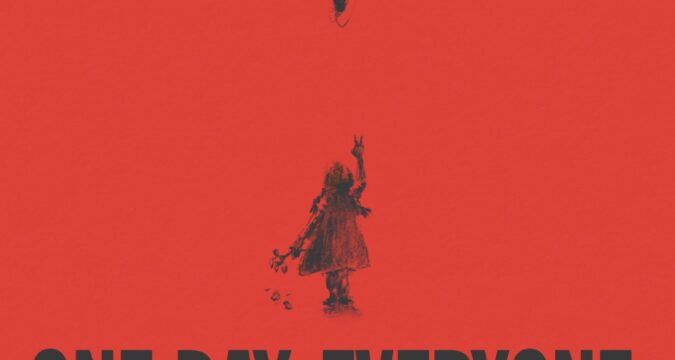
NEW YORK — Omar El Akkad’s “One Day, Everyone Will Have Always Been Against This,” a brief, searing indictment of American and European responses to the devastation in the Gaza Strip, has taken home the National Book Award in nonfiction, one of three prizes awarded to writers of Middle Eastern origin who addressed the traumatic past and present of the region in their books and in their remarks.
Omar El Akkad’s “One Day, Everyone Will Have Always Been Against This,” what publisher Knopf calls “a moral grappling” in which he considers the carnage in Gaza and the promises and realities of the West. (Courtesy/Knopf)
The awards have often served as a kind of counter voice to current events. The honorees Wednesday expressed gratitude for prizes bestowed and for literature itself, and horror and disenchantment at the political and social climate, from immigration raids in the U.S. by masked agents to the carnage in the Middle East.
El Akkad, an author and journalist, was born in Egypt, grew up in Qatar and Canada, and lives in the United States. He wrote two novels previously.
“It’s very difficult to think in celebratory terms about a book that was written in response to a genocide,” he said in accepting the prize. “It’s difficult to think in celebratory terms when I spent two years seeing what shrapnel does to a child’s body. It is difficult to think in celebratory terms when I know that my tax money is doing this and that many of my elected representatives happily support it.”
Omar El Akkad, at the 76th National Book Awards in New York. In his remarks on receiving the nonfiction prize for “One Day, Everyone Will Have Always Been Against This” he said, “It’s difficult to think in celebratory terms when I spent two years seeing what shrapnel does to a child’s body.” (Arturo Holmes/Getty Images)
Rabih Alameddine won the fiction prize for “The True True Story of Raja the Gullible (and His Mother),” a comic novel of intense family bonds within the chaos of modern Lebanon — about a 63-year-old Beirut high school teacher and “neighborhood homosexual” who lives with (and spars with) his mother.
In young people’s literature, Daniel Nayeri, who as a child emigrated from Iran with his parents, won for “The Teacher of Nomad Land: A World War II Story,” a novel about two siblings in Iran during the war.
The National Book Awards, which honor literature published in the United States and were established in 1950, are among the most prestigious in the country, often called the Oscars of book publishing. They are presented by the nonprofit National Book Foundation. Each competitive category is voted on by judging panels that include writers, booksellers and critics. They select winners from hundreds of books submitted by publishers.
Rabih Alameddine’s comic novel of an intense relationship in today’s Lebanon — “The True True Story of Raja the Gullible (and His Mother)” — which won the 2025 National Book Award for fiction. (Courtesy/Grove Atlantic)
The evening had its moments of levity. Alameddine thanked everyone from his gastroenterologist to the “psychiatrist who has been telling me to get over myself for more than 20 years,” and wore a tie sporting the comic strip characters Nancy and Sluggo. The event host, Emmy-winning actor Jeff Hiller, joked that he wasn’t sure why he was the host, thanked everyone from celebrities who lead book clubs to independent store owners, and lamented that a typo on the spine of early editions of his recent book, “Actress of a Certain Age,” left some readers thinking he had published “Actress of a Cetain Age.”
“Can you imagine Madeleine L’Engle discovering the cover of her book read ‘A Wrinkle in Tim’?”
But many of the speeches addressed federal immigration raids, the plight of refugees and attacks on free speech.
Accepting the award for translated literature, Argentine writer Gabriela Cabezón Cámara spoke in Spanish; her translator, Robin Myers, said the novelist did so because it would anger “fascists.” Their winning novel, “We Are Green and Trembling,” is based in part on the life of a 17th-century Spanish explorer, a woman who lived as a man.
The poetry winner was “The Intentions of Thunder: New and Selected Poems” by Patricia Smith, who has received numerous previous awards for her lyricism and intensity. Onstage she summoned images of her mother — extraordinarily harsh with her as a child, then seeming “emptied” during her years in a nursing home. Smith also remembered how, as a young girl, she tried to lighten her skin.
“There I was, looking for the top of the place I was, looking for the next place, looking for another home and another skin,” Smith said, and offered tribute to poetry as a path to transcendence. “But what the poets say to me: Child, look at where you are. Look at the blessings you’re trying so hard to be beyond.”
The National Book Foundation also presented two lifetime achievement awards.
George Saunders, an author and creative writing professor, was presented the Medal for Distinguished Contribution to American Letters. He is the author of 13 books, including “Tenth of December,” a story collection that was a fiction finalist for the 2013 National Book Award. His next novel, “Vigil,” comes out in January.
Saunders, widely praised for his legacy of dark humor and warm compassion, remembered his early growth as a writer and how revision changed him on the page and in real life, a “truth-seeking” process that sets the artist apart from the dictator and other bullies.
“We’re open to finding out how things actually are, not how we think they are, not how we wish they are, but how they actually are,” he said. “And this puts us in a less delusional relation to reality.”
Roxane Gay received the Literarian Award for Outstanding Service to the American Literary Community. She is an editor, publisher and cultural critic whose books include “Bad Feminist,” an essay collection, and “Hunger,” a memoir.
She has worked to elevate underrepresented voices in publishing, including at the imprint she founded at Grove Atlantic. Writing is a solitary endeavor, but sharing the word is a different challenge, she noted.
“I refuse to work from a scarcity mindset,” Gay said in her acceptance speech. “There is room for all of our voices and there are people in this very room who have the power to do better. You have the power to abandon old ways of thinking and nonsense metrics like social media followings as a determining factor in buying a manuscript.”
— From reports by Hillel Italie of The Associated Press and Elizabeth A. Harris of The New York Times.