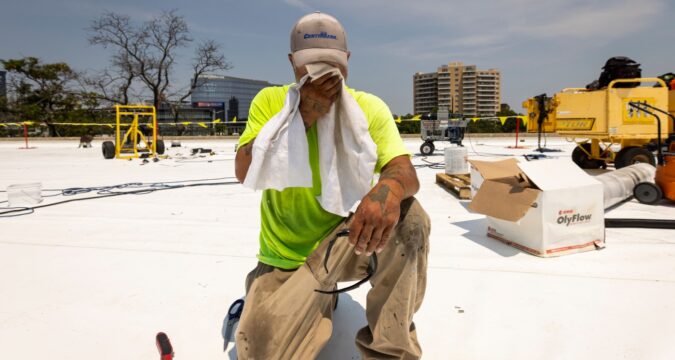
Data from the Virginia Department of Health shows nearly 4,000 heat-related illness emergency visits this summer, a number experts said is higher than average.
Since May 1, health department data documented 3,832 heat-related illness cases across the state. That marks a roughly 50% increase in heat-related illness visits from the average, which is 2,548 visits by this time each year on average and a roughly 18% increase from all 3,242 documented visits in 2024.
Across the United States, roughly 700 people die from heat-related illness a year, the Center for Disease Control reports.
The department’s eastern region, which is predominantly Hampton Roads, the Middle Peninsula, the Northern Neck and Eastern Shore, reports more heat-related illness cases than any of the other four while separately factoring for out-of-state visitors in Virginia. There were 1,038 cases recorded in the eastern region as of Wednesday, which makes up about 27% of the state’s total.
“The bottom line is that heat-related illness cases are higher here than we usually see,” said VDH Enhanced Surveillance Epidemiologist Meredith Davis. “We always want to emphasize that heat-related illness is preventable.”
Heat-related illness cases tracked by the Virginia Department of Health as of Aug. 29, 2025. (Courtesy of VDH)
Davis, part of the health department’s team tracking dangerous heat and other public health hazards, notes that the raw total of cases don’t tell the full story. The department also tracks the rate of heat-related illness cases per 10,000 people, a measure which Davis said can provide a more practical baseline.
“It’s a better comparison,” she said. “There’s a lot of difference between population centers. There’s definitely some differences across the state of Virginia.”
Health department data shows about 18.3 Virginians in 10,000 have experienced heat-related illness this summer — about 29% more than the year-to-date average of 14.2 cases per 10,000.
The eastern region, when looking at this rate, does not particularly stand out the way it had when looking at the raw number of cases recorded. Its average was also recorded as 18.3 cases per 10,000 people as of Wednesday.
Heat-related illness cases per 10,000 Virginians, tracked by the Virginia Department of Health as of Aug. 29, 2025. (Courtesy of VDH)
The cases the VDH tracks aren’t all hospitalizations. The counts recorded by the health department can also refer to visits to emergency departments and urgent care.
Demographics
Despite most medical professionals’ warnings that the youngest and oldest members of the population are the most vulnerable, health department data shows that those aged 20-29 and 30-39 were the most likely to experience heat-related illness this year, with each group having 18% of cases.
Davis said that corresponds with the sorts of people spending the most time outside. Health department data shows about two men to every one woman in Virginia experience heat-related illness.
The VDH reports a spike in cases in the last week of June, with a peak of 249 visits recorded on June 24 and 244 visits recorded on June 25.
Signs and symptoms
According to Rachel Huovinen, emergency department manager at Sentara Norfolk General Hospital, there’s a number of different degrees of severity when it comes to heat-related illness.
She said most cases lead to dizziness, fatigue, dryness and a change in the skin’s color.
The best thing one can do for treatment is go inside a climate-controlled room and drink water — not soda or energy drinks. Low-carb, electrolyte drinks can also have a positive effect.
The next degree of severity, she said, was heat exhaustion.
Those who experience heat exhaustion can expect amplified symptoms, like weakness, headache and nausea. In these cases, she said, it’s common for someone to continue perspiration after starting treatment.
Then there’s heat stroke.
“You’re completely overheated,” Huovinen said. “Poor body temperature that is not life sustaining. It can actually cause brain damage and death. It’s a big deal.”
She said common cases include folks in the military, those who spend too long at the beach and those experiencing homelessness to heat stroke after spending too long in the elements, not listening to their body when it comes to drinking fluids and taking breaks.
Exacerbating the problem
Sarah Dawson, a clinical pharmacist at Sentara Virginia Beach General Hospital, said a great number of patients treated for heat-related illness aren’t aware of how other medications can affect susceptibility to the heat.
She said antidepressants, antipsychotics, antibiotics and cardiac medication can predispose someone to heat-related illness. Side effects of such medications impair one’s temperature control regulation or increase photosensitivity, making them more sensitive to the sun.
“These are very common medications that millions and millions of Americans are on,” Dawson said. “It’s like the top 100 medications that most Americans are on.”
Similarly, she notes that high heat can affect the effectiveness of certain medications, like insulin or an EpiPen. Storage of these in high heat can render them ineffective.
John Buzbee, 757-879-7421, john.buzbee@virginiamedia.com
https://www.dailypress.com/2025/09/05/dangerous-heat-virginia/