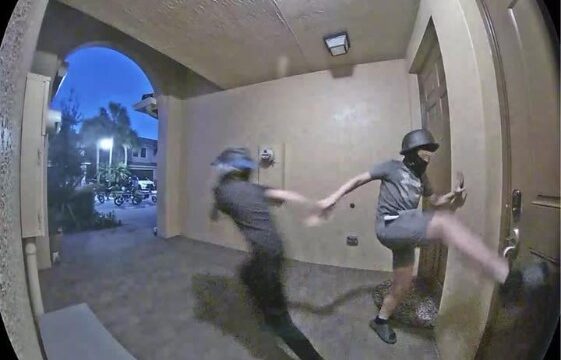
A little after 10 p.m. on a recent October night, a group of kids ran up to the doorbell of a West Boca Raton home and made to flee, one of a series of “ding-dong ditch” pranks they said they were committing in the neighborhood, according to a probable cause affidavit.
But instead of escaping, one of the pranksters — a 14-year-old boy — ended up on his knees on the ground outside, thinking he was about to be shot as the home’s resident aimed a gun with a flashlight at him and told him “you messed with the wrong guy,” the teen told police.
The resident, Santiago Cairo, 40, was arrested Oct. 16 on an aggravated assault charge after admitting to police he “went too far,” though he said he never pointed the gun at the boy and believed the group was trying to break into his house. The Palm Beach County Sheriff’s Office petitioned for a risk protection order against him the day after his arrest, and a judge granted a temporary one. Prosecutors have not yet filed formal charges.
The prank is now one of several in Florida and across the country to end with children held at gunpoint, injured, or killed in recent months, leading to warnings from law enforcement officials against participating in the mischief. Today, the teens are fueled by social media trends, though the concept of ding-dong ditching dates as far back as the 19th century. Yet some say that such pranks, once tolerated as juvenile fun, are no longer safe or acceptable in today’s cultural climate, in part due to the allowance of open carry and the expansion of “stand-your-ground” laws.
The incidents are also part of a broader conversation about stand-your-ground laws and homeowners’ rights. Earlier this month, the documentary The Perfect Neighbor brought national attention to a 2023 case involving a Marion County woman who called the police several times on children playing near her home before shooting and killing one of the children’s mothers through her door, claiming she thought the woman was breaking in. For months, prosecutors did not file charges, leading to public backlash.
In response to the ding-dong ditch incidents, South Florida residents and gun rights supporters have argued that kids need to take responsibility and gun rights are not to blame, while others say that homeowners have become too trigger-happy.
“This is a very dangerous game,” said Michelle Suskauer, a West Palm Beach defense attorney and former president of the Florida Bar. “To ring someone’s doorbell and run away, especially in this era of open carry and stand your ground. It’s a dangerous game. But it still does not give someone the unfettered ability to misuse the law.”
Pranks end in violent confrontations, deaths
Several ding-dong ditch pranks have led to violent altercations and even deaths in South Florida and beyond.
In September, a 42-year-old military veteran shot and killed an 11-year-old boy after the child banged on his door as part of a prank in Texas, according to reports. The man is facing murder charges.
In May, a group of middle school boys in Palm Beach decided to ding-dong ditch a classmate’s house multiple times during a sleepover when a 45-year-old man followed them in his car, got out, and pointed his gun at each of them, asking them “who did it?” until one of the boys told him which of the friends rang his doorbell, according to a probable cause affidavit. The man later pleaded guilty to improper exhibition of a firearm, was sentenced to a year probation and ordered to take anger management classes. His guns were removed under a risk protection order.
Meanwhile, in March, a Margate man pursued a car carrying a group of five teenagers and pointed a gun at them after they knocked on his car door and ran away, according to a probable cause affidavit. He later told police his friend had informed him that someone was trying to steal his vehicle, so he followed the group of teens he believed were responsible, pointing the gun at them to get them to stop, according to the affidavit. He faces four counts of aggravated assault.
Perhaps the most well-known tragedy took place almost 22 years ago in a Boca Raton neighborhood less than a mile from Cairo’s home. Just after midnight on Oct. 25, 2003, the night of his 16th birthday, Mark Drewes went ding-dong ditching with a friend along Woodbury Road when a resident shot him in the back as he was running away. He was only 10 houses away from his own home when he died, his paternal uncle, Russell Drewes, told the South Florida Sun Sentinel this week.
Mark Drewes’ mother ran out into the street and held him as he was dying until police told her to move away due to the crime scene, Russell Drewes said.
The shooter, Jay Levin, who was 40 at the time, later pleaded guilty to manslaughter as part of a deal that allowed him to spend weekends in jail for a year, followed by nine years of probation. A judge later cut his probation short at the five-year mark, despite protests from Drewes’ family.
Attorney Roy Black, left, escorts his client, Jay Levin, into the court facility at the Palm Beach County Sheriff’s Office in West Palm Beach on Nov. 24, 2003. Levin entered a plea during an arraignment on a manslaughter charge in the fatal shooting of 16-year-old Mark Drewes. (South Florida Sun Sentinel file)
Throughout the case, which received national attention, Mark was described as “large for his age” and “intimidating,” Russell Drewes said, while many took Levin’s side.
“They said these crazy kids nowadays can’t be ringing the doorbell and will probably be robbing your house,” Drewes recalled. “… (Levin) was treated with kid gloves. Mark was treated as if he was a murderer or he was a crazily dangerous person.”
‘No such thing as a prank anymore’
Similar sentiments in favor of homeowners have emerged online in response to the recent ding-dong ditch incidents.
Earlier this month, the Broward Sheriff’s Office Parkland district posted a warning on Facebook urging children not to participate in door-knocking pranks.
“Heads up, Parkland parents! We get it … it’s just a prank. But when masked kids on e-bikes keep showing up on Ring cameras in Parkland Reserve, and we keep getting calls, it’s not so funny anymore,” the post read, alongside a Ring camera picture of masked children appearing to kick a door. “Our SROs are helping identify them and will be contacting parents. This ‘prank’ may make homeowners feel unsafe, escalate into confrontations, and in some cases, lead to criminal investigations if property is damaged. We all have better things to do, so let’s choose fun that doesn’t cause problems for our neighbors.”
After identifying the children, deputies met with them and their parents and “educated them about the dangers of this prank,” Carey Codd, a spokesperson for BSO, told the Sun Sentinel in an email. The prank did not cause any damage and no criminal charges were filed.
“This issue is not isolated to Parkland, and when these incidents do happen in Parkland, deputies make a concerted effort to identify and locate the juveniles involved, meet with them and their parents/caregivers and inform them of the dangers of this prank and the potential consequences of their actions,” Codd said.
After BSO shared the post, hundreds of commenters defended the homeowners, with some encouraging violence against the children.
“Pellet in the back is first warning,” one person wrote in a comment that received over 20 likes. “Caliber goes up from there.”
On a different Facebook post about Cairo’s arrest, residents defended him and criticized the children, with some suggesting they were in fact attempting a break-in.
“How do we know it’s not a burglary attempt split decisions are made when someone tries to knock down your door,” one commenter wrote. “A good Lawyer will get all charges dropped. He was in fear of his life. I will do the same. Don’t come knocking around me.”
“Of course the kid will say its ring and run,” said another. “But he was probably checking to see if the house was empty to break into. No such thing as a prank anymore.”
Cairo told deputies that he was walking his dog when he saw the group of children near his front door and thought they were attempting to break in. He went inside, grabbed his gun, and then called 911 while looking for the group outside, at which point he came upon the 14-year-old boy. Holding the gun with the light attached, Cairo ordered the boy onto his knees and told him to put his phone on the ground, the boy said, according to the affidavit. He thought Cairo was law enforcement “based on his tone, commands, and possession of a firearm.” Cairo then grabbed the boy’s shoulder and tried to push him down. When deputies arrived, the boy ran to them “for safety.”
The boy’s father declined to comment when contacted by the Sun Sentinel.
Cairo’s attorney, Luis Cartaya, told the Sun Sentinel that he hopes prosecutors will decide not to file charges as his client was doing what any homeowner would do in a similar situation. Cairo still believes the children may have been planning to break into his house, Cartaya said, while it was not clear that the alleged pranksters were children.
“You can’t really wait until a person’s inside your house to determine whether or not they’re doing a prank or it’s someone ready to rob your house,” Cartaya said. “If someone at your house is committing a felony you have the right to arm yourself. It comes down to stand-your-ground rights. It’ll come down to whether or not he was in fear for his life.”
‘Back when I was a kid’
When a group of children arrived at the door of Nancy Cavanagh’s Boynton Beach home one evening in 2021, she was finishing dinner with her triplet 14-year-old daughters. Then a sudden banging left all three of the girls petrified.
If it weren’t for their Ring camera, Cavanagh wouldn’t have known the visitors were children playing a prank. For several weeks, the group returned to the house, sometimes ringing the bell, other times pounding on the door. The pranks were “invasive,” Cavanagh said, though she was mostly concerned for the children’s safety, not her own. Eventually, she posted a warning in her community Facebook page to alert the neighbors.
“I’m familiar with ding-dong ditching,” she told the Sun Sentinel. “If this was done back when I was a kid, it wouldn’t have mattered. But now, in this day and age, there’s just a lot of wackos out there with guns.”
Others share Cavanagh’s perception that it is more dangerous than ever to play pranks on strangers’ homes. While there is no data that specifically tracks gun usage in response to pranks, more homeowners own guns than ever before, and studies show that a growing number of gun owners say they purchased their weapons specifically for protection.
Citizens have long maintained the right to defend their own homes against intruders under what is known as the castle doctrine. But in Florida in 2005, that doctrine expanded beyond the home into the state’s “Stand Your Ground” law, the first in the nation, which allowed citizens to shoot and kill others in public as well as private as long as they had a reasonable belief that they were defending themselves against great bodily harm or a forcible felony, such as burglary. Prior to 2005, Floridians had a duty to retreat in public, unlike in private.
The law also created a mandatory presumption that homeowners have a “reasonable fear” of death or great bodily harm as long as someone unlawfully and forcibly enters their house. Before, those prosecuted for shooting an intruder had to prove in court that their fear was reasonable.
Further loosening of gun laws has followed in recent months. In September, Florida began allowing open carry following a court ruling that deemed a ban on the practice to be unconstitutional.
Some legal experts say these changes could contribute to more self-defense-related shootings and a broader sentiment among the public that using a gun to defend the home is lawful, even when it’s not.
“I think there is a perception that now, with open carry, you can do whatever you want when someone is on your property,” Suskauer said. “And maybe it’s because there’s a misunderstanding of what a homeowner can or can’t do, or maybe there’s a misunderstanding that the homeowner can basically do whatever they want to do.”
Open-carry laws may also create more fear among the public that someone might have or be reaching for a gun, leading to more self-defense shootings, said Tamara Lave, a law professor at the University of Miami.
But gun advocates say that stand-your-ground and open-carry laws have little effect on the dangers of children’s pranks.
“Gun laws have nothing to do with this,” said Luis Valdes, the Florida state director for Gun Owners of America. “This just comes back to the simple fact that the majority of Florida’s gun owners are responsible and they understand, when it comes to use of force, there is a time and place and justification for it.”
Ultimately, Valdes said it is the parents’ responsibility to ensure their children’s safety.
“Parents need to be responsible and teach their kids, don’t play pranks,” he said. “That’s the proper response here.”
Where is the line?
Though homeowners may feel entitled to wield guns or shoot at a perceived threat at their door, those confrontations are often still illegal, experts say.
“What people have to argue is, when kids come to the door, that what they’re doing constitutes a forcible felony,” Lave said. “It means they’re in the process of unlawfully and forcibly entering a dwelling, residence or occupied vehicle. That’s a question of proof. And I don’t think ringing a doorbell meets that.”
Whether a situation is dangerous enough that a homeowner could be justified in shooting or brandishing a weapon often comes down to “really small facts,” Lave said, such as if the visitor only rang the doorbell or attempted to open the door or banged on the window.
In the Marion County case that inspired the documentary, for example, Lave said a major issue in the investigation became whether the woman killed, Ajike Owens, had grabbed the handle of the door before the resident, Susan Lorincz, shot her through it. Lorincz claimed that Owens had “pounded aggressively” on the door and she feared that Owens would open it. For several days, police did not arrest Lorincz, leading to public backlash.
One of the children in West Boca had reached for Cairo’s door handle, Cartaya said, though that detail is not mentioned in the probable cause affidavit.
Stand-your-ground laws often make it more difficult to prosecute residents or those claiming self-defense, even if they were in the wrong, legal experts say. When a shooter claims self-defense, police are not allowed to make an arrest and can be fined if they do, which can impede or delay investigations, leading to a lack of evidence should prosecutors ultimately decide to file charges.
“The police officer is not interviewing anybody, not doing a search incident to arrest, not fingerprinting, or looking at ballistics evidence,” Lave said. “What ends up happening is it slows down and may end up imperiling or undermining investigations.”
The recent ding-dong ditch pranks that resulted in arrests often involved public skirmishes even though the prank initially took place at a home. Many times, defendants followed pranksters off of their own properties. Cairo detained the 14-year-old about 200 feet from his front door, off of his immediate property, a deputy noted in the probable cause affidavit. The 11-year-old killed in Texas was running down the street when the homeowner ran out into the same street and shot him, police said. The man has since been charged with murder. In Mark Drewes’ case, Levin shot him from where he stood at the front door.
Levin later argued that he feared for his life. After serving five years of his 10-year probation sentence, a judge cut the probation short, against the wishes of Drewes’ family. The family had originally agreed to the plea deal, but regretted it because they felt Levin was not remorseful for what had happened, according to reports from the time. Levin’s attorneys disputed that characterization.
Russell Drewes was concerned to hear that children are continuing to ding-dong ditch two decades later in the same area his nephew once did. He thought Drewes’ death would make the dangers of those pranks clear.
“You can’t ring doorbells anymore,” he said.