LOUDOUN — When Julia Mason moved into her new home in Loudoun Meadows six years ago, the community was less than 10 years old, and the view across Quail Ridge Lake was a farm, with woods and a red-and-white barn.
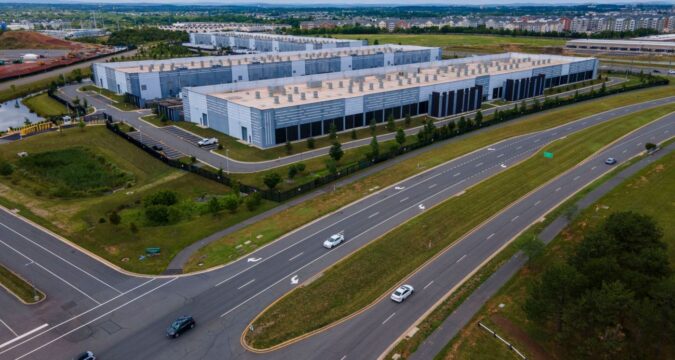
Mason didn’t know that the same day she arrived, a developer broke ground for a 1-million-square-foot data center for Amazon Web Services that now rises 70 feet directly across from her home on a cul-de-sac in this community near Aldie in southeastern Loudoun County.
The view from the community landing on Quail Ridge Lake now features the Amazon complex on one side and a 1.5-million-square-foot data center built by Microsoft on the other, with an electric power substation next to it. Neither data center is operating yet, but their presence is inescapable.
“It was a farm when we were looking at it,” she said. “Now we’re staring at a substation.”
That’s the new reality in the “ground zero” of data center development in the world. Loudoun is home to about 200 data centers, with 3,500 tenants occupying nearly 50 million square feet of space. As of early 2024, neighboring Prince William County had 44 existing data center buildings, with 12 million square feet of space. It had 15 more under construction with 4 million square feet.
Both counties benefit from a surge in data center tax revenues — nearly $1 billion this year in Loudoun, which has used the money to slash its real estate tax and car tax rates, build schools and athletic facilities, and even buy a historic estate proposed for a new state park south of Leesburg. Prince William collected $293.7 million in total revenues from the industry in 2024, more than 1.5 times as much as it did two years earlier.
“It’s been a great industry for us,” said Buddy Rizer, Loudoun’s economic development director. He began chasing data center development in 2007 when the county faced a financial crisis with the collapse of the housing industry that it had depended on for tax revenue.
State study
A state watchdog commission told legislators that the data center industry is projected to make big annual contributions to Virginia’s economy, mostly derived from the construction phase:
• 74,000 jobs
• $5.5 billion in labor income
• $9.1 billion in GDP
Data centers also can generate “substantial local tax revenues” depending on the number of data centers and local tax rates.
Challenges:
• An independent forecast commissioned by the Joint Legislative Audit and Review Commission found that “unconstrained demand for power in Virginia would double within the next 10 years, with the data center industry being the main driver.”
• “Data centers are currently paying their full cost of service, but growing energy demand is likely to increase other customers’ costs.”
• “The industrial scale of data centers makes them largely incompatible with residential uses.”
Source: Joint Legislative Audit and Review Commission
Now, the massive buildings — and what some consider the unsightly electric power facilities to serve them — aren’t just crowding ” Data Center Alley” in eastern Loudoun near Washington Dulles International Airport.
Data centers are rising in semi-rural neighborhoods around Leesburg — the county seat — and along Route 50 from Ashburn to Aldie. They’re spreading through neighboring Prince William, pushing into Fauquier County near Remington, the city of Fredericksburg and its surrounding counties, and south to the Richmond area.
This month, Amazon Data Services bought a 270-acre site in western Prince William for $700 million. In Loudoun, a data center developer paid $615 million for 97 acres east of Leesburg in the county’s first property sale to exceed $6 million an acre, according to Loudoun Now, a nonprofit news outlet.
Virginia’s statewide market
Cushman & Wakefield, a global real estate company that monitors the industry, now says the world’s leading data center market is Virginia, not just Northern Virginia.
“They stopped calling it the Northern Virginia market, and they started calling it the Virginia market because you’re seeing this migration out of Northern Virginia,” said Josh Levi, president of the Data Center Coalition, based in Leesburg but advocating for the industry across the United States. “That was a turning point in my mind.”
“They stopped calling it the Northern Virginia market and they started calling it the Virginia market,” said Josh Levi, executive director of the Data Center Coalition.
Rizer said Loudoun is “toward the end of our growth” in data centers. The industry is following the path of high-voltage electric transmission lines to avoid the kinds of power constraints that prompted Dominion Energy to temporarily halt data center connections in the county three years ago until it could expand the electric grid to serve them.
“I think the industry is chasing power,” he said.
Electric power is the most essential requirement for an industry that uses more and more electricity as it expands into artificial intelligence and other advanced technologies. Data centers talk about size in megawatts of electricity, followed by square feet.
“The tenants essentially want to know ‘How much power can I get in that facility?’ ” Levi said in an interview in Leesburg, across from a pair of 250,000-square-foot data centers owned by STACK Infrastructure and another operated by Microsoft. “Power is the basic challenge for the industry right now.”
The availability of electricity to run data centers is also the biggest challenge for Virginia: its public utilities and electric cooperatives, state and federal regulators, and the ordinary people who will have to live with the transmission lines and substations necessary to deliver power on a scale not seen in generations – and help pay for them. The industry’s need for enormous amounts of electricity also threatens to undermine laws, such as the Virginia Clean Economy Act, which legislators passed in 2020, aiming to reduce fossil fuel power plant emissions to combat climate change.
Dominion Energy, the state’s largest electric utility, expects to need 40 gigawatts of electricity for the 450 data centers it already serves and the long line of companies seeking to connect proposed data centers to the electric power grid in the near future. The Richmond-based utility company estimates that serving a large data center, requiring at least 100 megawatts of power, or enough for 25,000 homes, could take as long as seven years from the time a developer asks for service.
Multiple Manhattans
“Every data center cluster, we’re getting another Manhattan in Northern Virginia,” said Mark Christie, who stepped down in August as chairman of the Federal Energy Regulatory Commission after a career that included 17 years as a utility regulator in Virginia.
“If Dominion hooks up all 40 gigawatts (enough power for 10 million homes) of those data centers that are in their queue, Dominion has to find 40 gigawatts of generating capacity, and they have to either build it or they have to buy it,” Christie said in an interview. “And then you get to the question, who pays?”
Data centers’ thirst for electricity has caught the attention of Gov.-elect Abigail Spanberger, who has raised concerns about a looming energy crisis that could cause household electric bills to rise further.
Spanberger has watched closely as the State Corporation Commission completed hearings this fall on Dominion Energy’s proposal to create a separate rate class for data centers. The new rate class, which the SCC approved on Tuesday, is meant to ensure that residents or businesses that do not generate the demand for power or drive up the cost do not bear the costs of serving data centers.
The cost of purchasing power supplies on the regional grid has already bumped up monthly charges for customers of Northern Virginia Electric Cooperative. It serves more than 180,000 consumers, primarily in Loudoun and Prince William.
‘No guardrails’
“I have heard from constituents about rising energy costs,” said Prince William Board Chair Deshundra Jefferson. She defeated the incumbent, Ann Wheeler, in a Democratic primary two years ago over widely different visions of data center growth.
Jefferson took office weeks after the Prince William board approved the Prince William Digital Gateway at the end of 2023. The project would allow development of 37 data centers, encompassing more than 22 million square feet, or nearly double the amount already operating in the county.
The data centers would be built on 1,790 acres bordering the Manassas National Battlefield Park, site of two major Civil War battles. The project has touched off a political and legal war in Prince William, resulting in Jefferson unseating Wheeler as board chair and two lawsuits attempting to overturn the rezoning of the land, which scattered homes, fields and woods now occupy.
Prince William Circuit Court Judge Kimberly Irving overturned the rezoning on Aug. 7. Irving ruled that the board had violated the legal requirement for advertising the board’s rezoning hearing. It began on Dec. 12, 2023, and lasted 27 hours before the board voted 4-3 to rezone the land for the project. “The sheer size of this development cannot be overstated, and it gives credit to the unique concerns raised by the Plaintiffs in this case,” she said.
Data center developers are now eyeing the Richmond area. While counties welcome the sites’ tax revenues, residents’ concerns have prompted developers to withdraw some proposals and Henrico imposed further oversight.
Irving’s decision is under appeal, but it guarantees that the battle won’t end soon.
“The litigation is going to end up lasting longer than the Civil War with the track we’re on,” said former state Sen. Chap Petersen, D- Fairfax City, an attorney for a group of residents and the American Battlefield Trust in a separate lawsuit pending in the Virginia Court of Appeals. (The Civil War lasted four years.)
Bill Wright, a Gainesville resident who publishes a sharp-tongued email critique of data centers and their political influence in Prince William, estimates that with the Digital Gateway, Prince William would have 40 million more square feet of data centers than the highest demand that a county consultant projected over the next 20 years in a study completed just three years ago.
“Most citizens in the county aren’t aware of the full scope of the development that is planned,” Wright said. “There are no guardrails.”
Big tax benefits
Data centers produce enormous tax benefits to local governments. Loudoun has reduced its real property tax rate from $1.235 per $100 of assessed value in 2012, to 80.5 cents per $100 this year, the lowest rate in Northern Virginia.
Those revenues have also allowed the county to reduce its personal property tax on vehicles — the local car tax. “My goal is to get rid of the car tax in Loudoun County with data center money,” said Loudoun supervisor Laura TeKrony, who represents a district that sprawls from the suburbs around Dulles to the hunt country around Middleburg.
The money has also enabled Loudoun to pay for a new high school with a 5,000-seat stadium and use $22 million to buy Oak Hill, the historic estate of President James Monroe south of Leesburg, for a proposed state park.
But TeKrony, elected in 2023, says it’s time to put the brakes on data center construction near homes and in rural areas.
She was part of a board majority that voted in March to remove data centers as a “by-right use” in certain zoning districts so that they would have to apply for special exceptions to locate there. A divided board agreed to except 21 data center applications submitted before Feb. 12, as long as the projects were at least 500 feet from residences.
“I think they’re starting to creep into areas where they really don’t belong,” TeKrony said. “I think we’ve reached the saturation point.”
This month, the board adopted her proposal to require a minimum of 500 feet between homes and electric substations that serve data centers. Currently, 61 substations operate in Loudoun, with 17 proposed.
The board also approved Tekrony’s proposal to encourage “transit-oriented” development around the Loudoun Gateway Metro station, which is surrounded by data centers.
Julie Bolthouse, director of land use at the Piedmont Environmental Council, said the station, near Sterling, has the lowest ridership on the Metro system because no other users can afford the land around it. “Nobody is willing to build anything else, when land is going for $4 million an acre, other than data centers,” she said.
Jefferson, the Prince William board chair, said the county has been able to lower tax rates on real estate, vehicles and meals, but she also expressed concern that data center demand is driving up the price of land and pushing out other types of businesses.
“It’s hard for other industries to compete,” she said.
Residents’ concerns
Some say the biggest challenge is living next to data centers.
“You hear it, you smell it, you feel it,” said Elena Schlossberg, a Haymarket resident and executive director of the Coalition to Protect Prince William County. “You’re talking about the basic ability to live in your home peacefully.”
Ted Lewis lives next to scenic Goose Creek outside of Leesburg, but he sees the data centers that have been built near the creek and along nearby Sycolin Road. He hears them when they have to rely on diesel generators for power. Last year, he said one of the centers ran the generators for six days after an outage at a utility substation.
The generators are permitted for emergencies, including stabilizing the electric grid, but he told a county committee, “It seems clear to me the data center industry will use these emergency generators to supplement their power.”
The Piedmont Environmental Council has sounded the alarm over a state proposal of new guidance for what constitutes emergency use for diesel generators. Currently, the state limits its use to “sudden and reasonably unforeseeable events,” but the Department of Environmental Quality now proposes to let diesel generators run during planned power outages if they receive notice two weeks in advance.
TeKrony is concerned about the air pollution and noise for neighbors.
“That’s not OK,” she said.
DEQ spokeswoman Irina Calos said the agency proposed the change because of “ongoing confusion” over the emergency definition.
“It is important to note, the proposed guidance does not change any emissions limits included in the facilities’ (air quality) permits,” Calos said.
Lewis doesn’t see how the area will remain rural as the data centers creep closer.
“There are only 11 people who live in this area,” he said. “They’re just going to run right over us.”
Ben Keethler, president of the Loudoun Meadows Homeowners Association, has worked with TeKrony to strengthen the county zoning ordinance to tighten requirements for data center location, setbacks, noise and lighting.
“Ultimately, it’s a compatibility issue with residential neighborhoods,” Keethler said.
The Amazon data center sits 140 feet from the back deck of the nearest residence, he said. “To say that their view changed is an understatement.”
Levi, head of the data center coalition, said: “The balance is finding how and where to build data centers to address the community concerns, mitigate the impacts and ensure a successful and viable project.”
The two data centers next to Loudoun Meadows won’t begin to operate until next year, so Keethler and Julia Mason, who serves on the association board of directors, said they’re waiting to gauge the full effects on homeowners and work with the companies to address them.
“They’re there,” Mason said. “They aren’t going anywhere.”
© 2025 Richmond Times-Dispatch, Va.. Visit www.timesdispatch.com. Distributed by Tribune Content Agency, LLC.
https://www.dailypress.com/2025/12/01/northern-virginia-ground-zero-for-living-with-data-centers/