The first thing to know is J. André Smith and Mary Curtis Bok were friends. Great friends. The second thing to know is that they wrote letters. Lots of letters.
Those facts have unlocked the mystery of how exactly the Maitland Art Center came to be in 1937, thanks to a trove of letters stashed away but newly read. And, surprise: Although Smith founded the art center, it turns out credit for the idea is due to Bok.
Like many discoveries, it started with a happy accident.
Mary Louise Curtis Bok Zimbalist, to give her full name, founded the Curtis Institute of Music in Philadelphia in 1924, and the school holds a large collection of her letters. Out of curiosity, Katie Benson — the exhibitions manager for the A&H Museums, which oversees the art center — reached out and asked if they had any correspondence between Bok and Smith.
“When they went to look, they were like, ‘We have 600 pieces of correspondence between Mary and André,” said Dan Hess, the A&H chief curator. The Institute sent copies, and Hess and Benson got reading.
J. André Smith had a quick and breathless reply to Mary Curtis Bok’s offer to fund an art center in Central Florida, an offer that was the genesis of the Maitland Art Center. (Courtesy Curtis Institute of Music Archives)

Some are funny: Bok commisserates with Smith on the “vile people that infest New York City.” Smith complains about the art tastes of Central Florida and thinks any potential museum would be “about Old Masters and looking backwards” or “a depositing of discarded old paintings.”
But in one, dated Oct. 27, 1936, Bok makes an audacious suggestion on her typewriter: A suggestion that finally clears up how the Maitland Art Center got started.
“What would you think of securing, if possible, a bit of ground, more or less centrally located, and putting up an inexpensive but sufficiently adequate little Gallery of your own, me helping to this financially, providing it wouldn’t be too expensive?” she wrote.
Smith didn’t even wait for regular mail service to respond. He dashed off a telegram, also included in the collection: “As soon as I can breathe evenly and think clearly again I will write you regarding your amazing offer.”
The rest, as they say, is history.
Newly read letters between Maitland Art Center founder J. André Smith and his patron and dear friend Mary Curtis Bok inspired an exhibit at the venue titled “A Return to Espero.” The letters reveal crucial details about the center’s origin. (Courtesy A&H Museums — Maitland)

Bok and Smith had met in Maitland, introduced at a social occasion by the actress Annie Russell, whose name today graces the theater at Rollins College — a theater Bok also financially supported. When they decamped to their Northern homes, the letters flew between them fast and furious.
For the museum curators, reading the written exchange about establishing the art center, originally known as The Research Center, felt transcendental.
“It was an amazing moment for us,” Hess said. “For these letters to reveal themselves now… it’s closing that gap in the record. We’re really finding out what our roots are.”
The letters had other information to impart, as well — most significantly, the reason Smith chose the distinctive “Fantasy Architecture” features that make the arts center’s Art Deco-Mayan Revival aesthetic so unique to Central Florida.
Historic Maitland Art Center to undergo major expansion
“There was this whole mythology of why did André build the center in that style,” Hess said. But Smith explains himself — and the explanation is as simple as a childhood memory and as poignant as a quest just out of reach.
He writes to Bok about his lifelong love of Aztec carvings, dating back to his childhood when he would gaze upon them in the basement of the Museum of Natural History. (You can still find them in that New York City institution today, albeit in a newer gallery.)
Smith had wanted to see such Mesoamerican treasures in their natural habitat but was advised by friends the trip to Mexico and Central America would be too difficult for him; Smith’s right leg had been amputated after an injury during World War I.
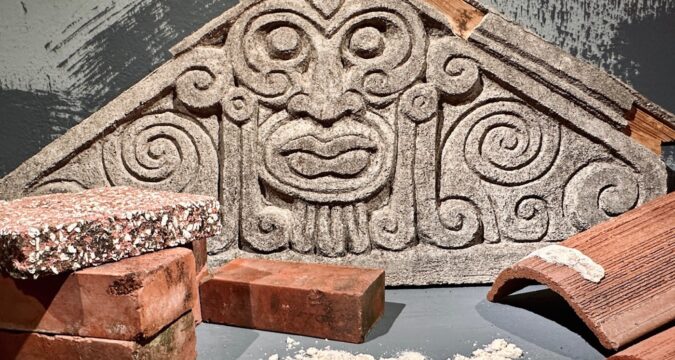
So Smith created his own Mesoamerican fantasy in Maitland.
“It’s heartbreaking,” Hess said. “He set out to build his own place here because he could never visit there.”
His artistic vision for the art center’s architecture would eventually get the venue selected for the National Register of Historic Landmarks in 2014.
J. André Smith’s letters are like works of art themselves, often illustrated by the artist and founder of the Maitland Art Center. (Courtesy Curtis Institute of Music Archives)

Hess compares Smith’s letters to works of art themselves.
“They are beautifully illustrated,” he said.
The public can judge for itself — and see the significant letters that filled in the art center’s historical gaps — in an exhibit titled “A Return to Espero.” It opens with Smith’s World War I battlefield drawings to show how his near-death experience changed him and paved the way for his Central Florida sanctuary.
The exhibit, titled with an early name for the center — “Espero,” which means “I hope” in the Spanish of Smith’s yearned-for Mesoamerica — also contains pieces of Smith’s concrete work that has never before been on display.
Remember Bok’s exhortions in her letter that the center not be too expensive?
In this letter from Mary Curtis Bok to J. André Smith, she suggests the idea for what would become the Maitland Art Center. (Courtesy Curtis Institute of Music Archives)

“Because of a somewhat restricted budget, he turned to concrete,” Hess said. “And he really figured out how to make concrete his own.”
The “Espero” exhibit goes on to demonstrate how the arc of Smith’s life followed the development of modernism in the art world, and ends with a photo from the day before his died along with works by the artists who have been inspired to create at the center.
“There are paintings by those who have come and been changed by the place,” Hess said. “And that was his goal.”
It’s not just artists who have been affected by the center, which has offered public art classes for years.
“Two older women had taken classes as children came to the exhibit, and one woman was in tears,” Hess said.
The “Return to Espero” exhibit at the Maitland Art Center concludes with works by artists inspired through J. André Smith’s vision for an artist colony in Central Florida. (Courtesy A&H Museums — Maitland)

He’s glad Bok is now getting the credit she deserves.
“We never knew how much she contributed until these letters,” he said.
And he thinks its appropriate that the bond between Bok and Smith is now even more firmly placed at the heart of the Maitland Art Center’s story.
“It was a friendship birthed in the art community here in Central Florida, and the art center is still about community now,” Hess said. “We’re looking at the center differently now because of these letters.”
Follow me at facebook.com/matthew.j.palm or email me at mpalm@orlandosentinel.com. Find more entertainment news and reviews at orlandosentinel.com/entertainment or sign up to receive our weekly emailed Entertainment newsletter.
‘A Return to Espero’
Where: Maitland Art Center, 231 W. Packwood Ave. in Maitland
When: Through Oct. 5 (hours are 11 a.m.-4 p.m. Tuesdays – Sundays, plus 5:30-8 p.m. the last Wednesday of each month)
Cost: $6; $5 for seniors; free for UCF, Valencia and Seminole State students, military personnel and veterans, and Maitland residents
Info: artandhistory.org
https://www.orlandosentinel.com/2025/09/10/maitland-art-center-smith-letters-exhibit/