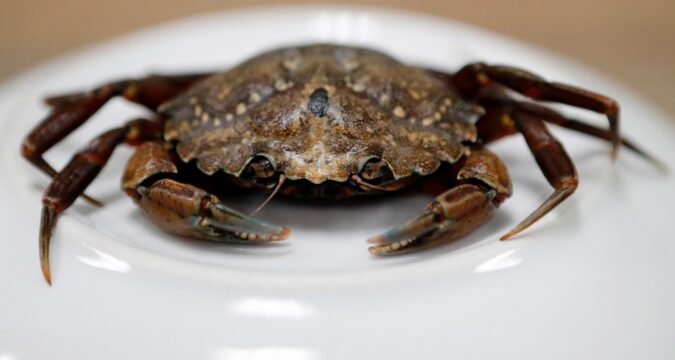
The European green crab, commonly found in the Long Island Sound, is becoming a beloved culinary dish known for its sweet, rich and complex flavor.
But unlike other types of standard seafood fare found on menus in Connecticut, the green crab is considered one of the “world’s most invasive species” to inhabit the icy waters off New England. The crab is believed to have come to the eastern Atlantic from western European waters over 200 years ago and is known for causing ecological harm as a voracious predator, consuming up to 40 half-inch soft-shell clams in a single day and eating a variety of shellfish including scallops, mussels and oysters.
According to the National Oceanic and Atmosphere Administration, green crabs are considered one of the most invasive species in the marine environment because they have very few predators, aggressively hunt and eat their prey, destroy seagrass and outcompete local species for food and habitat. The crab is now found from Maine all the way down to Delaware, according to the NOAA.
Now new ideas on how to control the population of the invasive crustacean are hoping to solve a two-century-old problem. Founded in 2020, GreenCrab.org is a nonprofit organization that aims to build culinary markets for European green crab and spread awareness of its invasive impact across the globe.
“Fortunately, green crab is also a sustainable seafood that is popping up on menus across the U.S. It can be served soft-shell, fermented, shucked for roe or transformed into stocks, sauces and soups,” said Mary Parks, executive director of GreenCrab.org.
“Green crabs are one of the world’s worst invasive species that threaten some of the world’s most valuable fisheries and vulnerable ecosystems. While we will never be able to eliminate green crabs through developing culinary markets, we can mitigate their invasive impact while creating a sustainable fishery,” she said.
In this Wednesday, Aug. 15, 2018, photo, University of New England marine sciences professor Markus Frederich holds a green crab at a campus research lab on in Biddeford, Maine. Frederich is researching an aggressive species of green crabs from Canada that’s making its way into New England waters, potentially causing greater harm to the marine environment than green crabs that are already here. (AP Photo/David Sharp)
As the green crab sheds, it swaps out its gill and digestive systems. If the crab is taken out of the water within 12 hours of molting, the new shell is still very soft and the new tissues have not developed enough to be off-tasting. That is when the crab is considered most desirable for cooking, according to GreenCrab.org.
Green Crab Week started in 2019 focused on establishing a new green crab fishery and promoting innovative dishes featuring the invasive species in restaurants across New England and New York. Since then, the culinary movement has spread across the country with several restaurants featuring green crab dishes each year. This year, Green Crab Week was held from June 20 through June 29.
Three restaurants and a seafood market in Connecticut joined over 75 restaurants, crabbers and organizations participating across the U.S. The Shipwright’s Daughter in Mystic, Swyft in Kent and New Haven’s BLDG at Passive House Hotel Marcel all featured the invasive crustacean on their menus back in June. To The Gills in Oakville was the sole participating seafood market in Connecticut selling the crabs during Green Crab Week.
Zach Redin, owner of To The Gills, said that he first heard of cooking green crabs after meeting Mary Parks of GreenCrab.org at a conference last year. That conversation sparked an interest that led him to participate in Green Crab Week for the first time. Now he says he can’t imagine not having them as part of the menu. Redin said that during Green Crab Week he sold soft-shell green crabs, green crab curry and green crab stock.
“I started putting green crab on my radar a little more last year and then this year I started cooking with them,” Redin said. “When you make a stock with green crabs it starts off gray and cloudy and then because this dark green color. It has this intense crab flavor that is just remarkable. You can make it with blue crabs but it wouldn’t have the same flavor. Green crabs really give you this unique intense flavor you can’t find anywhere else. People are really surprised when they try it.”
Redin said that green crabs were a popular item during Green Crab Week and that he believes as more people find out about their flavor, the more popular they will become. Redin is on the board of directors for the nonprofit Eating with the Ecosystem, where he said he aims to put green crabs on more menus across New England.
“The green crab flavor is so intense, but a lot of people don’t know what to do with them because there’s no practically meat on them,” Redin said. “They’re very tiny crabs so they’re mostly used for stock or making a crab chili oil. But once people learn how to cook them, it’s really a lot of fun. I think they will be on more menus as more people find out about their flavor.”
Stephen Underwood can be reached at sunderwood@courant.com.