He pulled up to his newly rented, modest house in Colts Neck in the fall of 1981, somewhat guilt-ridden in his newly purchased Z-28 Camaro, his girlfriend (Joyce Hyser) recently departed, his band, exhausted by the endless array of three-hour shows just concluded, had scattered.
As a fall chill fell over New Jersey, the roars of sold-out arena crowds finally stopped ringing in his ears, Bruce Springsteen walked alone into an empty house with a pocket uncomfortably full of money, a hard-fought career seemingly finally turned his way after a nasty lawsuit, but…at the same time, he sensed something was cooking and he hadn’t been near a stove.
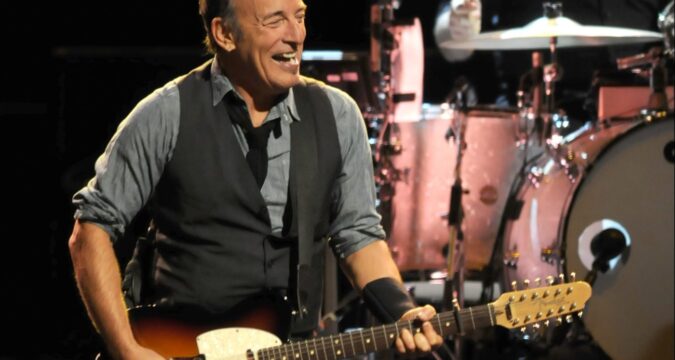
PHOTOS: Bruce Springsteen and The E Street Band perform at Mohegan Sun Arena
“I knew that something had happened to me that hadn’t happened to anyone else I knew,” Springsteen explained in Warren Zanes’ “Deliver Me From Nowhere,” Zanes’ 2023 in-depth look at the circumstances around Bruce Springsteen’s most unusual solo 1982 release “Nebraska.” The book offers the basis for the brand new Springsteen movie due out this weekend.
A haunting, deeply introspective record as intimate as if it had been recorded in some guy’s empty bedroom (and it was – his!) Bruce’s “Nebraska” album was a modest collection of dark, superbly drawn, homespun songs that filled the air in stark, absolutely diametrical opposition to the sounds that would normally set you alight during a three-hour Springsteen bonanza.
It was as if in all these years and tours and shows, he’d discovered a whole new set of untold, overlooked or forgotten tales from the American heartland that, well, if he didn’t share with us, nobody else would.
There was that sort of urgency about these homely, dead-honest performances of these songs from trailer parks and used car lots and wayward police stations and lonesome highways, songs lovingly feathered with the kinds of intimate details only someone who truly cared would notice.
And at the heart of it all this, this plunge into a previously unseen world was something Bruce finally had and, didn’t particularly seem to want— money.
“I was a guy that when I first made a record I didn’t know anyone else who’d made a record,” he said. “I’d never met another recording artist. I was totally on my own turf, having my own experience.
“The main thing that did happen to me when I came off The River is that I was solvent, which would make me unique in my little neighborhood. And that was where I still lived. So I was dealing with that, with all my very conflicted feelings about being so separate from the people I’d grown up around and that I wrote about. I was trying to figure out how I was gonna deal with that. And it was with a lot of guilt for a long time.”
Just buying a car, for example, was difficult.
“I sat around and anguished over whether I should spend ten thousand dollars on a new car,” he wrote. “I was thirty-one and I’d never owned a new car in my life. For that matter, outside of studio expenses, I’d never spent ten thousand dollars on myself. I didn’t know anyone who was making more than they were living on.”
“He kind of went into seclusion,” Max Weinberg, drummer for the band, told Brian Hiatt. “You didn’t see a lot of him, and for a while, none of us even knew where he lived. I remember that distinctly.”
By wanting to blend in, to play his small part in the American story, Springsteen had made himself invisible. And on the other side of fame, glory and fortune, he was there with his acoustic guitar, lonesome harmonica and his songs about the America that nobody else seemed to have time to sing about.
He had started with the songs for “Born In The USA”, too, was trying to find the right tone, how to react to these songs that seemed to coming to him non-stop. Why not get these down, he thought, giving the OK for his roadie, Michael Batlan to purchase a TEAC home recording device, just to get some of them on tape.
That was the environment, the beginning of Ronald Reagan’s eight-year run in Washington where Springsteen found these songs, for the first time hearing our president tell us in an Inaugural, “Government is not the solution to your problem, government is the problem” then went out and proved it. Those who now seemed stunned by Springsteen’s political activism should have listened a little closer to “Nebraska.”
As should have Reagan himself, who gave a nod to Springsteen on a campaign speech only to have it come back at him from a Pittsburgh stage where the artist seemed genuinely ashamed to have the president speak of him and his work. That America had gone that far afield. And that was then.
That Zanes and Springsteen and the filmmakers have chosen this sensitive moment in a long, triumphant career can, perhaps, point us again where we used to look for inspiration, for honor and integrity. The compass points that once used to guide all of us, from Washington on down. Could this film help us reset our course?
Zanes’ well-researched book is filled all sorts of gems like the technical trouble Springsteen caused by deciding to actually release a demo cassette he’d carried in his pocket for weeks on end as an official Columbia record, the somber and serious dip Bruce took into the unruly short stories of Flannery O’Connor which may have impacted these “Nebraska” songs.
“With Bruce, you don’t know what’s going to stick, where it’s going to come from or what it’s going to influence, often because his eyes are going to focus on something other eyes are not,” his manager Jon Landau observed.
Not only does Zanes recount the major depression Springsteen headed into shortly after completing this set of songs, at the same time he was stockpiling the gems he’d unleash for all of us on “Born In The USA” in a few months, once he felt it was time to move ahead, he even tells of Springsteen actually reaching out to an Omaha TV station for further details on Caril Fugate, the 14-year-old girlfriend of psycho killer Charlie Starkweather, whose tale is re-told in the title song. Bruce did the research.
Later, Zanes shares the centerpiece of Springsteen’s own memoir “Born To Run” where he’s on a cross country trip with a friend Michael Delia and they stop in a small western town and Bruce realizes that what’s been cooking all this time, all these years, has come to a full boil.
“From nowhere,” he writes in “Born to Run,” “a despair overcomes me; I feel an envy of these men and women and their late-summer ritual, the small pleasures that bind them and this town together…Right now, all I can think of is that I want to be amongst them, of them, and I know I can’t. I can only watch. That’s what I do. I watch and I record. I do not engage, and if and when I do, my terms are so stringent, they suck the lifeblood and the possibility out of any good thing, and real thing I might have…At 32, in the middle of the USA, on this night…I feel a deeper anxiety than I’ve ever known.”
He’s better now. “Nebraska” was probably one of the reasons. Years and years of therapy was another. A lengthy, happy marriage and family — he’s a grandpa now—have, too. And lastly, as someone who truly believed everything he’d always been taught about our country and its citizens, especially the forgotten ones, and decided long ago to let that belief be the lifeblood of every song he’s sung or written ever since. Bruce Springsteen’s gift for music gave him a platform, his unflinching, unrelenting belief in America has given him — and us — something else.
John Nogowski is a former Connecticut resident, author and sports writer. His book, “Bob Dylan: A Descriptive, Critical Discography and Filmography 1961-2022” is available online at Amazon.
https://www.courant.com/2025/10/24/opinion-bruce-springsteens-gift-to-america-and-to-us/