“If my son had long hair and sandals he should have been shot too.”
That’s what one mother said to the filmmaker Richard Myers who interviewed residents on the streets of Kent, Ohio the day after Ohio National Guardsmen shot into a crowd of students involved in the fourth day of protests at Kent State University, May 4, 1970.
Four students, two girls and two boys, were killed, and nine others were shot but survived, one was paralyzed for life.
Dean Kahler, Paul Keane and Alan Canfora at 25th anniversary of Kent State shootings, Emerson College 1995. Contributed photo.
I saw the bloodshed as a graduate student and dorm counselor in Manchester Hall that day, and equally shocking to me as the killings was the hatred and ignorance which divided that mother from her own flesh and blood in that interview.
‘What is wrong in America?’ I thought.
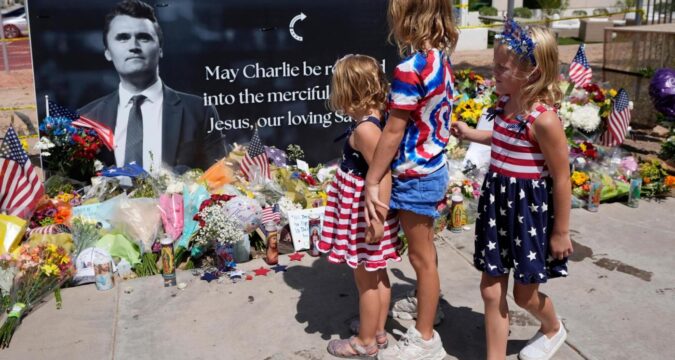
It is the same thought people are uttering 55 years later in September, 2025 when the 31-year-old “Prove me wrong” conservative activist and public debater, Charlie Kirk, has been shot and killed in front of 3,000 students out in the open on a college campus in Utah.
He was in the middle of a sentence answering a student’s question at his trademark “prove me wrong” debate format.
In both cases, the Kent State killings and Charlie Kirk’s murder, the bloodshed was witnessed by thousands of horrified students and instantly transmitted around the world.
In 2O25, worldwide circulation was no surprise because the internet and social media are equipped with instantaneous abilities, but in 1970 worldwide circulation by the clunky newsprint media astonished everyone.
A single photograph of a 14-year-old girl kneeling with upraised arm in despair near the blood of Kent State student Jeffrey Miller trickling down the asphalt walkway near his prone body with his head blown apart by a guardsman’s bullet —- that single photograph did it.
A man reads the Ohio historical marker commemorating the Kent State shootings, Monday, May 4, 2020, in Kent, Ohio. The Ohio National Guard opened fire on unarmed college students during a war protest at Kent State University on May 4, 1970. Four students were killed, and nine others were injured. Not all of those hurt or killed were involved in the demonstration, which opposed the U.S. bombing of neutral Cambodia during the Vietnam War. (AP Photo/Tony Dejak)
It went around the world instantly on wire services.
That photo appeared in nearly every newspaper in the world and won a Pulitzer Prize for student photographer John Filo.
In 2025 pundits are shocked that videos of the bloody body of Charlie Kirk have circulated on the internet. Pundits call it ghoulish and blame social media.
I agree with the despondent First Lady Jacqueline Kennedy in her pink suit and pink pillbox hat splattered with blood from sitting next to her husband, John F. Kennedy, in the open presidential limousine in which he was murdered, Nov. 22,1963, by a bullet from Lee Harvey Oswald’s rifle.
When asked if she wanted to change her bloodstained clothes before she was photographed at the swearing in of Vice President Johnson, the First Lady, suddenly a widow, replied, “No. Let them see what they have done.”
It became almost a visual pink and blood prophecy.
Jacqueline Kennedy speaks to all those who want to banish Charlie Kirk ‘s blood from the internet.
“No. Let them see what they have done.”
Paul Keane is a Connecticut native, a Yale Divinity School graduate and a retired Vermont teacher.