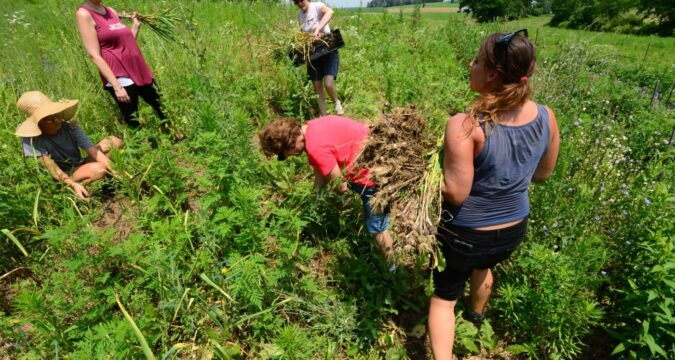
Farmland is not just scenery or nostalgia. It is industrial infrastructure. Just as roads, bridges and sewers are physical assets that keep a community functioning, farmland is a working resource that sustains our food supply, supports the economy and strengthens the local tax base. Once it’s paved, it is gone forever. Preservation protects a critical and irreplaceable resource. The author of a recent op-ed in The Morning Call, “What Are We Saving? Rethinking Development in the Lehigh Valley,” misses this central point.
On another point, however, I agree. Articles in The Morning Call announcing newly preserved farms often don’t explain why particular farms are protected, leaving readers with only the feel-good headline. In reality, farmland preservation is anything but random. It is a rigorous, criteria-driven process administered locally through each county. Each property is evaluated by county Farmland Preservation Boards using objective scoring systems. In Lehigh County the system first looks at soil quality. It considers development pressure and proximity to growth areas or public utilities. Parcel size matters, along with whether the farm is part of a larger block of contiguous farmland or near already preserved farms. We try to create unbroken agricultural belts, making it easier for farmers to work the land. Boards also weigh overall farm viability, including stewardship practices and long-term potential. Finally, we ask whether a farm is compatible with the surrounding area and consistent with the Lehigh Valley Planning Commission’s Regional Plan.
Lehigh County has preserved 413 farms on 28,400 acres but still has a waitlist of more than 40 farms, while Northampton County has preserved 266 farms on 19,800 acres — clear evidence that landowners want their family farms protected for the future.
Farmland preservation also makes financial sense. In a time when property taxes and the cost of living make it harder for families to achieve and maintain homeownership, farmland and open space create almost no demand on costly public services. Farmland produces no traffic, creates no crime, requires no new fire or police protection, and does not send new students into our schools.
By contrast, sprawling commercial or warehouse development, or the latest challenge of data centers, often cost municipalities more in infrastructure and services than they return in tax revenue. Liabilities can outweigh new revenue.
The author also does not give communities enough credit. I do not see blanket opposition to all development. I mostly see opposition to bad projects — those residents worry could burden taxpayers and undermine long-term quality of life. Yes, there are not in my backyard voices. Folks who oppose any progress or change. But those voices are far fewer than those who understand that change is inevitable, if not welcome, but who simply want things to evolve responsibly.
And yes, we need more housing inventory. The answer to rising home prices is not heavy-handed government interventions or market disruptions that often backfire. It is increasing supply by adding more homes. On this point, I also agree with the author. Communities should not be afraid of targeted density along corridors where infrastructure and services already exist, as well as in town centers and our regional city cores. We also need to reduce government barriers that make responsible infill, mixed use and adaptive reuse projects unnecessarily complicated and expensive.
There is a reason developers so often prefer to plow over cornfields: it is consistently cheaper, faster and less complicated than redeveloping sites already on or near infrastructure.
The question is not whether we should grow. The Lehigh Valley is and will continue to. The real question is how we grow, and at what cost. Preserving farmland is not about halting progress. It is about protecting a resource that keeps our tax base strong and our communities resilient. At the same time, we can meet housing needs through local smart growth strategies: targeted density, infill and redevelopment where infrastructure already exists, while eliminating government barriers. Farmland and housing are not at odds. With thoughtful planning, we can have both, while avoiding the sprawl that drains local budgets and erodes our quality of life.
This is a contributed opinion column. Ron Beitler is a Lehigh County commissioner and chair of the Lehigh County Farmland Preservation Board. The views expressed in this piece are those of its individual author, and should not be interpreted as reflecting the views of this publication. Do you have a perspective to share? Learn more about how we handle guest opinion submissions at themorningcall.com/opinions.
https://www.mcall.com/2025/10/01/opinion-lehigh-valley-farmland-is-infrastructure-not-nostalgia/