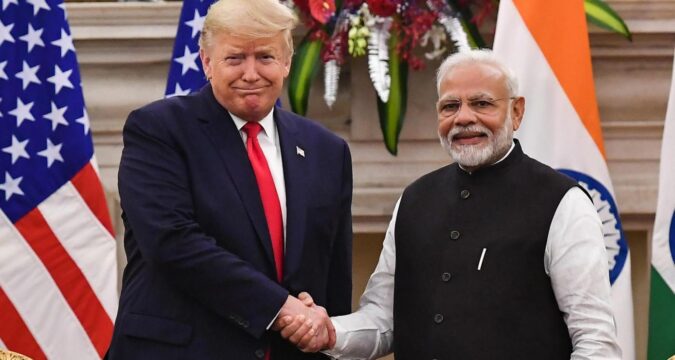
President Donald Trump imposed a crushing 50% tariff on Indian goods to punish the country for buying Russian oil, upending a decades-long push by Washington to forge closer ties with New Delhi. It’s a stunning reversal of fortune for India and a further sign of Washington’s realignment with regional rival, Pakistan.
When Donald Trump entered the White House, few expected him to reshape America’s approach to South Asia. For decades, U.S. policy had tilted toward India—courting its market, cultivating its democracy, and counting on New Delhi to serve as a counterweight to Beijing. Pakistan, by contrast, was cast as an unreliable partner—useful only as a proxy to fight terrorists in Afghanistan but accused of taking U.S. aid for granted. In the last year however, Trump has unsettled that orthodoxy. In his own disruptive way, he has forged a more strategic balance between Pakistan and India—one that recognizes Pakistan’s enduring importance to regional stability, while reminding India that Washington’s support is not unconditional.
The shift was first signaled during Trump’s State of the Union address, when he singled out Pakistan for its role in an operation in Afghanistan that resulted in the capture of a senior ISIS commander responsible for the deaths of 21 American servicemen in the Kabul airport bombing. It was a rare moment: a U.S. president publicly crediting Islamabad with a success that mattered deeply to American families. For years, Pakistan has bristled at being treated solely as a problem. Trump’s acknowledgement validated the reality that Pakistan’s counterterrorism role—imperfect as it may be—remains indispensable. The message was not lost in Islamabad, where officials saw it as a sign that Washington might be turning the page on years of finger-pointing.
India sees ‘upward trend’ in China ties amid Trump threats
That recognition has been reinforced by action. Earlier this year, Trump met privately at the White House with General Syed Asim Munir, Pakistan’s Chief of Army Staff, to discuss not only counterterrorism but also bilateral economic relations—an unprecedented step for an American president. Such outreach matters. The Pakistani military remains the central institution in the country, and any genuine reset requires its buy-in. By engaging directly with Munir, Trump not only signaled respect but also opened the door to practical cooperation on trade, investment, and energy. For a country struggling with economic headwinds, the promise of deeper economic ties with the United States is powerful leverage.
There are also signs the rest of the world is noticing Pakistan’s reforms. After years of scrutiny, the Financial Action Task Force (FATF) recently removed Pakistan from its “grey list,” recognizing the government’s serious steps to crack down on terrorist financing and money laundering. The move was more than symbolic—it gave Pakistan renewed access to international markets and credit, and bolstered its argument that it is prepared to be treated as a responsible stakeholder. For Washington, that progress provides another reason to keep the door to cooperation open.
Trump also showed an ability to act as a mediator when Pakistan and India edged dangerously close to open conflict. Following cross-border skirmishes and escalating rhetoric, the region teetered on the brink of a potential nuclear flashpoint. Here, Trump’s intervention was decisive. He leaned on both sides, applying pressure behind the scenes, and helped broker a de-escalation.
India, for its part, has badly misplayed Trump’s overtures. Instead of seizing on U.S. efforts at peace and dialogue, New Delhi doubled down on hardline positions, including repudiating Trump’s effort to deescalate the recent conflict with Pakistan. At the same time, its economic decisions have clashed with Trump’s “America First” priorities. Most notably, India has continued importing the bulk of its oil and gas from non-U.S. sources, even after repeated warnings. The result: massive sanctions. For a relationship once billed as the centerpiece of America’s Asia strategy, it was a sharp downturn. Trump made clear that even large democracies are not immune from pressure if they disregard U.S. interests.
This represents a broader shift. For years, Washington viewed India as the senior partner in South Asia, betting on its vast population and rapid growth to serve as a counterweight to China’s rise. American firms transferred technology, capital, and intellectual property into India, hoping to build a like-minded economic giant. Yet this bet has come at a cost. Much as the U.S. once “coddled” China—ushering it into the World Trade Organization and tolerating mercantilist practices that hollowed out U.S. industry—India now enjoys privileged access to American technology and markets. Its economy has grown in ways that often come at America’s expense. The uncomfortable question arises: could India be the next China?
Consider the parallels. China was once seen as a partner whose growth would benefit the world and lock it into a cooperative system. Instead, it became a strategic rival, leveraging Western capital and technology to fuel its rise. India, though a democracy, is already showing signs of divergence: pursuing its own independent foreign policy, resisting U.S. sanctions regimes, and guarding its domestic markets. It is not inconceivable that in a decade or two, India could stand in an economic position similar to China’s today—empowered in part by American technology transfer, yet pursuing ambitions that challenge U.S. interests.
Trump, characteristically, has little patience for such illusions. His administration’s willingness to sanction India, pressure it on energy imports, and publicly highlight Pakistan’s cooperation suggests a reset in U.S. thinking. South Asia is no longer viewed through a simple India-centric prism. Instead, Trump is carving out a more balanced approach: rewarding Pakistan when it delivers, cautioning India when it strays, and inserting American leverage at moments of crisis. It is not a polished doctrine, but it reflects a kind of disruptive pragmatism—recognizing realities on the ground rather than clinging to past orthodoxy.
Looking ahead, the future holds the possibility of strategic convergence. Afghanistan remains an unresolved issue, with troubling reports that Al Qaeda is reconstituting there. That makes Pakistan’s intelligence cooperation and counterterrorism partnership even more critical for American security. At the same time, Pakistan sits atop significant mineral deposits—including rare earths—that its leaders have signaled they want to offer the United States preferential access to. And in a symbolic gesture that underscores the goodwill Trump has cultivated, Pakistan has gone so far as to nominate him for the Nobel Peace Prize. If cultivated carefully, these shared interests could underpin a durable partnership: one that strengthens U.S. security, supports Pakistan’s economic recovery, and creates new leverage in a region long defined by volatility.
In South Asia, balance is not weakness; it is strategy. Trump’s instincts, however unconventional, have managed to reassert America’s role as the indispensable power—able to shape events between nuclear-armed rivals, while protecting its own economic interests. In a region where missteps can spiral into catastrophe, that balance is an achievement worth noting.
Christopher Shays represented Connecticut’s 4th Congressional District for 21 years including holding senior positions on Homeland Security and Government Reform Committees.
https://www.courant.com/2025/09/02/opinion-massive-india-tariffs-signal-a-u-s-shift-in-south-asia/