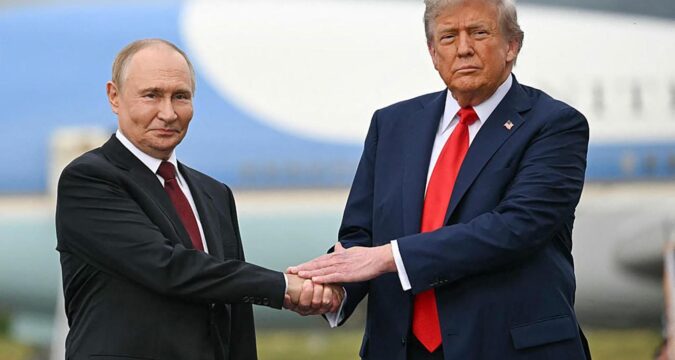
For some time now President Trump has been exhibiting a couple of mindsets that are cause for concern. One is that he seems intent on a fundamental reordering of the post-World War II structure of interlocking diplomatic, military and economic agreements/organizations, the very agreements and organizations that were able to preserve relative peace, stability and prosperity for several decades after 1945. In their place he has indicated a preference for transactional bilateral relations, conceived as zero-sum rivalries in which he is the dominant player and always “wins.”
This may be seen in his initiating trade wars with allies and adversaries alike, justifying increased tariffs on the specious pretext that many of these countries are a threat to our national security. His naïve and narcissistic confidence in his own powers of personal diplomacy and his faith in a handshake with the likes of Vladimir Putin recall the hapless Neville Chamberlain in the 1930s.
Then there is his open admiration of authoritarians, all in the context of his constant disparagement of our democratic allies. This is no small matter for we have been seeing a wave of rising authoritarianisms in the world recently. Perhaps the most apt description of this new authoritarianism is the insidious term “illiberal democracy.” Recep Erdogan in Turkey, Putin in Russia, Viktor Orban in Hungary and the Ayatollah Khamenei in Iran have all discovered that opposition parties can be left in existence or elections can be held in order to provide a fig leaf of democratic legitimacy, while in reality these elections pose scant challenges to their power. Along the way, rival opposition leaders are neutralized, if not totally eliminated, one way or another.
The great danger of these new authoritarianisms is that, unlike some of those that came to power in the 1920s and 1930s, and in the midst of the Cold War, the construction of overtly antidemocratic dictatorships is deemed unnecessary for holding power. Likewise, total control of the press and other media is also unnecessary, since a flood of managed and fake news so pollutes the flow of information that facts and truth become irrelevant as shapers of public opinion. Once-independent judiciaries are gradually dismantled through the appointment of politically reliable loyalists. Xenophobic nationalism with its inherent anti-immigrant bias is crucial to these regimes in mobilizing popular support. So, too, the prioritization of “law and order” over individual rights. Unfortunately, Trump has shown a great affinity for these major tenets of illiberal democracy right here at home.
Yes, the domestic agenda of Trump’s illiberal sense of democracy falls considerably short of totalitarian dictatorship exemplified by Hitler and Stalin. But that is small comfort for those who hope and believe that the arc of history inevitably bends toward greater emancipation, equality and freedom. Likewise, it is small comfort that in foreign policy Trump does not emulate the Hitlerian goals of wars of conquest and genocide. Nevertheless, the prospects for peace and stability are still being seriously threatened. Escalating trade wars, for example, may well tip the world economy into decline, this despite the fact that America’s own economy in the midst of Trump’s tariffs is proving more resilient than many believed possible.
It may be that Trump is engaged in excessive rhetorical posturing as a bargaining chip and will retreat to more moderate positions. We have seen evidence of this in the last few days with him reducing tariffs on a range of imported food items in the face of rising prices. But it is also possible that adversarial momentum will build, room for concessions will disappear, and he will plunge the country into dangerous economic or military conflicts as he becomes increasingly captive of his own rhetoric. His recent threats against Venezuela, accompanied by a rapid buildup of naval capability in the Caribbean, immediately come to mind. Historically, such confrontations and escalations have sometimes escaped the control of our politicalleaders.
Then, too, as Trump’s bombing of boats allegedly carrying drugs from Latin America demonstrates, the line between war and peace has become ever more blurred while the constitutional role of Congress in this area continues to atrophy. That said, how will Trump respond to the challenges facing America in the Arctic, in orbit, on the sea floor and in cyberspace? His recent approach to Greenland would seem to indicate he prefers mafioso tactics over long-term strategic wisdom. If so, no wall will be high enough to shelter the U.S. from unexpected threats in these areas.
No matter how the Trump presidency ends, the specter of illiberalism will continue to haunt American politics more generally, and the country’s foreign relations in particular. Case in point: Within several decades after Trump’s presidency is over, the looming effects of ecological disaster due to human-caused climate change will likely come home to roost. Alas, it is this reality that Trump has not only denied but is doing so much to accelerate.
This is a contributed opinion column. Roger Whitcomb is a professor-emeritus of foreign policy studies at Kutztown University. The views expressed in this piece are those of its individual author, and should not be interpreted as reflecting the views of this publication. Do you have a perspective to share? Learn more about how we handle guest opinion submissions at themorningcall.com/opinions.
https://www.mcall.com/2025/12/03/opinion-president-trumps-actions-put-americas-future-in-doubt/