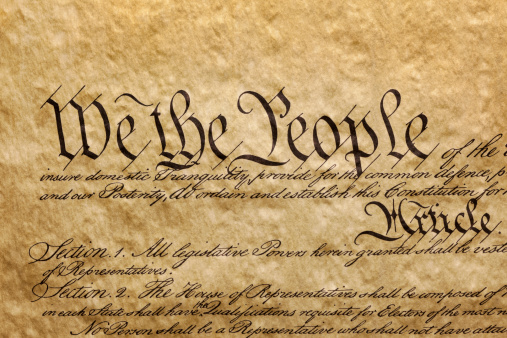
The U. S. Constitution is the world’s longest-surviving written constitution. However, some have expressed frustration with our government’s fundamental rule book. Some have even suggested the Constitution needs to be replaced with something more modern.
For example in her book “We the People,” Jill Lepore, a professor at Harvard, argues that America’s constitution has become an anachronism because it is, contrary to the founders’ wishes, too hard to change.
The Constitution has been amended 27 times. The most recent amendment, the 27th, (1992) prevents raises for Congress from taking effect until after the next election. The most recent substantive amendment, the 26th, (1971) lowered the national voting age from 21 to 18.
The framers intended the Constitution to be amended laying out the process in Article V, but they did not intend doing so to be easy. Amendment purposely requires consensus in the form of a double supermajority.
Critics complain that Article V is unworkable, and this has led to our government dysfunction. For example, Congress delegates too much legislative power to agencies and fails to legislate at all on pressing issues. Successive presidential administrations have relied on executive orders to replace legislation and the Supreme Court’s recent swing to more precedent-breaking constitutional interpretations, has laid bare the court’s exercise of power not explicitly granted by the Constitution.
Are our core principles — such as federalism, the separation of powers and the sovereignty of the people — once enshrined and protected by our Constitution now threatened by it due to its inflexibility?
Like so much today, these concerns while real are greatly overstated and in fact our constitutional rule book is up to the task of protecting our fundamental rights and core principals. In fact, I see the lack of constitutional amendments on hot-button issues as evidence that our Constitution is working precisely as intended.
The truth, which both the extreme right and left find so frustrating, is that we the people are fairly evenly divided with respect to many of the most passionate issues of our day. In other words, the consensus required by Article V does not exist. That is why proposed amendments fail.
This is neither the fault of the Constitution nor something that changing or amending the Constitution will remedy. My biggest concern is that those who are most in favor of wholesale change to the Constitution, really desire to make it easier for one group of people to force their views on those who disagree with them. This is fundamentally inconsistent with American individual liberty.
The framers could not have anticipated modern society (entrenched political parties, artificial intelligence, climate change), but the wisdom of the Constitution is reflected in fact that the basic principles underlying it are as true today as they were in the 18th century.
Absolute power corrupts absolutely, the people alone are sovereign and the only legitimate government authority comes from the consent and consensus of those governed. Consent or consensus is more than a simple majority, it is the general agreement of the people reached through deliberation and compromise.
This is why the rights enshrined in the Bill of Rights are so important. Free speech is needed for consensus to be reached. There can be no national religion because the power of government does not come from organized religion but from those governed. Individual liberty shall not be interfered with absent a consensus of the people.
The Supreme Court’s power of judicial review is not specifically mentioned in the Constitution, but the concept was prevalent among the framers as set out in Hamilton’s Federalist No. 78. The argument that the judiciary is the weakest branch of government as it controls neither the purse nor the sword is still valid today as is the need to protect individual rights from legislative overreach. Also, constitutional changes made by judicial decision, can be undone in the same way.
Our Constitution has served us well. It has facilitated American Exceptionalism — from 13 to 50 states, from a local to a global power, from a slave-owning society to a free one. The Constitution is also our best hope for the future as we the people continue the work of building a more perfect union.
This is a contributed opinion column. George A. Nation III, is a professor of law and business at Lehigh University. The views presented are the author’s and do not represent those of Lehigh University’s College of Business. The views expressed in this piece are those of its individual author, and should not be interpreted as reflecting the views of this publication. Do you have a perspective to share? Learn more about how we handle guest opinion submissions at themorningcall.com/opinions.
https://www.mcall.com/2025/10/15/opinion-the-constitution-does-not-need-replacing-or-major-changes/