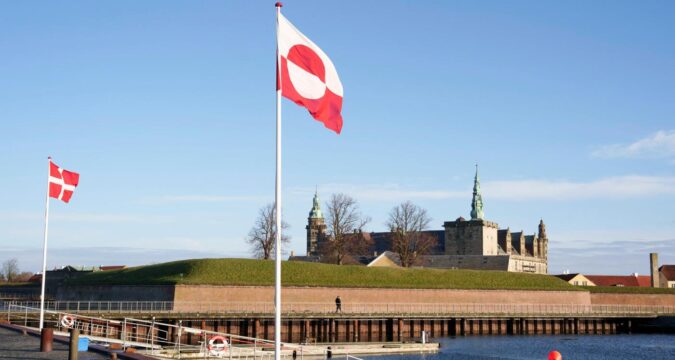
Greenland and America have been through a lot together, and the bonds forged from the commercial whaling and polar exploration days of the 19th century through World War II and the Cold War run deep. If America were to take Greenland, it would be less a hostile takeover and more a messy divorce leaving bruised feelings and broken hearts, all mendable with time. Indeed, one can think of an American intervention as something of a rescue mission, bringing a decisive end to a long and messy forced marriage between the Danes and Greenlanders.
Danish veterans of US wars feel betrayed by Trump’s threats against Greenland
This would not be the first time that the American military has come to Greenland’s rescue. First there were the Nazis, who infiltrated weather teams on Greenland during World War II to radio updates to the Wehrmacht to help its long fight against the western allies. We sent the Coast Guard to serve as the Greenland Patrol, and they held the line. The Germans, caught between the tightening vise grip of advancing western allies in the west and the Red Army in the east, were unable to break out of mainland Europe to threaten Greenland and beyond that Labrador, Newfoundland and the Gulf of St. Lawrence as many then feared they would.
Soon after the second world war ended, a new nemesis arose, when our old war-time partner, Stalin, turned his victorious forces of Eastern Europe’s liberation from Hitler into an army of occupation that quickly subjugated half the continent, snuffing out the embers of democracy for nearly half a century to come. America quickly pivoted from postwar euphoria and demobilization to planning for a long, cold war. It was bad enough that from 1945 to 1948, Eastern Europe fell under Stalin’s thumb. But then in 1949, the Soviets split the atom and the USSR thereby emerged as the world’s second nuclear power. With Stalin’s large standing army smothering half of Europe, and his fledgling nuclear arsenal extending Moscow’s ambitions overseas, America had to scramble.
And scramble we did. First, in 1949, we formed NATO with the April 4, 1949 signing of the Washington Treaty with a dozen founding members, several of which were former foes and/or colonizers, including the British we once overthrew at the birth of our republic. (And in 1955, even West Germany, which we had only defeated a decade earlier, joined the alliance – bringing together a motley crew of allies with complicated relationship history. Also in 1949, Newfoundland and Labrador, until then British, joined Canada – bringing their defense and security under control of America’s next door neighbor in Ottawa. From then on, Greenland, under colonial rule from tiny Denmark, was an outlier in the North American Arctic.
Two years after NATO was formed, the Danes and Americans agreed to extend their wartime defense of Greenland through the long twilight of the Cold War, with their 1951 bilateral defense treaty providing the Yanks unfettered access to the vast and lightly populated island (the world’s largest). At the same time, America bore nearly all of the cost of the island’s defense, to Denmark’s great sigh of relief. President Truman offered to buy Greenland outright, but the Danes said no to his $100 million offer of gold bullion. But the idea of America defending Danish sovereignty over such a large chunk of North America, with the American taxpayer footing the bill, never felt right.
And yet, America kept at it. Between 1954 and 1957, it completed construction of the world’s most massive and audacious construction project, the DEW Line (short for Distant Early Warning Line), a string of radar bases that stretched across the top of North America from Alaska across both Canada and Greenland, and incorporated the (then) new air base at Thule, now called the Pituffik Space Base. At one point, we built and manned up to 17 military installations, with a total manpower of 6,000 troops, well more than today’s 150-200 lonely troops at Pituffik, the sole remaining US base on the island.
Back then, America feared an armada of Soviet bombers laden with A-bombs barreling over the horizon, dodging our few anti-aircraft batteries, and dropping their deadly payloads on undefended American cities. But by the late 1950s, ICBMs emerged – and these deadly intercontinental ballistic missiles presented North America with a more insidious (and for a long time, indefensible) threat. In little more than 20 minutes, nuclear hell would fall upon the long-insulated Americans from the heavens above. Slow, lumbering bombers were no longer needed, nor were our efforts to counter them, as these deadly, far-reaching nuclear-tipped rockets entered the military arsenals of both America and the Soviet Union.
Greenland became less essential to America’s survival – which came to depend more and more upon space-based surveillance, and in time, ballistic missile defense systems (of the sort we now have in Alaska). The US presence on the world’s largest island soon declined, though its bilateral defense treaty with the Danes remained in effect, and was updated in 2004 to catch up to more modern, less colonial times, with the autonomous Home-Rule government in Nuuk joining the treaty – and in so doing, gaining a voice in the future defense of their island.
In 2009, more robust Self-Rule would strengthen Greenland’s autonomy, with an eye to eventual independence. But somewhere along the amicable journey toward a more independent Greenland actively involved in its own defense and security, a warming world with its increasingly accessible Arctic resources and declining sea ice caught the attention of nearly all world powers, great and small.
At the same time, Russia resurged as military power, and China rose as an economic superpower with an increasingly potent and global military reach. In no time at all, the Arctic was in play. As Russia turned its tanks upon Ukraine in a bid to restore its imperial past, NATO expanded across the once neutral Nordic region, nearly to the gates of Saint Petersburg (as it must have seemed to Russians), not all that long after the alliance had incorporated the tiny Baltic statelets once under Moscow’s direct rule. And soon, the future of Greenland itself came into play once more. But not from Russia or China, as the White House now contends in its effort to sell its vision for Greenland’s future under the star spangled banner. But rather from America itself, with the president enamored with the idea of a Mt. McKinley-sized geopolitical move via a Sewardian territorial expansion, right into the history books.
Donald Trump thanks you for your attention to these matters in his second term
At first, in 2019 when Trump’s big idea to purchase Greenland first arose, people laughed it off as preposterous. But with its successful overnight snatch-and-grab of Venezuela’s ruling family without a single lost American life (or aircraft), the White House now felt emboldened. If it could grab Venezuela’s oil (the world’s largest known reserves) at so low a cost, why not Greenland too, with its bountiful untapped mineral wealth? And so, now Greenland has transformed from beneficiary to target of American power.
Will, as many fear, the NATO alliance started buckle under this strain? While the alliance is distracted by this internal strife, some fear that the Russians might make a grab for Svalbard, or the Baltic micro-states, where Moscow’s ties are long and deep (and where their sovereign ambitions are perhaps even more convincing than America’s for Greenland.) Russia might also be tempted to grab Hokkaido, and continue the war that Stalin began in 1945 when he invaded the then-Japanese Kuril Islands.
US stocks recover half of the prior day’s plunge after Trump calls off Greenland-related tariffs
But we need not worry about NATO’s survival, or a fatal collapse in alliance cohesion. In 1951, when America entered into its bilateral defense treaty with Denmark to secure Greenland, NATO was at its zenith of unity and cohesion, but it was at the time still quite small, with only a dozen member-states, many not yet recovered from the devastation of World War II and many were, at one-time or another, adversaries in war or former colonies of one another. (Iceland and the UK would in time become future adversaries in their long-running, low-intensity “Cod Wars” from 1958 to 1976.)
A year after Greenland’s 1951 bilateral defense treaty, in 1952, NATO expanded to include Greece and Turkey, who would in 1974 also go to war against one another – on the island of Cyprus. And in 1966, NATO survived the exit of a key founding member, France – and had since the 1954-62 Algerian War excluded this contested French colonial territory from its collective defense commitments and in turn reduced its defensive footprint to exclude former French colonial territories in North Africa. In so doing, avoid withdrawing NATO’s commitment to defend NATO member states’ remote, former (and, in the case of Cyprus, coincidentally insular) colonial territories was thus established as a norm for the alliance, not an exception – one that is newly relevant once again.
With the subsequent expansions of NATO in the years since the Cold War ended, the alliance has become ever more fractious and diverse. This has made alliance politics more contentious, but in the end the alliance has not only endured, but even strengthened. Denmark says if President Trump annexes Greenland by force, it will mean the end of NATO. Many European allies agree. But this is not a foregone conclusion.
NATO has overcome such internal dissension before. When Iceland and Britain fought over disputed cod fisheries, their fight was over an expanding (and contested) maritime frontier as the Law of the Sea expanded territorial waters, to the frustration of global fishing fleets long accustomed to fishing in what were now somebody else’s waters. When Greece and Turkey came to blows, it was over a dispute on Cyprus, an island just beyond NATO’s borders. And when France exited NATO, NATO quickly modified its commitments to defend formerly French colonial territories in Africa, stepping back from a pledge of collective defense once its collectivity restructured under the pressures of decolonization.
Opinion: China’s Arctic ambitions intentionally exaggerated
Now, as America turns its hunger for territorial expansion (and likely, a treasure chest of natural resources) to Greenland, it is explicitly challenging Denmark’s right to colonize this vast North American island that America has been defending since World War II, and which even Seward himself sought to acquire over a century and a half ago.
As Trump’s Deputy Chief of Staff Stephen Miller told Jake Tapper recently on CNN, “There’s no need to even think or talk about this in the context that you’re asking of a military operation. Nobody’s gonna fight the United States militarily over the future of Greenland.” He may well be right on this.
The dispute over Greenland is ultimately a North American dispute, and its logic is rooted firmly in the Monroe Doctrine, which has been guiding American policy off and on since 1823. It’s more like the dispute between Iceland and Britain over the High North Atlantic cod fishery, or between Greece and Turkey over the future of Cyprus, another island nation contested by larger powers, which NATO easily weathered by turning its other cheek.
Trump cancels tariff threat over Greenland, says NATO agreed to ‘framework’ of future Arctic deal
Whether America annexes Greenland or not remains a question on everybody’s minds right now. And so it should be. It’s a fascinating and important question. But we need not worry about NATO or its ability to weather this new storm. The alliance has been through such storms before, and has always come out the other side intact, or even stronger. Yes, it is surreal that the alliance leader is challenging the sovereignty of a small member state. But America’s challenge is not to Denmark’s traditional homeland in northern Europe. It’s to its colonial claims in North America, a claim America has every right – with a very long tradition – to question.
When American polar explorer Robert Peary made North Greenland his stomping grounds at the end of the 19th century, it became known as Pearyland. He fully expected Pearyland to soon become an American colony – as did Denmark. Only when the Washington passed on this opportunity, tired of the colonial game (as a former colony that itself had famously thrown off its master), did Copenhagen pursue its own claim.
In the years since, America has second-guessed its recurring disinterest in this largest of islands, time and again. Under the presidency of Donald J. Trump, extending American sovereignty over Greenland has become national policy. Now, Washington may be ready to make its move. Denmark and Greenland understand this, and while they deeply oppose it, it need not end their alliance with America, nor put the Atlantic alliance at risk. Compensation will be offered, fences will be mended, and long-standing partnerships will inevitably endure. And NATO, I am confident, will live happily ever after – as it has before. There’s really no reason to fear otherwise.
Barry Scott Zellen, PhD, is a research scholar in the Department of Geography at the University of Connecticut (UConn) and a senior fellow (Arctic Security) at the Institute of the North. He is author most recently of “Arctic Exceptionalism: Cooperation in a Contested World” (Lynne Rienner Books, 2024).