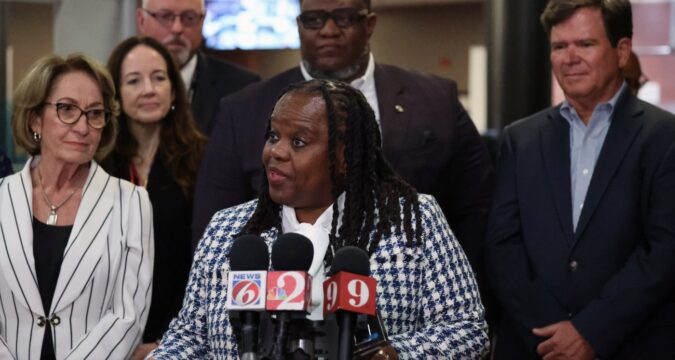
Orange County’s school board voted unanimously Tuesday to advance a land deal involving the historic Hungerford property in Eatonville despite outcry from locals.
The vote comes after Eatonville’s town council signaled its disapproval at an emergency meeting Thursday, where some members of the council said they felt “blindsided” by a deal for the former high school land announced just three days earlier. But board members stood firm that the long-sought deal made sense. After the meeting, Board Chairwoman Teresa Jacobs called the deal a “gift from God.”
“The people of Eatonville deserve progress. The people of Eatonville want their children to come back and have something to come back to,” said Stephanie Vanos, whose district includes Eatonville.
OCPS will take a $1 million down payment for the long-vacant land — a 117-acre former school campus along Interstate 4 and a gateway to the town — from Dr. Phillips Charities, according to the approved memorandum of understanding.
The Orlando-based nonprofit will develop the land with housing, educational facilities, medical facilities and parks but then donate some of the property back to the town. The plan also calls for retail businesses, including a grocery store, and a conference center hotel.
Members of Eatonville’s town council asked the board to delay a vote as they felt Eatonville mayor Angie Gardner — who was deeply involved in discussions with the school district and charity — kept them in the dark about the deal. Theodore Washington, the vice-mayor of Eatonville, was very critical of Gardner’s handling of the deal.
“They put the cart before the horse,” he said.
State Rep. Bruce Antone (D-Orlando) asked the board to stall a vote “30 to 45 days” to allow others to submit a proposal to the board for the land.
But Jacobs said the vote didn’t signify the final decision on a deal or a contract. The action marked the beginning of a process, not the end, she said.
“For me, walking away from this, I would regret that with my life,” Jacobs said.
Jacobs lauded Dr. Phillips Charities, saying that the nonprofit has “shown time and time again that they are not about themselves.”
Dr. Phillips Charities previously pursued a similar, successful effort to rehabilitate the Packing District area west of College Park in partnership with the City of Orlando. The charity developed a public park and donated millions of dollars for a new YMCA. Today, the area is home to a food hall, climbing gym, retail stores and thousands of new residents.
Tarus Mack, a member of Eatonville’s town council, said he preferred a lease-purchase agreement, where the town bought the property, instead of the Dr. Phillips deal.
But Ken Robinson, the president and CEO of Dr. Philips Charities, said the charity intends to be “stewards” of the property for the Eatonville community, and isn’t focused on profiting off the land.
“We’re just stewards, that’s how we look at it. We’re stewards of the Phillips family legacy, and we’d be stewards of this property,” he said.
About 20 people, including the town council members, also addressed the board during the meeting’s public comment time. Several Eatonville residents spoke against the deal, offering skepticism that the school district has the town’s best interest at heart.
“We’re not incompetent in our town. We’re very bright. We have a multitude of educators and we know when we’ve been bamboozled. We’re tired,” said Julian Johnson, an Eatonville resident and longtime activist on the Hungerford issue.
But some expressed a desire to get a deal done after decades of failed attempts. Others said it could help address poor socioeconomic conditions in the town.
“It’s time that we get it right. Otherwise we will lose the land,” said Theo McWhite, who grew up in Eatonville.
The Hungerford property is an important piece of history for a town founded by freed slaves. The site was once home to the Robert F. Hungerford Normal and Industrial School, a private boarding school for Black students when segregation-era white school districts would not educate them.
The school board purchased it seven decades ago — for under market value and under controversial circumstances — and ran it as a public school. The school was closed in 2009, and the buildings were demolished in 2020, leaving mostly vacant land surrounded by chain-link fencing.
The Hungerford site was recently considered for a state Black history museum and could be a key to the town’s revitalization efforts. In the last decade, the town worked to get the property sold by the district to private developers, which would put the land on town tax rolls. The school district is exempt from paying property taxes.
But contracts for the sale fell through and would-be buyers backed out.
The district’s most recent attempt to sell the property, which initially had town approval, prompted backlash from residents who feared the developer’s plans for a mixed-use project were too big and would lead to gentrification and displacement of long-time Eatonville residents.
The town council eventually voted to reject rezoning measures that would have made the development possible.