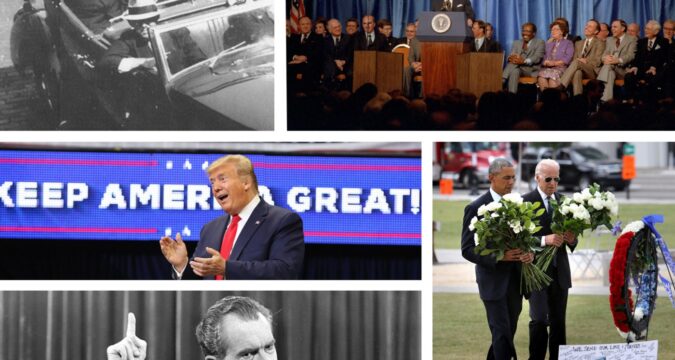
President Richard Nixon declared, “I am not a crook.” President Ronald Reagan coined the phrase “evil empire.” President Chester A. Arthur crankily said, “We shall not stop.”
What do those statements have in common? They were all made during presidential visits to Orlando.
By our count, 17 sitting presidents have come to Central Florida over the years. Chester A. Arthur was the first, followed by Grover Cleveland and later Calvin Coolidge. A streak of having every president since Franklin D. Roosevelt visit came to an end with Joe Biden, who had to cancel a July 2022 trip after he was diagnosed with COVID.
Here are a few notable presidential appearances, in chronological order:
Chester A. Arthur
Chester A. Arthur is sworn in as the 21st president on Sept. 20, 1881. He was the first sitting president to visit Central Florida.
The 21st president had “what may have been the dullest presidential visit in state history,” then-Sentinel deputy managing editor Jim Clark wrote in 1984.
Chester A. Arthur arrived in 1883 supposedly to inspect a new drainage system. “Actually, Arthur was here to go fishing; he used the inspection as a way to make it look like official business,” Clark said. “The president stayed with a friend in Maitland and at a hotel in Winter Park, spending a week fishing there and in Kissimmee.”
Maybe the fish weren’t biting because Arthur had an awful visit, Clark said. “He managed to be nasty to just about everyone he met.”
“I am here for rest, not for public display,” he told an aide who thought he should wave to a crowd as his train passed through Orlando. He refused to allow the train even to pause, shouting, “I say that we shall not stop at Orlando!”
Calvin Coolidge
President Calvin Coolidge and his wife sample Central Florida citrus fruit presented to them by the Florida Citrus Growers Clearing House during a stop in Sanford on Feb. 1, 1929. In this photo that appeared on the front page of the Orlando Morning Sentinel are (from left) Mrs. Harry H. Williams of Boston, First Lady Grace Coolidge, President Coolidge, clearing house secretary A.W. Hanley and general manager J. Curtis Robinson. (Sentinel file)
Traveling through Central Florida on Feb. 1, 1929, on the way to dedicate Bok Tower in Lake Wales, President Calvin Coolidge received (and looked like he enjoyed) some local citrus. But Orlando’s two rival newspapers at the time, the Morning Sentinel and the Evening Reporter-Star, had decidedly different accounts of his visit.
From the Sentinel’s story:
“At Sanford … secret service men and police held back a crowd of nearly 1,000 persons who thronged the station during the stay of the train. Crawling southward, the train passed knots of people all along the way until at Winter Park solid lines assembled along the route.”
Residents threw flowers at the president’s train, with “one large bouquet” smacking Coolidge in the face. “But he only smiled,” the Sentinel said.
From the Reporter-Star’s story:
“Silent Cal rode silently through an almost silent crowd of more than 1,000 people that gathered at the Atlantic Coast Line station here at 1:27 o’clock this afternoon…
“After waiting well over an hour to see the chief executive, the folk, many of whom had hoped that the president would at least say he liked Orange County sunshine better than that of any other where he had stopped, took their disappointment hard.
“The train slowed down to an almost immovable rate of speed and the crowd surged to the rear of the train but Mr. Coolidge was not there. A silence spread over people only to be broken by the voice of a woman, who said, ‘Well, Calvin must have overslept.’”
Months later when he was out of office, Coolidge visited Mount Dora to dedicate the Lakeside Inn. He sent a note to the Sentinel, which was printed on its front page, stating how much he enjoyed reading the newspaper. The Reporter-Star did not receive a similar note.
Franklin D. Roosevelt
The front page of the Orlando Morning Sentinel on March 24, 1936 is devoted to the visit of President Franklin D. Roosevelt. (Sentinel file)
There’s an old saying, “never pick a fight with someone who buys ink by the barrel.” The nation’s 32nd president seemed to have heard that message.
In March 1936, President Franklin Roosevelt planned to make a brief visit to Rollins College in Winter Park to accept an honorary degree on his way to a South Florida fishing trip. A few Orlando folks, including Martin Andersen, the publisher of Orlando’s two daily newspapers at the time, had another plan for the president. They wanted FDR to stay longer and take a little drive through “The City Beautiful.”
Being a shrewd politician, FDR agreed. After Roosevelt’s visit was hyped for days by the Sentinel and its newly acquired sibling, the Reporter-Star, a crowd estimated at 75,000 to 100,000 people showed up to watch the president be driven from Winter Park to Orlando — along Orange, Central and Fern Creek avenues. Then he departed for Titusville to catch his train for South Florida.
The next day Sentinel’s front page was devoted solely to FDR’s visit with eight photos of him under the headline, “When a President Comes to Town Floridians respond.” Another full page of stories inside included one that thanked the Sentinel’s publisher along with “Carl Byoir, the impresario who directs Orlando’s publicity and entertainment,” as well as DeWitt Miller, president of the Greater Orlando Chamber of Commerce, and Orlando Mayor Doc V. W. Estes, for getting FDR rerouted to Orlando.
“Let’s give credit where credit belongs,” the paper exhorted.
Richard Nixon
During a visit to Walt Disney World in 1973, President Richard Nixon says, “I’m not a crook” for the first time. It later became his Watergate defense. (Sentinel file via Associated Press)
In late 1973, with questions increasing about his involvement in the Watergate scandal, President Nixon did not famously declare, “I’m going to Disney World.” Yet that’s where he went to deliver what became his most famous line.
Nixon came to the Contemporary Resort Hotel on Nov. 17 for a convention of the nation’s newspaper editors. It was his third visit to Orlando as president, the first coming four months earlier as graduation speaker at Florida Technological University, now UCF.
Here’s how the Sentinel’s Michael McLaughlin reported Nixon’s appearance:
“President Nixon told the nation here Saturday night he is ‘not a crook,’ neither in Watergate nor his personal finances, has never obstructed justice and ‘the facts will show that the President is telling the truth.’
“For more than an hour, in a nationally televised appearance before the Associated Press Managing Editors convention at Walt Disney World, Mr. Nixon denied wrongdoing and declared time and again he is ‘telling the truth.’
“During the session, at which the Washington press corps was not permitted to pose questions, Mr. Nixon said he wants ‘to get all the facts out because the people want to know if their President is a crook or not,’ and, he added, ‘I’m not a crook.’”
Ronald Reagan
President Ronald Reagan had a news-making visit on March 8, 1983, speaking at Epcot and later to a group of religious leaders.
“Calling the Soviet Union an ‘evil empire’ and using anti-Communist rhetoric reminiscent of the 1950s Cold War, Reagan warned 1,200 evangelicals at the Sheraton-Twin Towers against ‘simple-minded appeasement or wishful thinking about our adversaries,’” Sentinel reporter Anne Goer wrote.
Technically, in what became famously known as Reagan’s “Evil Empire Speech,” he never directly called the USSR an evil empire. Speaking to the National Association of Evangelicals, he referred to battling “evil” nine times, setting up his final usage when referring to those who sought a freeze on nuclear weapons and felt the US and USSR were equally at fault for heightened world tensions. His implication was pretty clear, though.
“I urge you to speak out against those who would place the United States in a position of military and moral inferiority,” he said. “…So, in your discussions of the nuclear freeze proposals, I urge you to beware the temptation of pride – the temptation of blithely declaring yourselves above it all and label both sides equally at fault, to ignore the facts of history and the aggressive impulses of an evil empire, to simply call the arms race a giant misunderstanding and thereby remove yourself from the struggle between right and wrong and good and evil.”
While the evil empire speech got all the attention, overlooked that day were some of Reagan’s remarks to a group of students at Epcot, where he defended video-game obsessed teenagers of the 1980s.
“Many young people have developed incredible hand, eye and brain coordination playing these games,” the president said. “The Air Force believes these kids will be outstanding pilots should they fly our jets. Watch a 12-year-old take evasive action and score multiple hits while playing Space Invaders and you will appreciate the skills of tomorrow’s pilots.”
Barack Obama
On , June 16, 2016., President Barack Obama and Vice President Joe Biden place flowers during their visit to the makeshift memorial at the Dr. Phillips Center for the Performing Arts, honoring those killed in the Pulse club massacre in Orlando. (Joe Burbank/Orlando Sentinel
Days after 49 people were killed at the Pulse nightclub, President Barack Obama came to meet grieving families and comfort a shaken city, telling Orlando, “our hearts are broken, too.” He spent two hours at Amway Center mourning with the victims’ loved ones then traveled to the Dr. Phillips Center for the Performing Arts, where a makeshift memorial had sprung up.
“There, Obama and Vice President Joe Biden laid bouquets of 49 white roses,” the Sentinel reported. “The two stood in silence for several minutes, looking down at the hundreds of flowers, signs and tributes.”
“Four days ago, this community was shaken by an evil, hateful act,” Obama said. “Today we are reminded of what is good — that there is compassion, empathy, decency, and most of all, there is love. That is the Orlando we’ve seen in recent days and that is that America we have seen.”
He added, “These families could be our families. In fact, they are our families. They’re part of the American family, On behalf of the American people, our hearts are broken, too. We stand with you. We’re here for you. And we are remembering those you loved so deeply.”
Donald Trump
President Trump speaks during his reelection kickoff campaign rally at the Amway Center in Orlando, Fla., on Tuesday, June 18, 2019. (Stephen M. Dowell/Orlando Sentinel)
President Donald Trump kicked off his 2020 re-election bid in Orlando on June 18, 2019, with a vow to “keep on winning, winning, winning.” But one decision he made that night didn’t win over many of his supporters.
As Sentinel reporters Steven Lemongello and Michael Williams wrote, “A near-capacity crowd in the 20,000-seat Amway Center downtown cheered and stomped their feet to help Trump choose his new theme for the upcoming campaign: ‘Keep America Great!’ It replaces what Trump called ‘the greatest theme in the history of politics,’ 2016’s ‘Make America Great Again.’”
Trump supporters shunned KAG as if it were a Bud Light and continued using the Make America Great Again slogan — which continues today during his second, non-consecutive term.