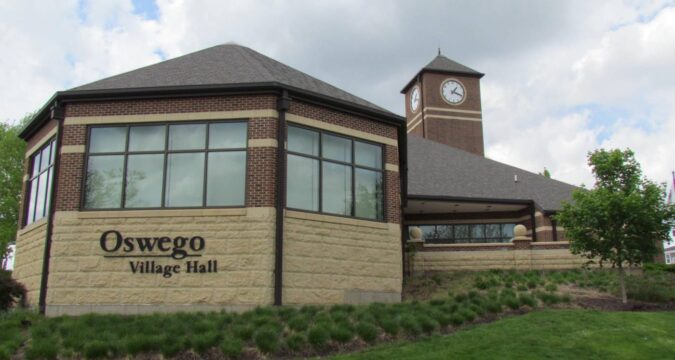
Oswego trustees meeting as a committee of the whole Tuesday evening directed village staff to prepare an ordinance to locally extend a 1% state grocery tax set to expire at the end of the year.
The Oswego Village Board is set to take a formal vote on the measure Sept. 16. However, trustees have yet to decide whether the funds generated by the proposed grocery tax extension should remain in the village’s general fund or to direct some or all of the revenue to the Water and Sewer Fund to help with debt service payments.
The Illinois General Assembly last summer voted to eliminate the state grocery tax and Gov. JB Pritzker signed it into law in August. The repeal of the 1% state grocery tax will take effect Jan. 1, 2026.
Several Fox Valley communities have already approved ordinances to implement a 1% municipal grocery tax to replace the state tax. Those municipalities include Aurora, Batavia, Montgomery, Yorkville, Sugar Grove and North Aurora, Oswego Finance Director Andrea Lamberg said in a report to trustees.
Geneva, St. Charles and Naperville are among other area towns that have approved local extensions of the tax.
Illinois first put in place the grocery tax in 1990 to help fund local governments. Communities have until Oct. 1 to ask the state to continue locally collecting the 1% grocery sales tax on their behalf.
“The grocery tax has been around for 35 years,” Oswego Village President Ryan Kauffman said of the state tax that will expire on Dec. 31. “No matter what action the board takes, there’s not going to be one cent of increase in taxes. I want to make that clear, we are not discussing a single cent in an increase to our taxes. This is solely about keeping a tax that has been around for 35 years.”
Kauffman suggested directing some funds from the grocery tax for a credit to “give residents some real relief.”
“I’d like to see us take some or all of the money and apply it directly to residential water bills,” Kauffman said.
No trustees at the Committee of the Whole meeting voiced opposition to continuing the grocery tax. However, trustees debated where to allocate the revenues.
The village’s required contribution to the Police Pension Fund for 2026 increased 17.5% over 2025, officials said.
“Putting this additional strain on general fund revenue in combination with removal of some, or all, of the grocery tax revenue, will result in a deficit in the 2026 budget unless cuts to programs or new positions are made,” Lamberg said in her report to trustees.
One option is to keep the funds from a grocery tax extension in the general fund where it has been or to direct some or all of the revenue to the Water and Sewer Fund, she said.
“Assuming annual revenue of $1 million, directing 100% of the grocery tax to the water fund would allow additional dollars for debt service payment which could save the typical resident up to $100 per year on their utility bill,” she said.
The village’s general fund revenue is about $28.4 million, so $1 million represents about 3.5% of the budget, Trustee Jennifer Hughes said.
“If we don’t enact it, we have to make up the difference,” Hughes said of continuing the grocery tax. “What are our options and what are our residents willing to tolerate in a reduction in service … is it going to be longer snow plow response times, fewer potholes filled … it could be fewer special events. There are things we can give up but is that what the community is looking for?
“Unless we are willing to see our roads get worse and see some of our services go down, I don’t see how we cannot approve this,” Hughes said.
Trustee Rachelle Koenig said she was disappointed “in the lack of public comment” about the issue at Tuesday’s meeting.
“There were people who have made some bold statements on social media and are not here,” Koenig said. “Part of our job as trustees is to listen to the public and react to what they say in a public setting. It’s a bummer.”
A percentage of the money from the grocery tax comes from those who live outside of Oswego who do their grocery shopping in the village, officials noted.
“If 50% of the tax (revenues) come from outside of Oswego, and 50% comes from within Oswego, by rebating 50% of the tax you are essentially giving residents their money back and using the non-resident money towards general fund expenses,” Oswego Village Administrator Dan Di Santo said of one proposal.
Di Santo said the decision on allocating the funds can be further discussed at the Sept. 16 Village Board meeting and at the board’s two meetings in October.
The deadline for municipalities to implement the local grocery tax extension is Oct. 1 to ensure timely filing with the Illinois Department of Revenue, village officials said.
Linda Girardi is a freelance reporter for The Beacon-News.