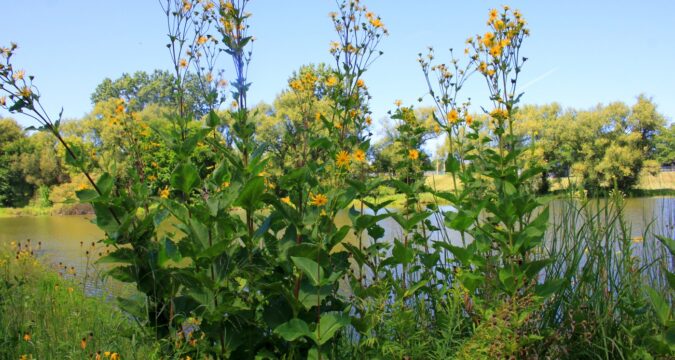
In spring and most of summer, I survey dragonflies and damselflies flying above the water and vegetation at a local pond for a statewide census program.
My most recent visit there, however, was not to document these fascinating insects, but to experience the pond in whole and all the delicious sensory treats it has to offer.
Surrounding this small body of water known as Community Pond in Mundelein is a mini ecosystem perfect for native plants and insects. Instead of mowing right up to the edge of the pond, the village has created a native vegetative buffer around the pond, and that’s great for dragonflies and damselflies which lay their eggs in the wet vegetation.
Indian grass at local pond in Mundelein. (Sheryl DeVore/For the Lake County News-Sun)
Lovely native grasses flourish here in late summer. In one little section, I found switch grass, yellow Indian grass, big bluestem, little bluestem and side oats grama. These are warm-season grasses with thin, linear leaves that help them survive the hot summer. It appears they did well with our excessive heat this year.
These grasses likely grew here or nearby long before Mundelein became a village. When walking up close to them, you can slide your hands across the feathery stems and look for the tiny flowers that bloom in late summer. Among the easiest to identify is the big bluestem, also known as turkey foot. The plant stalk rises as high as 10 feet above ground ending in a seedhead that is often branched into three parts that look like a turkey’s foot. In late summer and fall, tiny yellow flowers emanate from the seedhead.
Another plant native to tallgrass prairies growing at the pond is switch grass. It grows in large clumps 3 to 10 feet tall. The seedheads emanate from the stalks with tiny, reddish-purple flowers. I ran my fingers through the lacy grass feeling its delicateness.
Switch grass particularly likes wet areas, which is likely why it does so well at the edge of a pond. It may have gotten its name from the so-called “swishing” sound it makes when the wind blows, or because it remains sturdy while switching seasons from summer, to fall, to winter. You can find yellow clumps of switch grass in early winter, and I’ll be back to the pond looking for them when cold weather strikes.
While admiring the grasses, I heard the dog-day cicadas revving up in nearby trees for their last hurrah at the end of summer. I also noticed evening primrose in bloom. Some say this native plant is weedy, but I love it. It grows up to 6 feet tall and blooms from late spring through fall. Blossoms are sunny yellow cup-shaped flowers, which the primrose moth visits in the evening. The flowers typically open in the evening and close before the afternoon begins. On this cloudy day, there were plenty blooming. I might like to take a flashlight out at night and look for the moths.
Also growing among the grasses were gray-headed coneflowers, mostly done flowering but now giving off a light minty fragrance. I also saw cup plant, some of them holding on to yellow blooms, as well as the late-blooming sneezeweed, which does not make you sneeze. Copious jewelweed, a moisture-loving plant with small orange flowers that attract hummingbirds, grew at the woody edge of the pond.
Right along the water’s edge common arrowhead was growing. It has large, green arrowhead-shaped leaves, atop of which whorls of white three-petaled flowers bloom. Two familiar bluet damselflies, not even an inch long, hovered above one of the leaves. I heard a loud splash and saw a frog jump from the vegetation into the pond. Then, two sandhill cranes began chortling and calling to one another. I later saw them strolling on a grassy knoll just beyond the pond, as a great blue heron squawked.
In late summer, ponds are full of life with sounds, textures, colors and smells.
Spend some time at a nearby pond enjoying the beautiful early September weather, listening for birds and insects and searching for grasses and plants.
If you discover a pond that has nothing but lawn around it, perhaps you can convince the owners to create a buffer of native vegetation. All it takes is to stop mowing to the edge and plant some native prairie seeds.
Sheryl DeVore has worked as a full-time and freelance reporter, editor and photographer for the Chicago Tribune and its subsidiaries. She’s the author of several books on nature and the environment. Send story ideas and thoughts to sheryldevorewriter@gmail.com.
https://www.chicagotribune.com/2025/09/03/outdoors-column-pond-walk/