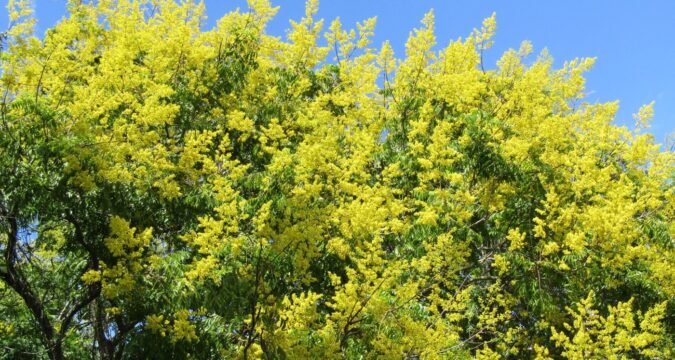
Question: We have recently noticed a number of yellow flowering trees in older neighborhoods. What are they and where are they available?
Answer: You have spotted the golden rain trees producing large spikes of yellow blossoms followed by pink seed pods. Regretfully, no matter how attractive the trees might be, they are very prolific and discouraged from planting in newer neighborhoods. They are listed with the Florida Exotic Pest Plant Council as a Category II invasive. It is doubtful you can find them at local garden centers. Golden rain trees in older neighborhoods were likely started from seeds disbursed by wildlife and continue to spread in these locations. The trees have their good points — in that they survive under varying soil conditions. But they also have a pest called the jadera or golden rain tree bug. The insects are red and black feeding on the seeds of golden rain trees. So they may be beneficial but a nuisance. So, if you don’t plant golden rain trees, you won’t have the bugs and lots of seedlings that need removal.
Q. My gold mound duranta hedge was heavily pruned by my yardman. If I water and fertilize will it come back?
A. Hedges normally do not mind a severe pruning and can make new growth to fill the voids. Admittedly, the email photo you sent showed a skeletonized duranta hedge with lots of twiggy shoots that do look a bit devastated. But there could be lots of yellowish leaves among the twigs. If the twigs are green when scraped, you can expect new growth to begin in a matter of weeks. Such renewal pruning is not unusual with hedges. When soils are kept moist and fertilizer applied they can recover to be the plants you remember.
Q. We have enjoyed our caladium plants with colorful foliage obtained from the garden center. At this time the leaves are declining and it looks like the plants are dying. Is this normal?
A. Gardeners get about eight months of great color from their caladiums before they start to decline and enter a rest period. The later the tubers, often called bulbs, started growth in spring or early summer the longer the foliage lasts into fall and early winter. Give your plants normal care and allow them to gradually decline. When the leaves turn yellow to brown they can be pruned from the plants. Allow plants in containers and in the ground to stay slightly dry as they go through the rest period which lasts until the warmer days of late winter and spring.
Q. I have azaleas plants that have not been fertilized since spring. Do I still have time to apply a product to feed them?
Plant Doctor: Tips to get the most blooms from your chrysanthemums
A. Fall is a good time to fertilize all your ornamental plants. If you know the soil acidity of the planting site, and it is acid enough for azaleas, any general landscape fertilizer will do. If you do not know the acidity, or it is neutral or above, use an azalea-type fertilizer. This supplies additional minor nutrients and helps make soil conditions adequate for azaleas.
Q. My cucumber plants have been flowering profusely but no fruit yet. The plants are in pots so do I need to move them to a better spot to attract pollinators?
A. Maybe you could post signs or do a bee dance to get the pollinators in or you could just wait a little longer. Often the first flowers on cucumber, squash and melon plants are males with no potential to bear fruit. But in a bit the female flowers with little immature fruits behind the blooms start to appear. Then the bees and other pollinators can do their work. If your plants are in a little shade you may move them to a full sun location. You could also locate other flowers that attract pollinators near your plants to help signal it’s a place to visit.
Q. Our poinsettia has been making good green growth but suddenly one side of the plant is dying. Is it time to prune the plant?
A. Growing through the summer, poinsettias can suffer a number of problems, but the worst is fungal. When one side of the plants declines it could be from mechanical damage like winds but it’s more likely a fungus has affected one or more of the stems. Pruning time is over for poinsettias — except for declining portions. Prune away the affected stems so the rest of the plant can be attractive for the holidays. You may also apply a fungicide following label instructions.
The larvae of moths, known as army worms, feed on the foliage of garden crops — often at night while hiding during the day. If there are only a few you might pluck from plants and destroy them as a control method. (Courtesy of Tom MacCubbin)
Q. Corn and squash plantings are being eaten by something in my garden. The leaves have lots of sections chewed but I cannot find the critters. What should I do?
A. If you look a little closer, down within the corn stalks inside rolled squash leaves you might find the immature stages of moths — often referred to as armyworms. These larvae feed on the foliage of garden crops, often at night, and hide during the day. If only a few in number you might pluck them from the plants and destroy as a control. You might also notice wasps flying in to gather the larvae to stuff in their nests. Luckily, if the larvae are too numerous to hand pick or are not controlled by wasps, there are also several natural controls for them available from your local independent garden center. Select either Thuricide- or a spinosad-containing insecticide to spray over the foliage following label instructions. A repeat spray may be needed if worms are not under control within a few days. Do note the time between last spray and harvest.
Tom MacCubbin is an urban horticulturist emeritus with the University of Florida Cooperative Extension Service. Write him: Orlando Sentinel, PO Box 2833, Orlando, FL 32802. Email: TomMac1996@aol.com.
Plant Doctor: It’s not too late to add sunflowers to your gardens