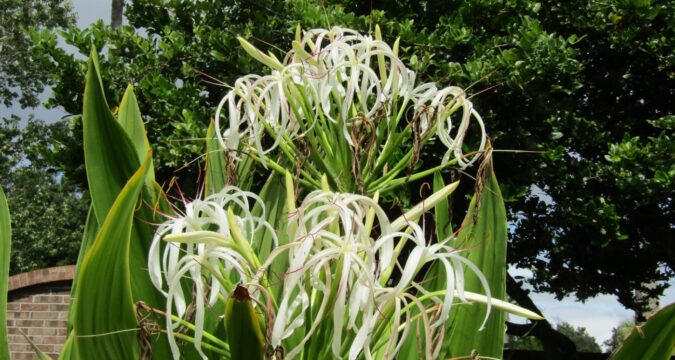
Question: Over the years my crinum lilies have developed red spots on some of the leaves. It makes the plants a bit unsightly. Is there a good control?
Answer: Maybe your lilies are popping out their holiday decor a bit early as red and green make a pretty combination. But I guess in this case it is a bit unsightly caused by the red blotch fungus. Regretfully some of these spots always seem to be present on crinum and amaryllis foliage and bulbs. A little of the fungus can be tolerated and is usually present on older plant portions. When possible, prune off affected plant portions such as leaves. If plants are heavily infected some horticulturists suggest removing them from the collection. Red blotch is worst when plants are growing in areas with poor air circulation or are kept overly wet. Newer fungicides and especially systemic-type products seem to give some control. They may have to be applied frequently when the disease is prevalent as instructed on the label. Some red blotch may always be present.
Q. I have trouble growing parsley, dill, sage, thyme and more herbs. Basil does fairly well. It is too hot here?
Newer fungicides, and especially-systemic type products, seem to give some control of red blotch fungus on crinum lilies. (Courtesy of Tom MacCubbin)
A. Good growing weather lies ahead for all the popular herbs. Some like basil, oregano, rosemary and mint do fairly well during the summer but most others struggle at best as they cannot withstand the heat and humidity. October begins the good herb-growing weather that should last through May. Some favorites you are already trying to grow — plus borage, chives, lavender, tarragon and more — are about ready for planting. Many gardeners like to keep their herbs in containers to display in areas of the landscape and patio as needed. Others growth their herbs in more traditional in-ground beds of prepared garden soil. Keep them moist and fertilize monthly to produce plenty of plant portions to use fresh and some to store.
Q. This year caterpillars have overtaken our azaleas when we’re out of town. When we’re home we try to spot them early and apply a control. What can we apply to prevent them?
A. Maybe if you are only going to be out of town for a short period of time applying a control might keep caterpillars from affecting your azaleas until you return. But if you are going to be away for more than a few weeks to a month maybe you could get a friend to check the plantings and treat them if needed. Caterpillars affecting azaleas are normally the immature stages of moths that fly in to lay eggs that hatch and start feeding. Pesticides control this feeding stage and are effective for a few weeks to maybe a month. So, you might try applying one of the natural insecticides like Thuricide or a spinosad-containing product right before you leave. One of the systemic insecticides might also give extended control and some can be applied to soil. Do check your azaleas when you arrive home as seasonal weather can affect insecticides applied to plantings.
Plant Doctor: Sow hollyhock seeds now for towers of blooms in spring
Q: I have a very tall and wide viburnum hedge. Can I trim the hedge now or should I wait until spring?
A. Use the next few weeks to reshape your overgrown viburnum hedge. This gives the plants adequate time to make new growth that should mature before a possible frost or freeze. Common viburnum hedges are hardy but may be susceptible to damage if producing young shoots. Also, do expect but don’t worry about leaf damage to foliage formerly hidden from the sun. This will be in the form of brown spots in the leaves. If you need to do major pruning complete it at this time by cutting the shrubs back to desired height and width.
Q. My yesterday-today-and-tomorrow shrub gets few blooms and is growing in morning and dappled sun. How can I get it to produce more flowers?
A. My experience is yesterday-today-and-tomorrow shrubs, also known by their scientific name Brunfelsia, flower best when growing in full sun. Plant guides suggest morning sun and afternoon filtered sun is best for good growth, but in these locations there seems to be fewer blooms. Do make sure your shrub has at least full morning sun then the dappled sun in the afternoon should be fine. Apply a slow-release landscape fertilizer once in March and again in May. Too much fertilizer can encourage growth with fewer blooms. Keep the plant moist during dry times and hopefully you will be rewarded with more blooms.
Q. Our pineapple plant has produced a fruit. Will I get another pineapple from the plant?
A. Expect your next crop of pineapple fruits in a year or two from side shoots that develop at the base of the parent plant. Pineapple plants, like other bromeliad relatives, slowly decline after they flower and set fruits. By the time the mother plant begins turning brown side shoots have grown to hide the deteriorating leaves. Keep up good care to obtain several more years of fruiting from your planting.
Q. We have a citrus tree growing in about a 5 gallon container. How long can we keep it in the container?
A. Keep your citrus tree in a container as long as you like, but the larger the tree grows the bigger the container needed. Your tree pictured in an email photo is ready for the next size container of 15 gallons or larger. Of course there is a limit to the manageable size of a container but a 50 gallon or larger container would eventually be needed. Trees in containers require more attention to water and fertilizer. During hot dry weather daily watering may be needed. Also use a slow-release fertilizer with minor nutrients made for container plantings following label instructions.
Tom MacCubbin is an urban horticulturist emeritus with the University of Florida Cooperative Extension Service. Write him: Orlando Sentinel, P.O. Box 2833, Orlando, FL. 32802. Email: TomMac1996@aol.com.