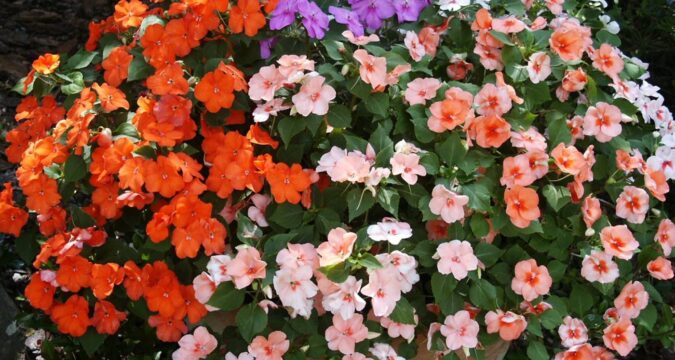
Question: I have an outdoor hanging basket of impatiens. Most of the flower petals have fallen off, but the remaining leaves and stems seem healthy. Will it eventually produce more flowers?
Answer: Winter is not the best time for impatiens but most survive and can look attractive if frost or freezes don’t damage the plants. It’s not unusual for the plants to become lanky and lose older leaves under a minimal care program. It’s best to keep the soil moist by watering when the surface begins to dry to the touch. Also apply a liquid fertilizer application every two to three weeks or scatter a slow-release product in the container following label instructions. When temperatures remain warmish and only dip to near freezing the plants can remain green, full of foliage and in bloom. Toward the end of February trim lanky plants back and continue the water and fertilizer applications. New growth with blooms to fill the containers should occur during the spring months and into summer.
Q. I have a shady back porch and after four years my peace lily quit. A bromeliad also declined even though I put a little water in the center cup of foliage. Any ideas what to plant in this container?
A. Don’t give up on either of the plants that have declined in your shady spot. Most likely there was a moisture problem. Start over again with the same shade lovers. Peace lilies need water once or twice a week and bromeliads weekly during the warmer months. Water so moisture seeps from the bottom of the containers into saucers. Bromeliads like to have water added to the surface of the soil as well as the center of those with cup-forming leaves. Do realize that bromeliad plants decline after a year or two but usually have offshoots to produce new plants. When this happens repot the plants and remove the older portions. Peace lilies usually need repotting and often division after a year or two. Other plants for your shady spot might include aglaonema, dieffenbachia, dracaena, parlor palm and sansevieria. All are very durable but may need consistently warm temperatures to flourish.
Plant Doctor: Taste test is best way to tell if oranges are ripe, ready to pick
Q. Several schefflera growing outside our home are probably 20 feet tall. Can I cut them back to 5 or 6 feet? If it is OK, what month should I do it?
A. Since winter weather can be damaging to schefflera it’s best to wait until late February or early March to perform needed pruning. The plants can sprout new shoots from most areas along the thick stalks at the spot that once produced leaves. Normally they sprout new shoots directly below where the upper portion of the stem is removed. So plan where you want the new growth to begin. Sometimes additional shoots start along the stems but you can usually count on one strong growth from the top. Scheffleras can also send out new stems from their base to form dense growth. Sometimes gardeners like to remove unwanted growth when this occurs.
Q. We planted caladium bulbs in containers during the summer and the tops have died. Do we remove the bulbs or leave them in the containers?
A. Probably it’s a matter of what you would like to do with the containers. If you want to replant them to seasonal color it would be best to remove the bulbs — which are actually compressed stems called tubers. If this is the case expect a number of tubers to have formed and gather them to store in dry peat moss or vermiculite. Keep them in a low light and warmish spot. During March they can be replanted in containers of fresh potting soil or in a garden site. If you do not need the containers keep the bulbs in their soil. Set the containers in a low light but warmish spot. Occasionally lightly moisten the soil. Since some of the soil has likely decomposed so a fresh layer may be needed in late February or before growth begins. Apply a slow-release fertilizer when new growth is noted and start normal watering of about twice a week for plants in filtered sun.
Q. Annual weeds are a continual problem in our shrub beds. How can I prevent their growth?
A. Maintaining and renewing the mulch layer can help reduce the presence of germinating weed seeds — but still some persist. Don’t remove old mulch but add a light topping as needed. Use of preemergence herbicides can also help. Several products in granular form are available at local garden centers. Do follow label instructions as plantings normally have to be established prior to application. Also, time needs to pass before new plantings can be added. Repeat applications are needed to continue the weed control as noted on the label. A few mulches are available with an incorporated herbicide to help with the weed control.
January in the Garden for Central Florida
Q. We planted a cool season garden sometime in October and everything is doing well except the broccoli whose lower leaves are turning yellow on the edges. What is going on?
A. Sounds like you have a great garden but sometimes one plant type has problems. Since only the older broccoli leaves appear affected, most likely this is a nutrient deficiency starting to become evident. Older leaves often show the deficiency first. Try a liquid fertilizer application for a quick boost and then about a week later apply a slow-release granular garden fertilizer. Gardens can also benefit from the addition of a mulch to keep the soil uniformly moist that helps with nutrient uptake. It also prevents soil from splashing onto leaves that may spread leaf-affecting organisms
Q. I have always heard petunias need deadheading. Is it really necessary?
A. Some gardeners try to remove spent petunia blooms, known as deadheading, but as most soon learn it becomes a chore. Modern petunias are fairly self cleaning, which means as the flowers decline they deteriorate and are not very evident. Some gardeners do trim their plants back after long stems of old blooms decline and seed pods begin to form. This treatment, along with a fertilizer application, can stimulate new growth and flowers for the spring months.
Tom MacCubbin is an urban horticulturist emeritus with the University of Florida Cooperative Extension Service. Write him: Orlando Sentinel, P.O. Box 2833, Orlando, FL. 32802. Email: TomMac1996@aol.com.