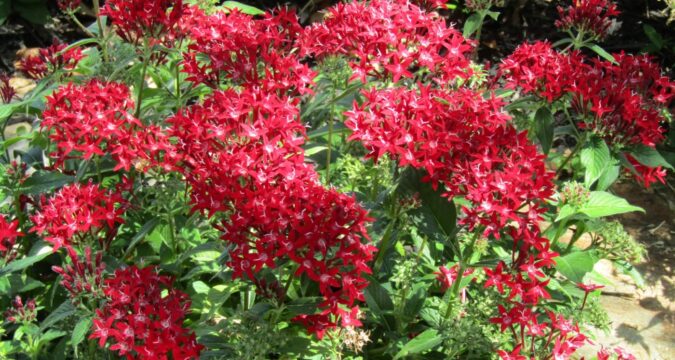
Question: I have noticed hummingbirds coming into my yard. How do I keep them here and what flowers do they like?
Answer: Lucky are you to have the right location for hummingbirds to visit. Residents without a nearby hummingbird population are probably not going to get them to come into their yards even with their favorite plants. Best locations are areas with clusters of trees and shrubs plus a water supply. Then you can add the flowers they like that includes firebush, salvias, pentas, firespike, cardinal flower and coral honeysuckle. Grow an assortment of these and others that can provide the blooms visited March through September when hummingbirds take up residence locally. The same plants are favorites of butterflies which are much easier to invite into a yard to visit.
Q. Crabgrass is overtaking areas of my St. Augustine lawn. My pest control company says they do not have a control. Is there a product I could use?
Firespikes not only attract hummingbirds to your yard, they are a favorite of butterflies, as well. (Courtesy of Tom MacCubbin)
A. Now is crabgrass time with the creeping greenery filling lawns thanks to the frequent rains and hot weather. It seems to grow much faster than St. Augustine and other turf types — overgrowing the top of the grasses. Lawn care companies do not presently have a chemical they commonly apply to home lawns. But you can obtain the Agralawn Crabgrass Killer, a naturally formulated product developed here in Florida. It is available from some independent garden centers and online. This crabgrass control contains cinnamon as the active ingredient. Many residents have found one of the other ingredients, baking soda, does a good job of crabgrass control by itself. It acts as a contact herbicide when lightly dusted over the blades of moist crabgrass. It may yellow St. Augustine a little, but when dusted lightly, appears to cause little real damage. Use of baking soda alone would be considered a home remedy so you would be responsible for any decline of the treated turf.
Q. Several ligustrum trees in my neighborhood have major dead areas among the limbs. The local companies don’t seem to be able to obtain control. What can we do for these about 10-year-old tree forms?
A. Many neighborhoods are noticing similar decline in their ligustrums. Normally tree forms in the 20- to 30-year range have the decline so your plantings are starting the limb loss a bit early. As ligustrum age they develop wounds or openings in the limbs where branches broke off or were pruned from the plants. These often do not adequately heal and become affected by fungal organisms that cause the limb decline. Help control major ligustrum decline by removing dead or affected portions as noted. Make cuts back into healthy wood. Disinfect pruners between cuts to prevent spreading the disease organisms. After pruning apply a copper fungicide spray following label instructions. Still, aged ligustrums are likely to have some limb decline.
Plant Doctor: Landscapes sparkle with red-and-white leaved stromanthe plants
Q. A thin bladed grasslike weed is choking out our St. Augustine. It has small greenish flower heads. Is there a control we can apply?
A. Notice this is also the most upright and shiniest leaf weed in your yard. It is one of the sedges and most likely green kyllinga. The stems with flower heads are triangular in shape which proves this is a sedge. Luckily there are a number of sedge controls to use in your St. Augustine lawn available from your local independent garden center. Most garden supply companies have one to use as a spray. Find a product such as Sedgehammer or Ortho Nutsedge Killer that lists sedge or nut sedge control to use with your lawn type. The products are slow to give control needing about a month to remove the sedge after following label instructions.
Firebushes are another bloom that can help lure hummingbirds to your yard if they’re in your neighborhood. (Courtesy of Tom MacCubbin)
Q. I purchased a bromeliad with a red center. If I plant a pup off this plant, will it have a red center too and what makes them red?
A. Bromeliads can come in many colors but you likely purchased one of the Neoregelia species sometimes called the blushing bromeliads. Many develop a colorful central cup of foliage as they near flowering while others have colorful leaves much of the time. The color is inherent with the variety you selected. New off shoots or pups are likely to be green when they start and after several months of growth produce the color you have been enjoying. Give your plant a filtered sun location, keep moist and fertilize lightly during the warmer months for the best growth and eventual color. The amount of light your plant receives can affect the color but it should be similar to the original plant.
Q. Many of my African iris plants have grown large and congested. Can I divide and transplant them at this time?
A. Take the shovel and maybe a sharp knife to these plants as needed as they don’t seem to mind when they are divided and replanted. African iris are most durable true iris perennials that flower mainly during spring with a few sporadic blooms during the remaining warm months. It is not easy to dig these clumps so select a shovel with a pointed edge. Then you may need a serrated knife to cut them apart. Make clumps of any size as after dividing they grow rapidly to form new plantings. Keep moist and fertilize when permitted for best growth.
Tom MacCubbin is an urban horticulturist emeritus with the University of Florida Cooperative Extension Service. Write him: Orlando Sentinel, P.O. Box 2833, Orlando, FL. 32802. Email: TomMac1996@aol.com.